
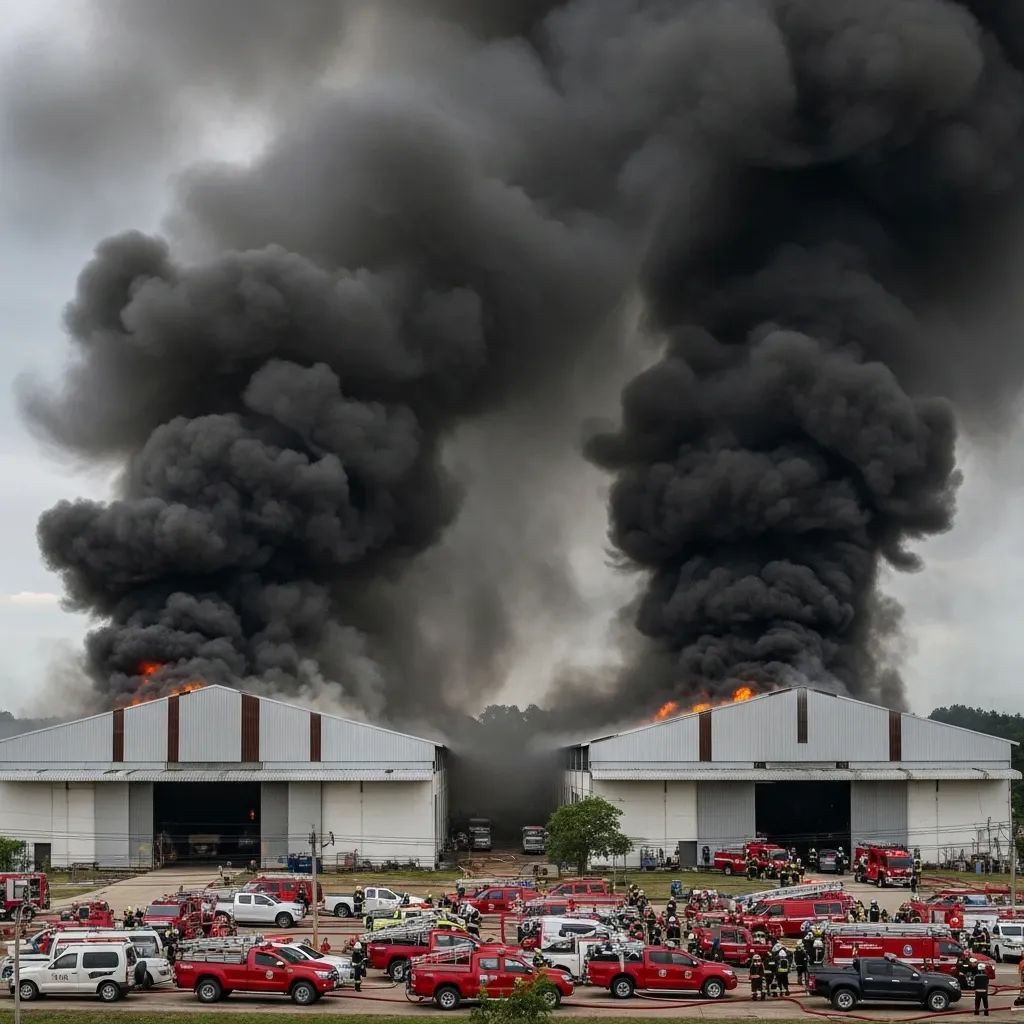
A wall of smoke rolled over rural Nong Yai on Sunday afternoon, swallowing two factories in separate blazes and jolting Thailand’s industrial heartland into a fresh debate over fire-safety standards. No one was hurt, yet the twin disasters exposed how quickly ni-khom u-tsa-ha-gam can turn from economic engines into tinderboxes—and how embers can leap kilometres despite every regulation on paper.
What just happened?
• Paper recycler ignites inside Golden Dragon Estate at 13:30, burns until nightfall.
• Heat and gusting winds push sparks 8 km to a GP Breeding chicken hatchery, setting a second roof ablaze at 17:30.
• Crews from three districts, backed by volunteer brigades, remain on duty through the night.
• Zero injuries reported, but warehouses partially collapsed. Damage estimates pending.
• Officials cite flying embers as likely trigger for second fire; formal probe launches once sites cool.
Twin infernos rattle Chonburi’s manufacturing belt
Water cannon arcs could be seen from Highway 344 as firefighters fought waist-high bundles of wastepaper that burned like giant briquettes. The Golden Dragon Estate—home to more than 40 export-oriented plants—quickly activated its internal emergency sirens, forcing nearby operators to shut ventilation systems to keep out toxic smoke. Four hours later, an orange glow appeared on the horizon at Khao Sok. Officers arriving at GP Breeding found day-old chicks already overcome by heat, though staff had left moments earlier.
How wind turned one blaze into two
Satellite data from the Geo-Informatics and Space Technology Agency (GISTDA) showed sustained 22 km/h southerlies exactly when corrugated-iron panels at the paper plant buckled. “A single ember can reach 700 °C and fly 10 kilometres,” notes Chulalongkorn fire-dynamics specialist Assoc Prof Sarawut Jantarak. December’s dry season lowers humidity while warehouse vents stay open for cooling, creating a chimney effect perfect for spot fires in neighbouring lots.
Immediate economic ripples
Neither company has disclosed figures, but logistics brokers in Laem Chabang told the Bangkok Post they expect at least 48 hours of traffic restrictions on container trucks until debris is cleared. That pause could stall up to 1,200 tons of recycled pulp and delay broiler-export schedules bound for Malaysia. Insurance adjusters caution that under the typical Industrial All-Risk policy, payouts hinge on proof that standard sprinkler systems were inspected within the past 6 months—a clause many SMEs overlook.
Why Chonburi keeps burning: 2025 in numbers
According to preliminary Ministry of Industry records, Thailand logged 10+ factory fires in the first 7 weeks of 2025. Chonburi alone counted 3 major incidents before this weekend, all in plants handling plastic, foam or paper, materials flagged by regulators as high-BTU fuel loads. Electrical faults still top the causal chart, but human error, poor chemical storage, and inadequate hot-work permits follow closely. “We are not learning fast enough,” warns Vipas Tangsakul, safety auditor with 25 years in the Eastern Economic Corridor.
Are safety laws keeping pace?
Thailand already has a lattice of rules—the 1992 Factory Act, the 2009 Fire-Prevention Ministerial Regulation, and IEAT’s own Process-Safety Management mandate—yet audits rarely penalise offenders beyond modest administrative fines. After October’s Sriracha foam-film blaze, the Department of Industrial Works ordered surprise inspections, but critics argue that findings rarely reach the public. Industry players now lobby for real-time sensor networks, stronger whistle-blower shields, and an online dashboard mapping every compliance lapse inside industrial estates.
Community and worker response
Local farmers in Ban Khao Mai gathered at a roadside pavilion to watch columns of smoke while sharing bottles of nam yen. Many recall the 2021 foam factory explosion in Samut Prakan and fear air-quality fallout. Provincial Environment Office teams have begun particulate sampling, promising results within 48 hours. Meanwhile, factory employee unions call for mandatory annual evacuation drills—not just paperwork—before year-end bonus season begins.
What happens next
Investigators will comb the charred paper bales for the ignition point once temperature falls below 50 °C. Expect preliminary reports within 15 days, followed by a joint damage tally from insurers and Chonburi’s industry chamber. If wind-borne embers are confirmed, Golden Dragon Estate may face orders to erect spark-arresting barriers and redesign storage layouts. The real test, however, lies beyond repair bills: whether Thailand’s rush toward high-value manufacturing can mesh with fire-safety cultures firm enough to stop the next gust from turning one factory’s crisis into the neighbourhood’s catastrophe.


