
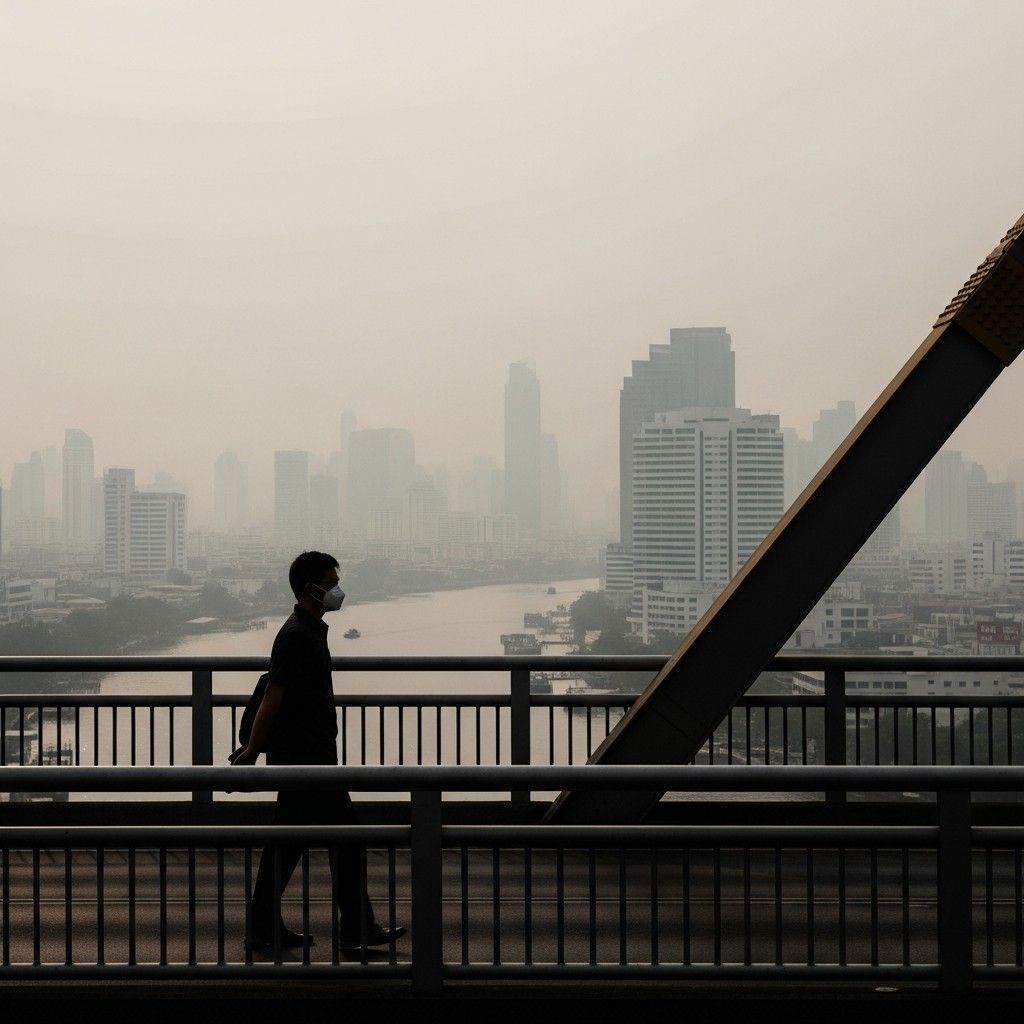
A blanket of grey has settled once more above Thailand, pushing the capital and much of the heartland back into a familiar public-health emergency. Commuters woke today to another official warning that the PM2.5 haze has breached the national danger line almost everywhere bar a handful of coastal and mountain pockets. Forecasts suggest only a brief mid-week reprieve before stagnant conditions return.
Heavy Haze Returns Despite Emergency Measures
Motorists crossing Krung Thon Bridge could barely make out the Chao Phraya this morning, a visual reminder that the government’s second-year action plan on particulate pollution is struggling to keep pace with reality. Satellite readings from GISTDA at 08:00 showed average fine-dust concentrations in Bangkok at 53.6 µg/m³, well beyond the legal limit of 37.5. The worst hot-spot lay in Samut Sakhon where monitors reported 60.7 µg/m³, underlining how quickly pollutants drift from the industrial southwest into the city core. Officials had hoped that upgraded Low-Emission Zones, a fleet of dust filters at construction sites and a renewed crackdown on diesel smoke would flatten the peak; instead, 48 of Bangkok’s 50 districts woke up in the red or orange health bands.
Where the Air Hurts Most
Neighbouring provinces are faring no better. Nonthaburi, Pathum Thani and Samut Prakan all posted averages above 76 µg/m³, creating a ring of contamination that funnels directly into heavily populated Thonburi and the inner CBD. Farther afield, readings above the national threshold stretched through the Central Plains, the lower North and the upper Northeast, a swathe that houses more than 38 M people. Only eight provinces – mostly along the Andaman coast and parts of the far North – enjoyed what the Pollution Control Department labels ‘good’ air, below 25 µg/m³.
Why the Sky Turned Grey Again
Climatologists blame a lethal cocktail. A cool surge from southern China has created a temperature inversion that behaves like an atmospheric lid, trapping vehicle exhaust, factory plumes and – crucially – agricultural burn-offs that multiplied as rice and sugar harvests peaked last week. Thermal imaging on Sunday revealed 759 heat points inside Thailand’s borders, up from 542 the previous day, with dense clusters in Central paddy fields. Add chronic traffic gridlock and the result is a city where fine dust can linger for 72 hours before winds disperse it.
Health System Under Strain
Public hospitals are already seeing the fallout. In the final quarter of last year the Ministry of Public Health logged more than 1 M respiratory cases linked to polluted air. Doctors at Thammasat University Hospital report a sharp rise in childhood asthma flare-ups whenever the index crosses 50 µg/m³. Epidemiologists warn that prolonged exposure to heavy-metal-laden particles – arsenic, cadmium, chromium – increases risks of heart disease, diabetes and even cognitive decline. Government actuaries estimate the annual economic drag at ฿2.17 T, or 13 % of GDP, once lost productivity and health costs are tallied.
Government’s Second-Generation Battle Plan
The Cabinet’s updated 2025-2030 clean-air roadmap leans on five pillars: expanding Low-Emission Zones city-wide, re-engineering urban design to break up pollution corridors, clamping down on cross-border burn-offs, shifting farmers away from open-field burning, and restricting imports of crops tied to slash-and-burn practices. Short-term directives ordered last month include a week of free BTS and BMTA rides, stricter 20 % opacity caps on diesel exhaust, and the roll-out of real-time AirBKK forecasts across 74 stations. Preliminary data show a 21.1 % drop in city-wide PM2.5 during November compared with 2024, yet today’s spike underscores that enforcement gaps and weather anomalies can erase gains overnight.
Will the Wind Save the Day?
Meteorologists expect a brief cleansing window from Wednesday through Saturday when a high-pressure ridge should pull stronger northeasterlies across the basin. The mix is forecast to deteriorate again on Sunday, repeating the stop-start pattern that has characterised the dry season for three years. Researchers at Chulalongkorn University argue that Thailand’s safety threshold remains too lenient; the WHO sets the limit at 25 µg/m³, meaning Bangkok can post a ‘legal’ reading while still doubling the global benchmark.
What Residents Can Do Right Now
Although climate policy moves slowly, personal protection is immediate. Physicians advise tight-fitting N95 masks for anyone who must commute, coupled with indoor air purifiers for households with children, the elderly or pregnant women. Outdoor exercise should shift to late afternoons during the mid-week clearing spell, and drivers are urged to switch car engines off while idling. Authorities continue to appeal for cooperation: abandon field burning, delay construction tasks that raise dust, and embrace remote work where possible. Thailand’s battle with haze, experts warn, will be won only when every sector – farmers, factories, motorists and city planners – treats clean air as a non-negotiable public good.


