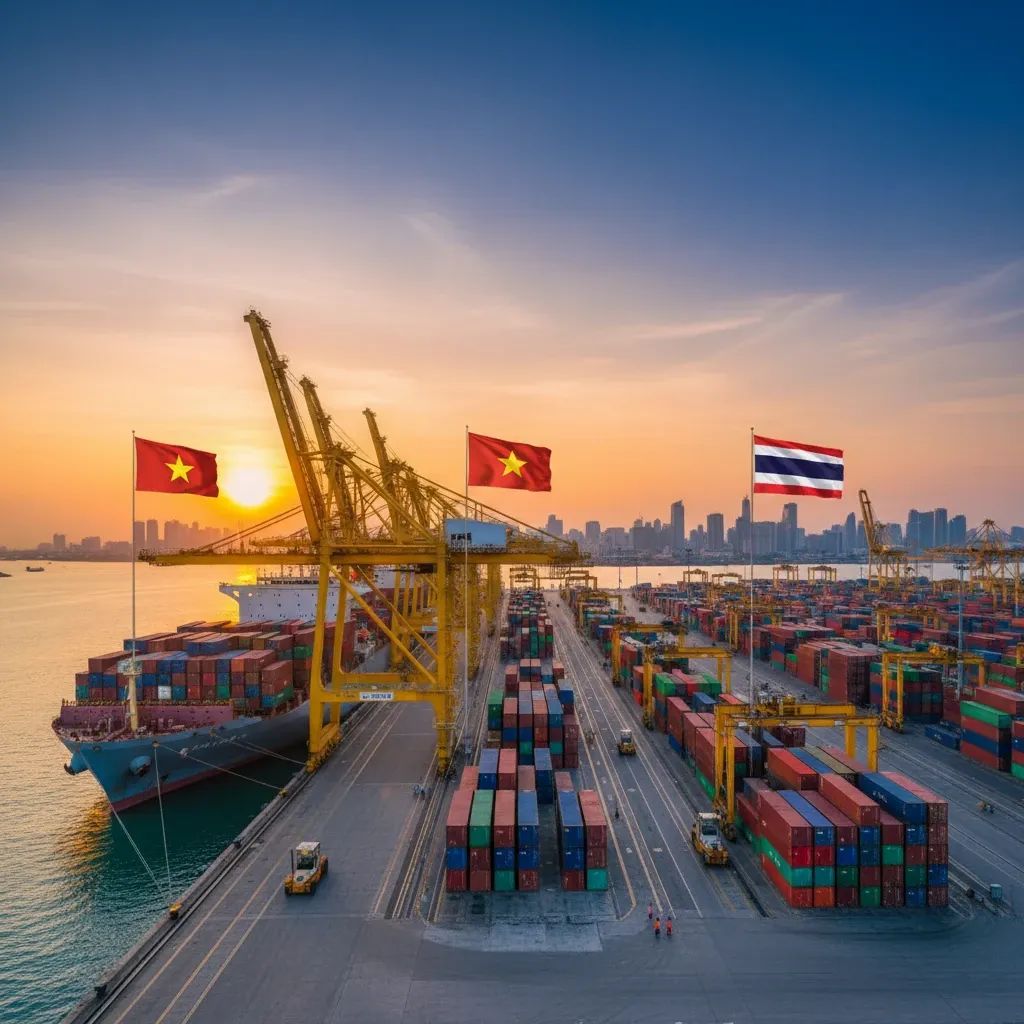
The U.S. administration has proposed charging Gulf states for American military protection of the Strait of Hormuz through a controversial 20% toll on all cargo transiting the waterway. However, the proposal faces immediate and unified rejection from Gulf governments, direct conflicts with international maritime law, and no enforcement mechanism—meaning the toll remains a policy announcement without operational architecture rather than imminent policy.
Why This Proposal Concerns Thai Businesses
• Oil pricing pressure risk: Thailand imports roughly 60% of its crude oil through the Strait of Hormuz. If implemented, a 20% surcharge could raise delivered costs significantly, directly impacting domestic fuel prices and manufacturing input costs across sectors. Industry analysts are modeling potential cost increases, though the actual figure depends on enforcement mechanisms that remain undefined.
• International law violations: The UN Convention on the Law of the Sea (UNCLOS) explicitly guarantees passage rights through international straits without toll collection. Legal experts and the International Maritime Organization (IMO) have stated there is no legal foundation for such tolls. Enforcement attempts would likely trigger WTO disputes and maritime insurance complications that could disrupt shipping.
• Supply chain recalculation: Thai importers are preliminary modeling costlier alternate routes—the Cape of Good Hope and Suez Canal alternatives add 10-14 days transit time, which could inflate inventory holding costs and compress working capital for manufacturers if the toll were actually enforced.
The Policy Proposal and Its Geopolitical Context
On July 13, 2026, U.S. President Donald Trump declared that wealthy Gulf monarchies—Saudi Arabia, the UAE, Qatar, Kuwait, and Bahrain—should reimburse Washington for decades of naval protection estimated at $30-60 billion annually. The administration framed these nations as security beneficiaries who had not formally compensated America for military capacity.
Significantly, this proposal emerged after months of escalating U.S. military operations against Iranian positions and renewed threats against Tehran. The timing and language echoed Cold War geopolitical positioning rather than conventional security burden-sharing.
Historically, burden-sharing operated through quieter mechanisms. During the 1991 Gulf War, Saudi Arabia provided logistical support and facilities rather than direct payments—a distinction rooted in both legal concerns and political considerations in Gulf capitals. This proposal marks a departure from that diplomatic approach.
The proposal targets specific mechanisms: according to administration guidance, the 20% levy would attach to cargo value at the point of export from Gulf terminals or during transit. However, no formal implementing regulations have been published as of mid-July, creating significant ambiguity around enforcement procedures, exemptions, or appeal processes.
Unified Regional Rejection and Legal Obstacles
Gulf governments responded with unusual unanimity before Trump's announcement was finalized. Secretary of State Marco Rubio reported that during a meeting in Bahrain with Gulf leaders on June 25, regional officials expressed "zero support" for any fee structure tied to Hormuz passage. This coordinated stance is notable—Gulf monarchies rarely align this visibly against Washington proposals, reflecting genuine concern that acceptance would establish precedent for further demands.
The legal objection is unambiguous. UNCLOS Article 38 guarantees transit passage through international straits, prohibiting coastal states and third parties from imposing mandatory tolls. Iran and Oman border the waterway but cannot control it exclusively; certainly the United States—with no territorial claim—has no legal foundation to unilaterally impose charges. The International Maritime Organization (IMO) has explicitly stated there is no legal basis for such tolls under international maritime law.
Gulf officials also raised the precedent risk. If the U.S. can demand 20% today, what prevents escalation tomorrow? For Saudi Arabia and the UAE, which have cultivated partnerships with China and India through initiatives like the Belt and Road Initiative, the toll proposal may accelerate strategic diversification already in motion.
International Pushback
Britain's Foreign Office branded the proposal "state-backed highway robbery" and accused the Trump administration of "economic extortion disguised as security provision." This transatlantic criticism signals resistance extends beyond the region.
Iran's response acknowledged that providers of secure passage deserve compensation, then rejected the 20% figure as excessive. This rhetorical competition reflects genuine geostrategic tension over who claims authority over the Strait.
Thailand's Energy Supply and Manufacturing Exposure
For Thailand, the practical stakes depend entirely on whether this proposal moves from announcement to enforcement. The state-owned PTT Public Company, a major energy conglomerate, sources significant crude volumes from Saudi Arabia and the UAE. If a toll were implemented, it could either raise per-barrel costs delivered to Thai refineries or require renegotiation of existing long-term supply contracts.
Thai manufacturers face diffuse but serious exposure. Electronics producers, automotive component suppliers, and processors depend on just-in-time supply chains fed by raw materials originating in or transiting through the Middle East. Should a sustained surcharge be enforced, even unevenly, it would compress margins and disrupt production schedules.
Thai freight forwarding companies are currently modeling route economics. The Cape of Good Hope alternative adds 10-14 days to transit time plus substantial storage costs. A two-week delay could ripple through manufacturing calendars, increasing working capital requirements.
Maritime insurance also presents a potential cost multiplier. Underwriters are already recalculating risk profiles for Hormuz transits, though premiums will only rise if the toll moves toward enforcement through naval inspection or cargo interdiction.
The Enforcement Question: The Critical Unknown
The proposal's core weakness is the complete absence of an enforcement mechanism. As of mid-July, the Trump administration has not published implementing regulations, issued commercial guidance, or clarified exemptions. The U.S. Navy has not announced boarding procedures or inspection protocols. Gulf governments have made clear they will not voluntarily remit payments.
This ambiguity is fundamental: without enforcement capability, the toll remains rhetoric rather than policy. Will the U.S. attempt collection through Suez Canal coordination? Will it impose sanctions on shipping lines? Each approach carries different consequences under maritime law and WTO protocols.
International maritime organizations and shipping trade journals have warned that any enforcement attempt would trigger World Trade Organization disputes, insurance litigation, and cascading court challenges. No modern precedent exists for a non-territorial power unilaterally charging toll on international straits.
Thailand's Diplomatic and Commercial Positioning
The Thailand Ministry of Foreign Affairs faces a delicate calculation. Thailand has maintained strategic neutrality in U.S.-Iran tensions, preferring multilateral forums and UN mechanisms. Explicit endorsement could alienate Iran; vocal opposition could strain U.S. ties at a time when Thai foreign policy depends partly on American regional counterweight to Chinese influence.
The Thailand National Shippers' Council has scheduled an emergency coordination meeting for late July to engage with the Thailand Ministry of Commerce on potential trade remedies or multilateral diplomatic interventions. Industry groups are signaling to government bodies that toll enforcement could trigger retaliatory action under WTO mechanisms.
Likelihood Assessment for Thai Residents
Whether this proposal progresses depends on factors currently unpredictable:
Scenario 1 (Low probability): The U.S. publishes enforcement regulations and attempts naval collection. This would trigger immediate international legal challenges, likely WTO disputes, and widespread shipping industry non-compliance. Implementation would face 18-36 months of legal proceedings before producing revenue.
Scenario 2 (Moderate probability): The proposal remains dormant policy, neither enacted nor formally abandoned. Thailand and businesses would continue contingency planning without experiencing actual cost increases.
Scenario 3 (Highest probability given unified opposition): Political pressure from allies and legal obstacles cause the administration to shelve or significantly modify the proposal within 6-12 months, possibly reframing it as a negotiating position rather than actual policy.
For Thai residents and businesses, the practical recommendation: monitor three indicators in coming weeks—U.S. naval activity patterns in the strait (increased inspections would signal enforcement intent), maritime insurance underwriting shifts (major syndicates typically adjust premiums 48-72 hours before changes), and alternate route costing dynamics (if major shippers begin diverting through Cape of Good Hope, pressure is mounting).
Immediate fuel price increases are unlikely given the unified rejection and legal obstacles. However, preparation costs for Thai businesses—insurance adjustments, route remodeling, contingency planning—are already accumulating. These costs may prove merely precautionary or may signal a genuine supply chain recalculation ahead.