The Thailand Commerce Ministry is preparing to roll out a nationwide subsidized meal program that promises rice and curry plates for just ฿40, but the initiative has already sparked controversy among economists and former officials who argue it offers little more than a public relations gesture disguised as economic policy.
Why This Matters:
• Limited reach: Only 100,000 restaurants will participate in the pilot, drawn from 250,000 eateries already enrolled in government schemes
• Quality concerns: Critics warn subsidies could incentivize restaurants to cut corners on ingredients and portion sizes to maintain margins
• Short-term fix: The program runs for just 3 months with one-time subsidies of ฿3,000 to ฿10,000 per restaurant, with no clarity on sustainability afterward
• Cabinet decision expected: The scheme, formally titled "Khao Kaeng Thai Chuay Thai" (Thai Helps Thai Rice-and-Side-Dish Programme), heads to Cabinet approval in the third week of July
A Subsidy for Businesses, Not Households
The program's mechanics reveal a fundamental question: who truly benefits? Participating restaurants receive direct financial support through ingredient subsidies, while consumers get an indirect discount on a limited menu. Former government advisers have pointed out that the primary beneficiaries appear to be the eateries themselves, not the Thai public struggling with inflation.
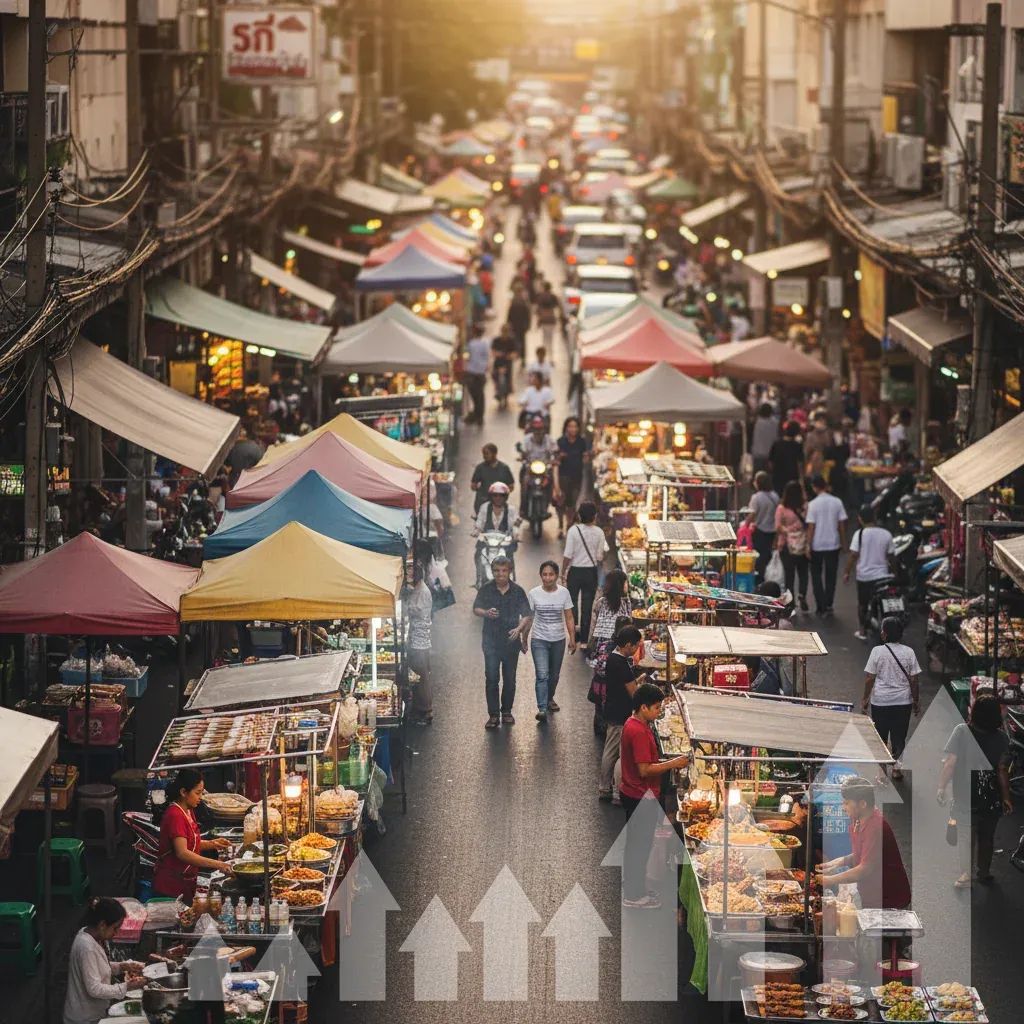
Under the proposed structure, restaurants would voluntarily offer selected ready-to-eat meals—rice with at least two side dishes—for no more than ฿40 per serving. The Thailand Commerce Ministry would provide ingredient packages worth ฿3,000, ฿5,000, or ฿10,000 to help offset costs. Official signage would identify participating outlets, making it easier for customers to locate subsidized meals.
The pilot phase targets 100,000 restaurants from the ministry's existing network of affiliates, many already part of the "Thai Help Thai Plus" program. If the Cabinet approves the scheme during the third week of July, implementation could begin immediately and run for at least three months.
The Market Distortion Dilemma
Critics contend the subsidy creates an uneven playing field that could distort normal market competition. Restaurants might adapt their operations primarily to qualify for government assistance rather than focusing on quality improvements or natural competitive advantages. This raises concerns about unfair competition between participating and non-participating establishments, potentially harming eateries that choose not to join the scheme.
There's also the risk of a "race to the bottom" on food standards. With a fixed price ceiling of ฿40 and limited government support, restaurants face pressure to maintain profitability by reducing portion sizes, switching to cheaper ingredients, or compromising on preparation standards. Consumers could end up receiving lower-grade food while believing they're benefiting from a government program designed to help them.
The voluntary nature of participation—intended to avoid imposing rigid price controls—also means limited accessibility. Not all eateries will join, and those that do might offer only a restricted selection of dishes at the subsidized rate. Once the initial subsidies conclude after three months, there's no guarantee restaurants will maintain the ฿40 price point without continued government support.
Missing the Root Causes
The fundamental criticism centers on what the program fails to address: the underlying drivers of food inflation. Raw materials, electricity, cooking gas, fuel, transport costs, and labor expenses have all risen across the entire production chain. By subsidizing the final point of sale rather than tackling these systemic cost pressures, the scheme offers temporary relief without structural change.
This approach contrasts sharply with alternative strategies already in place or proposed by other agencies. The Thailand Commerce Ministry's existing "Thai Help Thai" scheme partners with retailers and manufacturers to offer discounts up to 50% on over 1,000 alternative-brand products. The Blue Flag Low-Price Scheme cuts prices on essential consumer goods at more than 500 locations nationwide, with mobile trucks reaching remote areas.
More fundamentally, direct ingredient supply programs deliver rice, cooking oil, eggs, and sugar from source to food vendors, attempting to prevent unreasonable markups along the supply chain. The Green Flag Plus Project reduces fertilizer costs for farmers through factory-direct sales and subsidies up to ฿1,400 per farmer. These initiatives aim at strengthening the entire food system rather than simply subsidizing the endpoint.
What This Means for Residents
For Thailand's salaried workers and households facing rising living costs, the 40-baht meal scheme offers modest, short-term relief at best. If you're near one of the participating 100,000 restaurants during the pilot phase, you might save ฿20 to ฿30 per meal compared to current market prices for similar dishes. That could translate to savings of ฿400 to ฿600 monthly if you eat one subsidized meal daily—roughly equivalent to a utility bill or a tank of fuel.
However, several caveats apply. The program's voluntary nature and limited restaurant participation mean availability will vary significantly by neighborhood. Menu options at the ฿40 price point will likely be restricted, and quality standards remain uncertain. The three-month pilot timeline offers no long-term planning value for household budgets.
More concerning for residents is what the scheme signals about economic policy direction. Rather than addressing the fundamental cost pressures squeezing household purchasing power—energy prices, transport costs, housing expenses—the government is opting for visible but superficial interventions. Critics view this as a "PR exercise" that generates positive headlines without meaningful economic impact.
The Alternative Path Forward
Economists and policy experts have consistently argued for a different approach: reduce underlying business costs and strengthen household purchasing power through sustainable economic policies. This means addressing energy subsidies, transport infrastructure, agricultural supply chains, and labor market conditions rather than creating temporary price distortions at the retail level.
The government's existing co-payment scheme, announced in September 2025 with ฿47 billion in funding, subsidizes up to 60% of costs for certain food and consumer goods for eligible Thai citizens. This direct-to-consumer approach at least provides immediate purchasing power rather than relying on voluntary business participation and uncertain pass-through benefits.
Thailand's "Sufficiency Economy Philosophy" and Bio-Circular-Green (BCG) Economy model offer frameworks for long-term food system transformation. Sustainable agriculture, organic farming, and safe food production initiatives aim to improve farmers' income while stabilizing prices. These structural approaches require years to implement but address root causes rather than symptoms.
As the Cabinet prepares to review the 40-baht scheme this month, the fundamental question remains: does Thailand need another short-term subsidy program, or should resources be directed toward the harder work of systemic economic reform? For residents watching their living costs climb month after month, the answer may determine whether they face genuine relief or just another government sign on a restaurant window.