
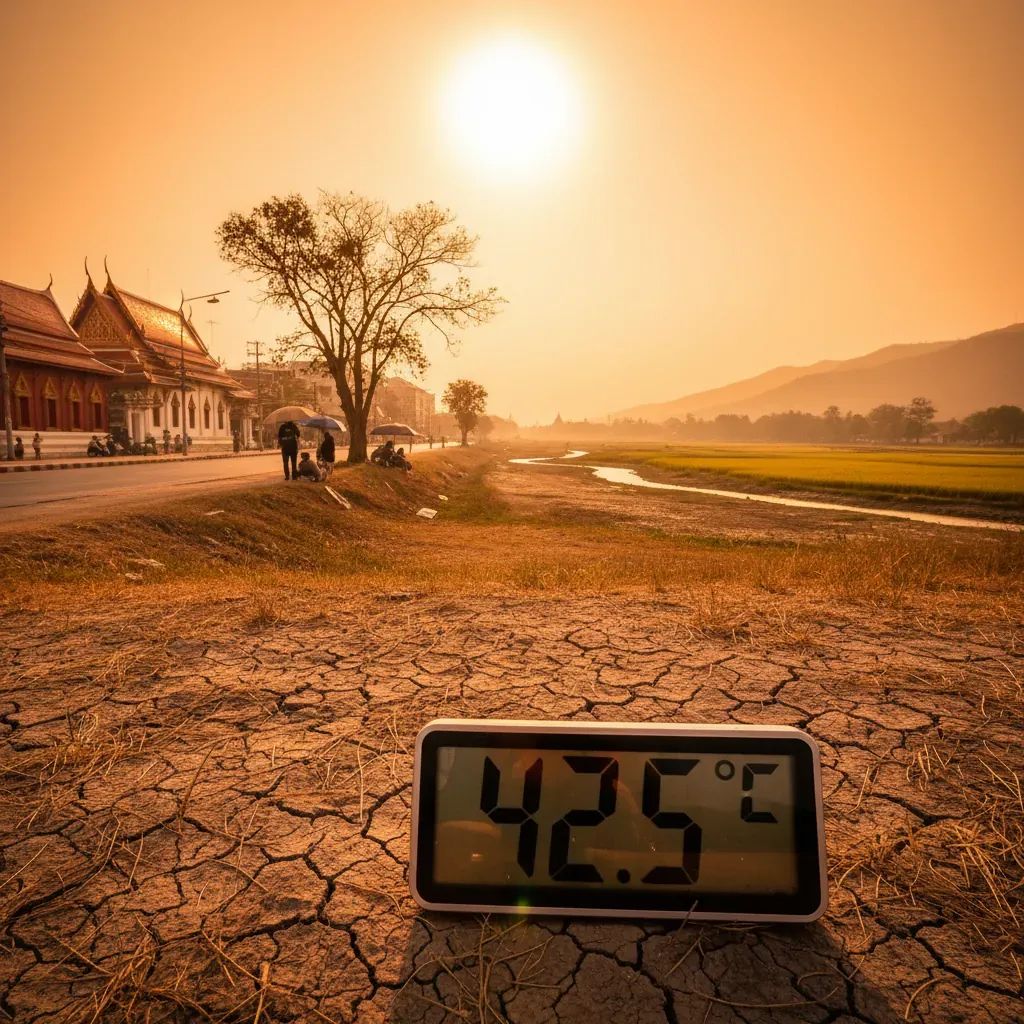
The Thailand Meteorological Department has issued weather warnings for scattered thunderstorms across multiple provinces as the country navigates the volatile transition into summer season. Hot daytime temperatures combined with moisture-laden winds from the Gulf of Thailand are creating conditions ripe for localized but intense weather events, with roughly 20% of eastern provinces—including the heavily populated zones of Chonburi, Rayong, Chanthaburi, and Trat—facing the highest risk of sudden storms.
Why This Matters
• Sudden storm risk: Thunderstorms can intensify rapidly, bringing wind gusts, lightning strikes, and brief but heavy rainfall with little warning.
• Heat stress alert: Daytime highs are climbing to 37°C in coastal areas and up to 39°C inland, posing health risks for outdoor workers and vulnerable populations.
• Air quality concern: Moderate to high particulate matter and haze levels are building across northern and northeastern Thailand due to weak surface winds.
• Marine caution: Wave heights in the Gulf of Thailand will reach 1 meter under normal conditions but surge past 2 meters during thunderstorms, creating hazards for small craft.
Regional Breakdown: Where the Weather Turns
Eastern Seaboard and Pattaya
Pattaya and surrounding eastern provinces are experiencing the sharpest weather contrasts. Morning temperatures hover between 21°C and 26°C, then spike dramatically to 37°C by mid-afternoon. Southern and southeastern winds are funneling humid air from the Gulf of Thailand and the South China Sea inland, creating the fuel for afternoon and evening storms.
Wind speeds range from 15 km/h to 30 km/h, with occasional gusts during storm activity. Residents and tourists in coastal districts should monitor sky conditions closely between noon and sunset, when convective storms typically develop.
Northern Regions Under Dual Threat
The Thailand Meteorological Department forecasts thunderstorms affecting approximately 10% of the northern region, with Mae Hong Son, Chiang Mai, Nan, Tak, Phitsanulok, and Phetchabun among the provinces on alert. Morning temperatures dip to 18°C–24°C in mountain valleys, climbing to 33°C–39°C by midday.
The heat itself is compounded by accumulating particulate pollution and smoke haze, driven by weak atmospheric circulation that prevents dispersion. Residents with respiratory conditions should limit outdoor exposure during peak heat hours.
Northeastern, Central, and Metropolitan Areas
Approximately 10% of the northeastern region faces thunderstorm potential, particularly in Loei, Chaiyaphum, and Nakhon Ratchasima. Central provinces including Kanchanaburi, Uthai Thani, and Saraburi are similarly exposed, with daytime highs reaching 34°C–39°C.
Bangkok and surrounding metropolitan areas will see hot, hazy conditions with scattered thunderstorms possible in localized pockets. Temperatures range from 22°C at dawn to 37°C in the afternoon.
What's Driving the Weather Pattern
The current instability stems from a weakening high-pressure system originating in China, which is being overtaken by a thermal low-pressure zone that has established itself over northern Thailand. This thermal trough creates rising hot air, which collides with moisture being pushed inland by southerly and southeasterly winds.
The result is a classic "summer storm" scenario: rapid convective development, short-lived but intense rainfall, gusty winds, and the potential for hail and lightning strikes in the most energetic cells. These storms typically last 30 minutes to an hour but can produce localized flooding in low-lying or poorly drained areas.
Meteorologists note that the interaction between cooler air masses moving south from China and the hot, humid air entrenched over Thailand creates the atmospheric instability necessary for severe weather. While the overall storm coverage remains modest—most provinces will see clear or partly cloudy skies—those areas that do experience storms can expect significant intensity.
Impact on Residents and Travelers
Health Risks from Heat
With temperatures consistently exceeding 35°C across most regions, the Thailand Ministry of Public Health advises residents to avoid prolonged outdoor activity between 11:00 a.m. and 3:00 p.m., the peak heat window. Dehydration, heat exhaustion, and heatstroke are genuine risks, particularly for construction workers, street vendors, agricultural laborers, and tourists unaccustomed to tropical heat.
Storm Safety Protocol
The Thailand Meteorological Department has published specific precautions for those caught in sudden thunderstorms:
If indoors: Remain inside a solid structure, close all windows and doors, and unplug electrical appliances—including computers and phone chargers—as lightning can induce dangerous currents through wiring. Avoid using corded phones during active lightning.
If outdoors: Seek shelter immediately. Avoid open fields, rooftops, balconies, and the base of large trees. Do not wear metal jewelry or carry metal objects above head height (umbrellas with metal tips, fishing rods, golf clubs). Exit bodies of water, including pools and beaches, as water conducts electricity efficiently. If no shelter is available, crouch low to minimize your profile but avoid lying flat.
For drivers: Staying inside a vehicle offers reasonable protection, but park away from flood-prone areas, under large trees, or near unstable structures such as billboards.
Agricultural Concerns
Farmers should secure fruit trees, reinforce greenhouse structures, and move livestock to sheltered areas. Hail and wind gusts can damage crops rapidly, and flash flooding remains possible in poorly drained fields or areas near waterways.
Marine Warnings
Small boat operators and coastal fishermen should exercise caution. Wave heights of 1 meter under normal conditions can more than double during storm activity, creating dangerous swells and reducing visibility. The Thailand Maritime Department recommends monitoring weather updates before departing and returning to shore at the first sign of darkening skies or rising winds.
Air Quality Deterioration
Northern, northeastern, and upper central Thailand are experiencing moderate to high levels of particulate matter (PM2.5 and PM10) due to a combination of agricultural burning, vehicle emissions, and stagnant air conditions. The weak winds associated with the thermal low prevent pollutants from dispersing, allowing haze to accumulate.
Residents in affected areas—particularly children, the elderly, and those with asthma or cardiovascular conditions—should limit strenuous outdoor activities, keep windows closed during peak pollution hours, and consider using air purifiers indoors.
Historical Context: March Storm Patterns
March typically marks the onset of Thailand's "summer storm season," a volatile transition period when the cool, dry northeast monsoon weakens and hot, unstable air begins to dominate. Historical data from March 2023 showed similar patterns, with thunderstorms affecting 15 provinces across the North, Northeast, Central, and Eastern regions between March 12–14, causing damage to 109 homes in Nakhon Phanom, Sakon Nakhon, and Roi Et provinces.
While the overall rainfall in March tends to be below annual averages, localized downpours can be intense enough to trigger flash floods in low-lying urban areas and mudslides in hilly terrain. The Thailand Department of Disaster Prevention and Mitigation recorded significantly fewer flood events in 2023 compared to 2022, but the risk remains real for those in vulnerable locations.
Looking Ahead
The current weather pattern is expected to persist through the remainder of the week, with daily thunderstorm chances hovering around 10%–20% in most regions. Residents should check daily forecasts from the Thailand Meteorological Department and remain alert to rapidly changing conditions, particularly during afternoon hours when convective storms are most likely to develop.
For real-time emergency assistance or to report public hazards such as downed power lines or damaged structures, contact the Thailand Department of Disaster Prevention and Mitigation at 1784 (available 24 hours) or via Line at @1784DDPM.


