
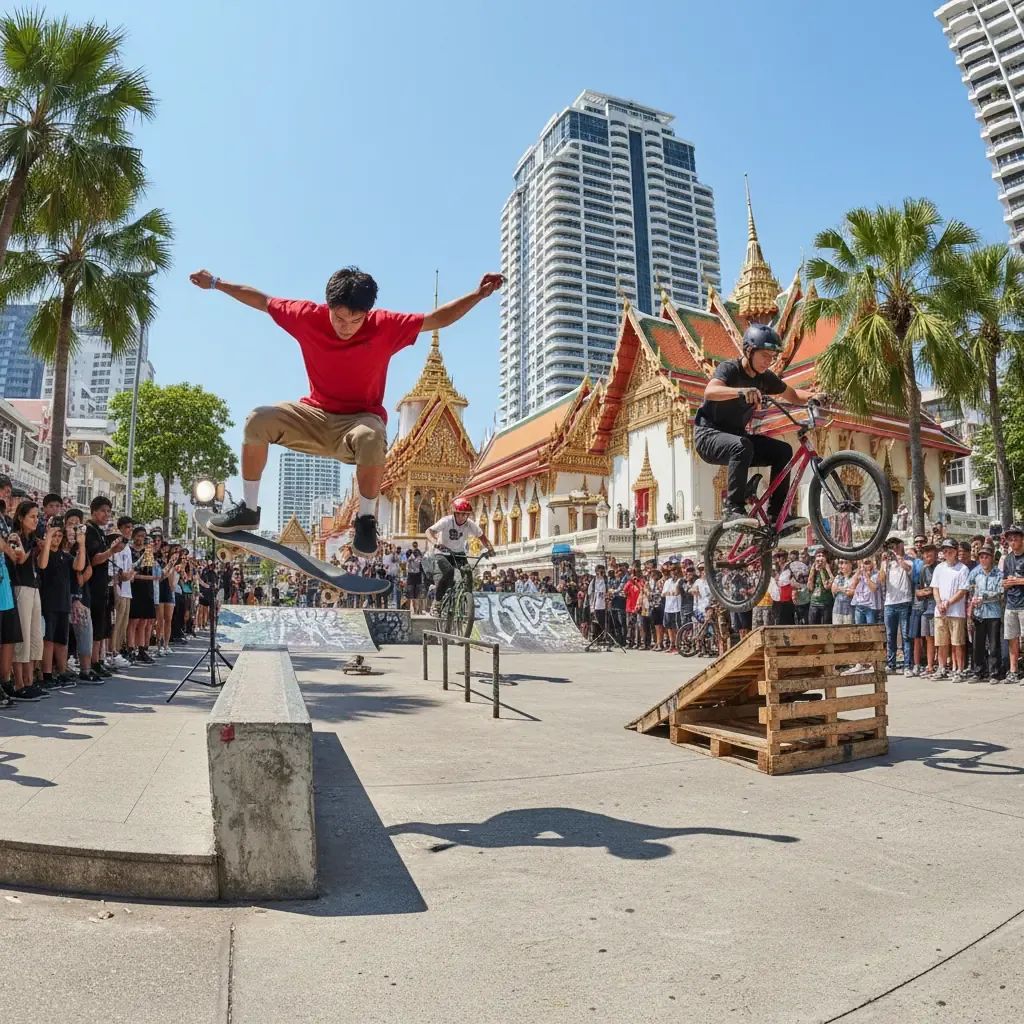
Pattaya will host Thailand's premier extreme sports talent search this month, with top competing athletes fighting for spots on the national squad heading to Japan's 2026 Asian Games in September. The Thailand Extreme Fest, running April 24–26, functions as the de facto qualifying trials for skateboard, BMX, and breakdancing—disciplines that have secured official medals and athlete quotas at Aichi-Nagoya. What happens on Pattaya's streets and parks over those three days will shape the direction of Thailand's extreme sports program for the next five years.
Why This Matters
• Qualifying tournament, not exhibition: Only medallists and top-eight finishers receive formal consideration for national team selection; the Sports Authority of Thailand has adopted a "quality over quantity" policy, meaning marginal performances likely result in exclusion from further trials.
• Venue logistics and spectator access: Competitions spread across four distinct sites (Central Pattaya, Thai Wake Park, Naklua Public Park, Big Buddha Hill) beginning April 24; road closures near Central Pattaya are expected, though spectator entry is free.
• Career inflection point: Strong showings unlock international funding, elite coaching access, and sponsorship pathways through mid-2026; weak performances close the door on Asian Games consideration entirely.
The Stakes: Why Extreme Sports Matter to Thailand's Asian Games Bid
Extreme sports represent Thailand's emerging competitive edge at continental competitions. The nation's skateboard and BMX athletes punched above their weight at the February 2026 Asian Championships in Sichuan, China, capturing three gold, two silver, and three bronze medals—a performance that surprised regional rivals and positioned Thai riders among Asia's top tier. That success did not arrive by accident; it came from deliberate investment in domestic infrastructure, coaching, and athlete development pathways. The Thailand Extreme Fest is the institutional mechanism through which that winning culture gets sustained and extended.
In December 2025, Dr. Kongsak Yodmanee, Governor of the Sports Authority of Thailand, publicly committed to a strategic shift: Thailand would send fewer athletes to future Asian Games but demand higher individual performance standards. The old approach—filling quota slots with marginal performers to show breadth—was abandoned in favor of concentrating resources on medal contenders. This philosophy directly governs how ESAT evaluates the Pattaya championship results and determines which athletes advance to final selection camps.
Which Disciplines Actually Count—And Which Don't
The Pattaya festival features seven sports, but not all seven have secured seats at the 2026 Asian Games.
Confirmed extreme disciplines with official Asian Games medals:
• Skateboard (street, park, and downhill variants)
• BMX (racing and freestyle)
• Breaking (breakdancing)
• Surfing (making its debut at Aichi-Nagoya)
These four guarantee athlete quotas and training camp funding. Skateboard downhill, BMX racing, and BMX freestyle all have established international ranking systems; medalists at Pattaya will directly influence selection discussions.
Disciplines without official 2026 Asian Games status:
• Cable wakeboard
• Cable wake skate
• Roller freestyle
• Inline freestyle
This creates an apparent contradiction. The Extreme Sports Association of Thailand included cable wakeboard and wake skate in the national championship despite them lacking confirmed Asian Games slots. The explanation lies partly in Thailand's recent wakeboard success: the national team earned gold at December 2025's SEA Games with athletes like Sarawut Niamkhun, Benjamin Phechyuenyong, and Lalada Liew delivering dominant performances. That pipeline justifies continued domestic investment even if immediate Asian Games spots remain unavailable. ESAT may also be building ranking systems and athlete databases ahead of potential future Asian Games additions or to develop talent for Southeast Asia Games and other international circuits where wakeboarding does compete.
How the Qualifying Process Actually Works
Selection for the Asian Games is neither automatic nor purely merit-based. The Sports Authority of Thailand uses a tiered system. Athletes who finish in the top three at Pattaya receive immediate consideration for national team invitations. Those placing fourth through eighth may access funding for international qualifiers scheduled May and June, extending their pathway toward selection. Athletes finishing outside the top ten face exclusion from 2026 Asian Games consideration—though they remain eligible for SEA Games and younger age categories at future multi-sport events.
Unlike established Olympic sports with multi-year funding commitments and transparent qualifying standards, extreme sports in Thailand lack that institutional depth. The Pattaya championship thus carries disproportionate weight. A single strong performance can elevate an athlete's international ranking; conversely, a poor showing at the national championship often signals the end of 2026 aspirations.
The Sports Authority plans to announce official rosters by late July 2026, leaving roughly eight weeks for final conditioning, international tune-ups, and team chemistry before the Asian Games opening ceremony on September 19.
Venue Logistics and How Pattaya Accommodates Seven Sports
Spreading competitions across four distinct zones addresses a practical bottleneck: no single Pattaya location possesses infrastructure for seven simultaneous disciplines plus crowd management.
Central Pattaya's multipurpose plaza hosts skateboard and BMX competitions—spectator-friendly disciplines that generate compelling visual content and draw casual observers. The venue sits at the heart of Pattaya's commercial district, maximizing foot traffic and media coverage.
Thai Wake Park Pattaya operates at capacity during competition weekends. The facility runs weekday hours from 10:30 AM to 6:30 PM, with beginner-friendly sessions from 10:30 AM to 12:00 PM. Weekends expand operations from 9:00 AM to 6:30 PM, with early beginner slots from 9:00 to 10:30 AM. Cable wakeboard and wake skate events occur here, leveraging the park's dedicated infrastructure.
Naklua Chalermprakiat Public Park and Big Buddha Hill handle downhill skateboard and freestyle disciplines suited to terrain features unavailable downtown. These hillside venues operate with limited crowd management, targeting enthusiasts willing to trek to secondary locations.
The multi-venue strategy achieves secondary benefits: it reduces congestion, prevents venue saturation, and allows spectators to circuit between locations across the weekend. Each site becomes a distinct media opportunity—Thai news outlets and social platforms compete to cover the spectacle from multiple angles, multiplying Pattaya's promotional exposure.
The Athlete Pipeline: Who's Already Pre-Qualified
Thawatchai Siengung, Atthapol Somaim, and Chankao Udomphen emerged as standout skateboard medalists at the Sichuan championships and are effectively pre-qualified for Asian Games consideration pending confirmation of event formats and final team size. Their performances demonstrated technical consistency and mental composure under pressure—the exact qualities the Sports Authority prioritizes.
On the BMX racing side, Kometh Sukprasert captured the men's elite title at the ASEAN BMX Racing Cup in March 2026, accumulating crucial Olympic qualification points alongside his pursuit of Asian Games medals. His momentum and international ranking elevate him to frontrunner status for Thailand's BMX racing berth, assuming Aichi-Nagoya allocates one competitor per nation per discipline—a common structure in continental games.
That said, repeat performances matter. Selection committees weight consistency across multiple competitions more heavily than a single exceptional outing. Athletes who medal at Pattaya, then place top-five at international qualifiers in May or June, generate the confidence required for formal roster inclusion.
Pattaya's Sporting Ambitions: The Bigger Picture
Beneath the athletic competition lies an economic calculation. Over the past five years, Pattaya has invested in sports infrastructure—wake parks, skate facilities, multipurpose venues—betting that hosting recurring championships will position the city as Thailand's primary extreme sports destination. The strategy mirrors successful precedents: Barcelona and Gold Coast built long-term sporting prestige by hosting championships and establishing training centers, which in turn attracted sport-tourism spending and international investment.
April's timing is deliberate. Pattaya typically experiences soft tourism numbers in spring before summer break travel accelerates. By hosting a marquee national championship, the city injects hotel bookings, restaurant traffic, and media attention during an otherwise quiet period. Athletes' families, coaching delegations, amateur enthusiasts, and curiosity-driven spectators travel to Pattaya specifically for the event, generating short-term revenue while reinforcing the city's sports-centric brand identity.
The festival also serves youth engagement. Local skateboard and wakeboard clubs use Pattaya's event as a recruitment and development opportunity, introducing recreational players to elite-level competition and potentially identifying raw talent for longer-term coaching pathways.
What Comes Next: The Selection Timeline
National team rosters for extreme sports should be formally announced by late July 2026, coinciding with final preparations before the September 19 Asian Games opening. The Sports Authority of Thailand will likely release selections in phases by discipline—skateboard selections first, then BMX, breakdancing, and surfing—to accommodate discipline-specific qualifying timelines and international competition calendars.
For athletes who medal at Pattaya but wish to strengthen their candidacy, international qualifiers in May and June offer final opportunities. For those who finish outside the top eight, realistic pathways to 2026 Asian Games participation close sharply. However, all competing athletes gain valuable exposure, ranking points, and professional network expansion—benefits that extend beyond immediate Asian Games consideration into longer-term career trajectories.
The Thailand Extreme Fest thus functions as more than a championship; it is the institutional gateway through which Thai extreme sports talent either advances toward continental and Olympic visibility or encounters the ceiling of domestic opportunity.


