
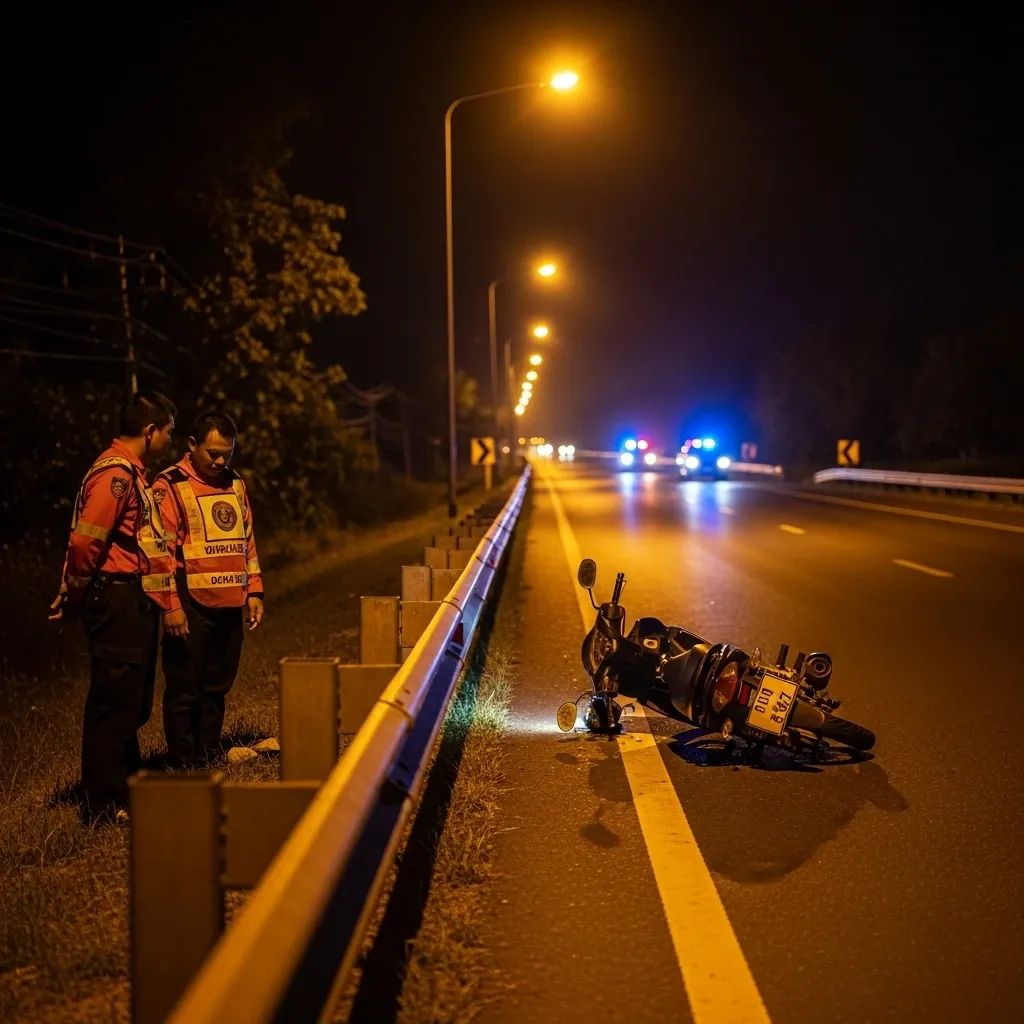
Why This Matters
• Speeding remains the leading cause of Songkran crashes, accounting for 43.5% of incidents, while drunk driving has emerged as a rising concern at 24%—requiring sustained enforcement and vigilant prevention throughout the holiday.
• Motorcycles dominate casualty statistics at 83%, with the most vulnerable age group (20–29 years) representing nearly 18% of all fatalities and injuries combined.
• Bangkok recorded triple-digit death tolls (19 fatalities), while remote provinces like Nakhon Nayok and Phichit achieved zero deaths through community-based checkpoint systems worth replicating nationwide.
Thailand's road infrastructure faced its Songkran test in mid-April 2025, and the results painted a mixed picture: fewer people died compared to last year, yet preventable factors like alcohol intoxication remain stubbornly persistent. Between April 11 and 17, the Thailand Ministry of Public Health documented 253 deaths and 1,495 injuries across 1,538 road incidents—a 12% reduction in fatalities and a 27% drop in accident frequency year-over-year. But the headline hides a troubling shift: while speeding continues to dominate crash profiles, drunk driving has emerged as an increasingly significant concern, suggesting that even as checkpoint enforcement successfully addresses high-speed highway driving, festive local roads where celebrations and alcohol consumption peak remain vulnerable to this rising secondary risk.
The Numbers Behind the Grim Picture
The seven-day campaign deployed nearly 51,000 personnel across 1,762 checkpoints nationwide. Deputy Prime Minister Anutin Charnvirakul credited stronger inter-agency coordination for the improvement, though the absolute toll—a death every 2 hours, an injury every 3 minutes—underscores how far Thailand remains from regional benchmarks. To contextualize: at 32 deaths per 100,000 people annually, Thailand's baseline road mortality already ranks among Southeast Asia's worst. Songkran compresses this annual risk into a single week, effectively doubling the national rate.
Saturday, April 12, alone produced a cascade of 208 crashes, 50 deaths, and 185 injuries. This concentration during the festivities rather than on peak travel days reflects a behavioral pattern that authorities have yet to fully address: celebratory intoxication in towns and villages, not inter-city highway chaos, now accounts for a significant portion of the fatalities.
Who Pays the Highest Price
Motorcyclists bear an outsized burden. At 83% of all accidents, two-wheelers dominate the casualty ledger far beyond their share of traffic. The data reveals a specific demographic trap: riders aged 20–29 comprise nearly 18% of all deaths and injuries—a population segment more likely to attend festivals, consume alcohol, and underestimate risk after extended celebrations.
Phatthalung province, a southern region of roughly 500,000 residents, logged 63 accidents and 61 injuries, the highest per-capita crash rate in the country. The culprit lies in its geography: rural, sub-district roads (classified as local village highways) account for 30% of all Songkran crashes nationwide, yet these thoroughfares receive a fraction of the enforcement attention devoted to expressways. Narrow, unmarked, and poorly lit, these lanes near homes and temples become death traps during festivities when tired riders navigate unfamiliar detours or alcohol impairs judgment.
In sharp contrast, six provinces—Nakhon Nayok, Phichit, Phuket, Ranong, Satun, and Sing Buri—reported zero fatalities across the entire seven days. The common denominator: robust "village guardian" volunteer teams staffed by local headmen and community members who intercepted risky behavior early. One rider spotted without a helmet, a group of youths on a single motorcycle, a visibly intoxicated would-be driver—these teams intervened with peer pressure and warnings before incidents escalated to tragedy. The Thailand Ministry of Interior plans to scale this community model nationwide.
Bangkok's Outlier Status
Bangkok stands apart, recording 19 deaths—triple the toll of the next-highest province. The capital's density, late-night entertainment districts, elevated alcohol consumption in nightlife venues, and high-speed urban expressway culture create a unique hazard profile. Most crashes occur on straight roads (90% of incidents), suggesting that drivers and riders maintain excessive velocity in situations where a moment's inattention or a sudden obstacle proves fatal.
The Drunk Driving Concern
The year-on-year comparison reveals an important shift in risk factors. In 2024, speeding accounted for 41.5% of crashes; in 2025, speeding remains the leading cause at 43.5%, while drunk driving now accounts for nearly 24% of incidents—a significant rise from previous years. This suggests that while checkpoint enforcement successfully maintains pressure on speeding violations on main roads, alcohol-impaired driving is increasing as a proportion of incidents, particularly on secondary roads and in residential areas. Checkpoints now aggressively intercept speeders on main roads, fining them on the spot with zero warnings. But enforcement weakens dramatically on village roads and within residential areas where private Songkran celebrations unfold, alcohol flows freely, and police presence is minimal.
The Thailand Excise Department restricts alcohol sales between 2 p.m. and 5 p.m., and prohibits sales after midnight, yet enforcement gaps widen in rural provinces. Moreover, at-home celebrations—where beer and whiskey flow without time restrictions—account for an immeasurable volume of drinking that occurs beyond regulatory reach.
For drivers caught over the legal blood-alcohol limit of 50 mg/dL, consequences extend beyond fines. Voluntary insurance policies may refuse claims, leaving individuals liable for medical and vehicle repair costs. Foreign expatriates and work-permit holders face additional scrutiny from the Thailand Immigration Bureau, with drunk-driving convictions triggering visa review procedures and potential cancellation. For long-term residents, a DUI conviction can mean months of legal entanglement and mobility restrictions in a country where private transport often proves essential for employment and daily life.
The Infrastructure That Matters
Before the holiday, the Thailand Department of Highways resurfaced high-crash zones, upgraded signage, and repainted reflective road markings. Public buses and inter-provincial transport underwent brake inspections, tire-tread verification, and driver rest-log audits. Overloaded pickup trucks—a practice technically illegal but customarily overlooked—faced on-the-spot fines of ฿2,000 at major checkpoints. The Thailand Royal Police enforced a zero-tolerance policy on ten major violations starting April 1, with no discretionary verbal warnings.
The three most consequential rules for motorcycle riders:
• Missing helmet (driver or passenger): up to ฿2,000 fine, 1 demerit point deducted.
• Speeding: up to ฿4,000 fine, 1 point deducted.
• Drunk driving: ฿5,000–฿20,000 fine or up to one year imprisonment, 4 points deducted.
The demerit system begins at 12 points; losing all points triggers a 90-day license suspension. For expats and long-term residents, this suspension can disrupt employment, visa compliance, and rental agreements tied to personal vehicle access.
What Residents Need to Know Before Riding
Straight roads dominate crash statistics (90%), a counterintuitive finding suggesting that speed and inattention, not difficult terrain, kill. Riders should assume that every familiar lane near home becomes hazardous during Songkran. The Thailand Department of Land Transport recommends sleeping 6–8 hours minimum before long rides; drowsiness remains under-reported but implicated in many "unknown cause" accidents. Tire tread and brake-fluid condition should be verified before departure—water-play festivities extend stopping distances by 30% on wet roads. Riders passing through water-play zones should slow to 20 km/h and shield their faces to prevent talcum-powder-induced temporary blindness.
Planning an early-morning departure (before 9 a.m.) bypasses the peak water-festival crowds concentrated between noon and 6 p.m., reducing exposure to intoxicated pedestrians and distracted drivers. For pickup truck owners, the practice of transporting passengers in open beds—technically illegal but customary—now carries on-the-spot fines of ฿2,000, transforming an ignored violation into a cash liability.
The Structural Lesson
The data suggests that intensive checkpoint enforcement on main roads successfully maintained pressure on speeding violations, a measurable achievement. Yet this enforcement reality—concentrating resources on highways while secondary roads and private celebrations receive less scrutiny—reveals an enforcement paradox: controlling one risk vector may inadvertently allow another to rise. Community checkpoints, staffed by volunteers rather than professional police, appear to address this gap by embedding safety monitoring into the social fabric of villages and townships where formal police capacity is stretched thin.
The government's stated goal remains a 5% year-on-year reduction measured against a three-year rolling average. This year's figures narrowly met that target, but critics observe that enforcement intensity evaporates immediately after the holiday, allowing risky habits to resurface. For residents in Thailand, the takeaway is unambiguous: the practices that reduce Songkran casualties—defensive riding, sobriety, helmet use, adequate rest—cannot be seasonal. They must become embedded in daily habit, because the road environment where motorcycles bear the brunt of systemic risk does not reset after the festivities end.


