
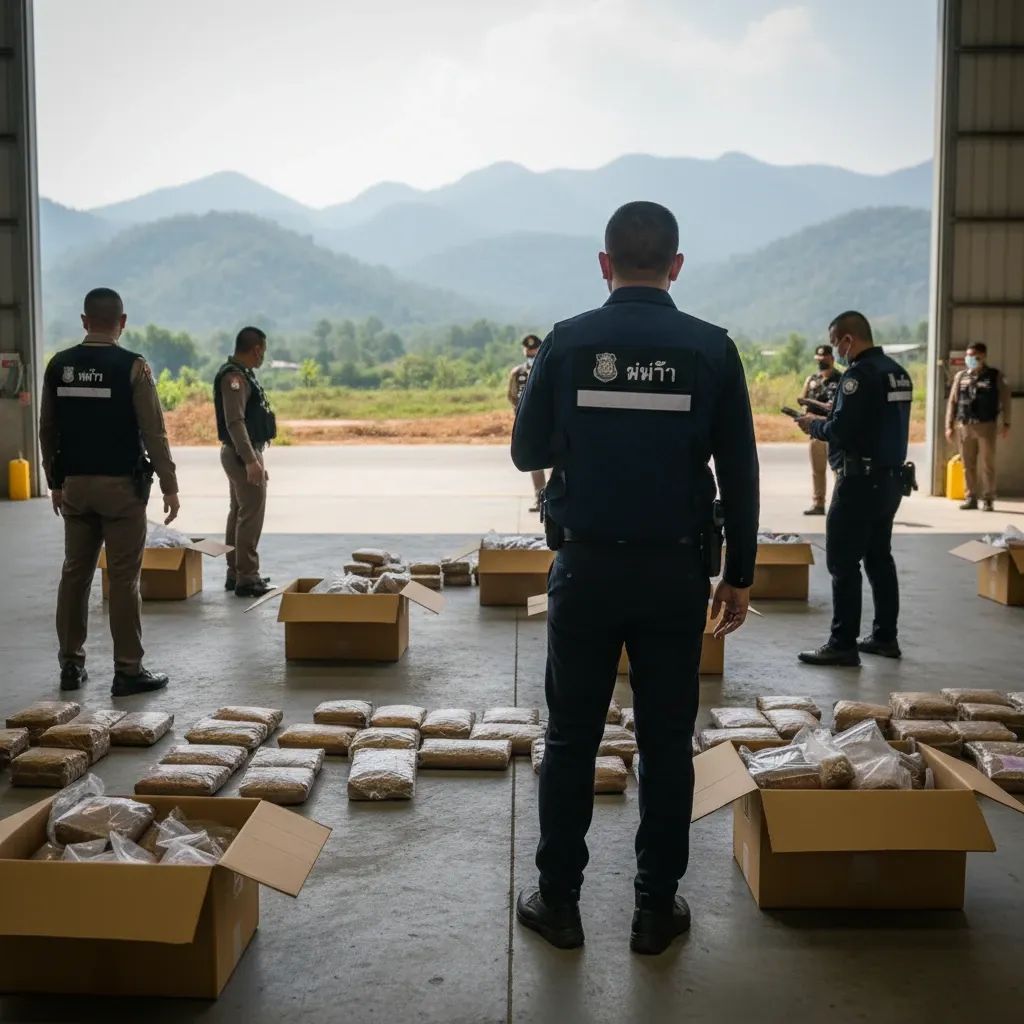
Thailand Border Patrol Police have intercepted a 40-year-old driver hauling half a tonne of crystal methamphetamine toward greater Bangkok, marking another dramatic escalation in the country's intensifying war on drugs. The June 8 arrest in Kalasin province adds to a staggering total of 34 tonnes of ice seized across the kingdom in the first eight months of the Thai fiscal year.
Note: Thailand uses the Buddhist Era (BE) calendar, which is 543 years ahead of the Common Era. The incident occurred on June 8, 2026 CE (2569 BE).
What Happened at the Roadside
A tip-off about narcotics movement along the Sri That-Kranuan route triggered the high-speed pursuit that ended with the suspect vehicle veering off the Tha Khantho-Nong Kung Si road in tambon Na Tan, Tha Khantho district. Officers from Border Patrol Police Region 2 (BPP Region 2) had positioned units along the highway after receiving intelligence that a smuggling operation was underway. When they signaled the car to stop for inspection, the driver — later identified as Awut, a 40-year-old man from Pathum Thani — accelerated in an attempt to evade capture. The vehicle lost control moments later, crashing into the roadside embankment.
Inside the wreckage, investigators found 10 black sacks containing 500 kilograms of ice, street value estimated at over ฿60M. Awut reportedly confessed during interrogation that he had been hired as a transporter, though he declined to name his employers. The seizure is the direct result of an ongoing investigation that began with a separate bust in May, when officers captured approximately 316 kilograms of methamphetamine in Mueang Khon Kaen district.
The Bigger Picture: Thailand's Meth Tsunami
This single arrest is a data point in a much larger crisis. Between October 2025 and June 2026, Thai law enforcement has logged more than 180,000 drug-related arrests, seizing 915M methamphetamine pills, 34.1 tonnes of ice, and 756 kilograms of heroin. Asset forfeitures tied to narcotics trafficking now exceed ฿7.1B. For context, that asset total is roughly equivalent to the annual budget of a mid-sized provincial government.
The Thailand Royal Police and the Office of the Narcotics Control Board (ONCB) have publicly acknowledged that the country remains both a primary market and a critical transit corridor for synthetic drugs manufactured in Myanmar's Shan State. The political instability in Myanmar since the 2021 military coup has emboldened clandestine chemists and dismantled what little regulatory oversight existed along the border. United Nations analysts have stated flatly that no factors in 2026 will reduce production volumes flowing out of Myanmar's conflict zones.
Why This Matters for Residents
Increased enforcement presence: Expect more checkpoints and vehicle inspections along major highways connecting the northeast to Bangkok, particularly routes through Khon Kaen, Kalasin, and Saraburi. Travelers should anticipate delays and ensure vehicle documentation is current.
Mental health and public safety: The ONCB Region 3 has reported a sharp uptick in complaints about drug users exhibiting psychiatric symptoms and violent behavior in urban areas. In the first six months of Thai fiscal year 2026 alone, more than 1,800 complaints were filed about individuals displaying erratic conduct linked to methamphetamine use.
Economic cost: The ฿7.1B in seized assets represents money that has been drained from legitimate economic activity. Meanwhile, the 1.5M active methamphetamine users estimated by Wongchavalitkul University's Substance Abuse Research Center translate to productivity losses, healthcare burdens, and incarceration costs that ripple through the tax base.
Border security investment: The government has committed substantial resources to integrated intelligence-sharing and joint operations involving the Department of Special Investigation (DSI), military units like the Pha Mueang Task Force, and regional police divisions. Residents in border provinces may notice increased military and police activity near frontier crossings.
The Smuggling Playbook
The Kalasin bust reveals a well-worn trafficking pattern. Methamphetamine produced in Myanmar's conflict-afflicted Shan State crosses into Laos, where it is staged in transit hubs near the Thai border. From there, couriers ferry loads across the Mekong River or overland through Chiang Rai, Chiang Mai, Phayao, and Mae Hong Son provinces. Once inside Thailand, the narcotics are temporarily stored in provincial warehouses — often in seemingly legitimate commercial facilities — before the final leg to Bangkok and surrounding provinces.
Transport methods have grown increasingly sophisticated. In one case documented earlier this year, traffickers disguised ice inside asphalt-hauling trucks; in another, officers discovered modified pickup trucks with hidden compartments welded beneath cargo beds. The DSI has noted the use of decoy vehicles traveling ahead of drug transports, equipped with radios to warn couriers of police checkpoints. Routes and vehicles are changed frequently, and multi-national crime syndicates involving Thai, Malaysian, Chinese, Singaporean, and Lao nationals coordinate logistics and money laundering operations.
Law Enforcement's Counterstrategy
Thai authorities have adopted a "Hit the Point" approach, targeting not just couriers but the financial infrastructure and local distribution cells that sustain the trade. The 180,000 arrests recorded in eight months reflect a deliberate shift from low-level users to mid-tier distributors and logistics operatives. The ฿7.1B in frozen assets includes real estate, bank accounts, and luxury goods tied to trafficking kingpins.
Border Patrol Police Region 2 has intensified patrols along the Sri That-Kranuan corridor, a known smuggling artery. In a single month-long operation earlier this year, the Narcotics Suppression Bureau (NSB) dismantled 1,611 trafficking networks, seizing 128M pills and 9 tonnes of ice while freezing ฿631M in suspect assets.
The government has also emphasized community-level intervention, working with village headmen and tambon administrators to identify local dealers and users before violence or psychiatric crises erupt. In 2025, the Department of Corrections reported that methamphetamine-related convictions accounted for the largest single category of incarcerated individuals, with 129,686 inmates serving sentences for meth offenses.
The Human Cost
Beyond the statistics, the methamphetamine epidemic has a grinding, daily impact on Thai communities. The ONCB estimates 3.8M residents used illicit substances in 2025, with methamphetamine comprising the vast majority of cases. Treatment centers admitted 120,915 individuals for substance abuse therapy in 2022, with 96,248 seeking help specifically for meth addiction.
The psychiatric toll is mounting. Emergency room physicians in provincial hospitals report a growing caseload of patients presenting with meth-induced psychosis, paranoia, and violent outbursts. Police in urban centers like Bang Kho Laem district in Bangkok and traffic intersections in Roi Et province have logged arrests of dealers openly conducting transactions in broad daylight, a sign of both desperation and brazenness within the trade.
What Comes Next
Investigators are now working to trace the supply chain behind Awut's 500-kilogram haul. The May arrest in Khon Kaen provided the initial thread; this latest seizure offers additional leads. Authorities hope to identify the logistics coordinators who arranged the transport, the financiers who funded the shipment, and the distribution network awaiting delivery in Pathum Thani.
The broader challenge remains daunting. As long as Myanmar's internal conflict persists, clandestine labs in Shan State will continue churning out industrial-scale quantities of methamphetamine. Thailand's geographic position — sandwiched between production zones and lucrative markets in Southeast Asia and beyond — ensures the smuggling pressure will not ease. Residents should expect law enforcement operations to remain aggressive, border surveillance to tighten, and the social costs of the drug epidemic to persist.


