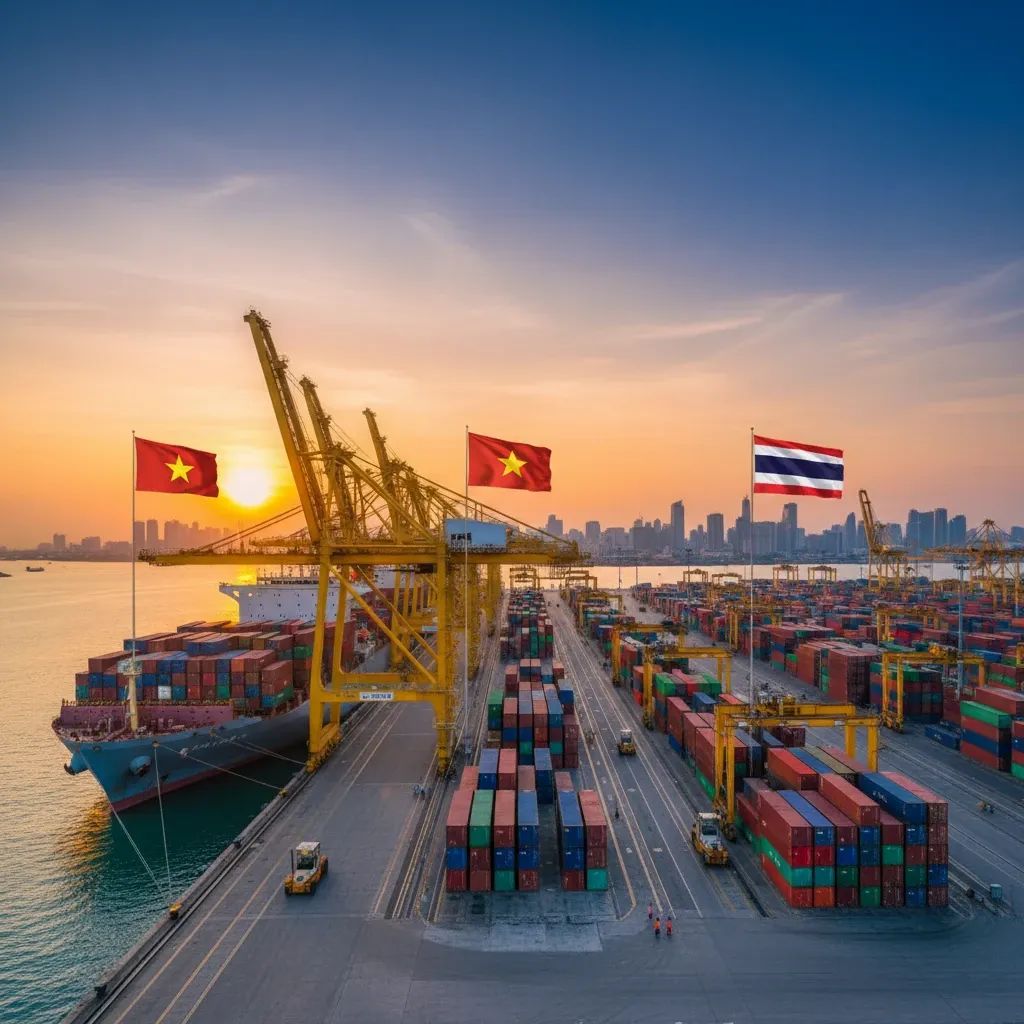
Thailand's industrial land market is cooling after two years of rapid price growth. Roughly 9,000 rai of serviced industrial plots will launch in Q4 2026, concentrated in the Eastern Economic Corridor and central provinces. This wave of new inventory is expected to cap further price spikes and restore equilibrium between developers and manufacturers hunting for affordable space.
Why This Matters
• Price pressure eases: Nationwide serviced industrial land plot (SILP) prices climbed 10% in 2025 and another 4% in the first half of 2026; the new supply should brake that trajectory.
• EEC still hot: Three of the five major projects launching Q4 are inside Chonburi, Rayong, and Chachoengsao—home to automotive, petrochemical, and electronics clusters.
• Affordability window: Mid-sized manufacturers priced out in 2025 may finally find inventory at stable rates, especially in Ayutthaya and Samut Prakan.
The Numbers Behind the Shift
As of mid-2026, the nationwide average for SILPs stood at approximately 8.4 million baht per rai, marking a 7% year-on-year uptick but a far cry from 2025's double-digit surge. Phongphan Phloiphet, director of logistics and industrial at Cushman & Wakefield Thailand, calls it a "price maintenance period"—the natural outcome when inventory floods a tight market. In fact, empty land in Chonburi alone jumped 41.3% year-on-year during the first nine months of 2025, and certain EEC pockets saw 10–15% annual gains between 2023 and 2025. That frenzy stemmed partly from Chinese firms racing to lock in sites under the Board of Investment (BOI) incentive clock and partly from "China-plus-one" supply-chain restructuring accelerated by new US tariff regimes.
The five estates bringing fresh supply are Amata City Chonburi 2 (2,213 rai in Ban Bueng district), Amata City Rayong 2 (1,547 rai in Ban Khai), TFD Industrial Estate 2 (1,240 rai in Bang Pakong, Chachoengsao), Rojana Ayutthaya Phase 10 (2,296 rai), and Araya (1,700 rai in Samut Prakan). Collectively they add approximately 9,000 rai—or about 1,440 hectares—to a market that absorbed more than 5,000 rai in transactions during 2025 alone.
Why the Buying Spree Happened
Two forces collided over the past eighteen months: geopolitical upheaval and domestic policy engineering. Multinational corporations, especially from China and Japan, rushed to diversify manufacturing footprints away from single-country exposure. The phrase "China-plus-one" became shorthand for spreading risk across ASEAN, and Thailand's strategic location, deep-water ports, and EEC infrastructure—including high-speed rail and expanded container terminals—made it a natural beneficiary. Meanwhile, BOI tax holidays and customs breaks sweetened the pitch, and government investment totals for 2025 hit 1.9 trillion baht, with 54% channeled into the EEC.
Add to that the shadow of global energy and logistics shocks—periodic closures and bottlenecks that sent companies scrambling to lock in manufacturing sites early—and the result was a land-grab mentality. Some developers reported vacancy rates for ready-built factories below 5%, signaling that demand was outrunning supply until now.
What This Means for Residents
For foreign investors and expats operating manufacturing subsidiaries or sourcing partnerships in Thailand, the stabilization offers a tactical opening. Land that became prohibitively expensive in prime EEC zones may now plateau, making it feasible to finalize site acquisitions without fear of another 20–30% spike. Domestic SMEs in sectors like food processing, auto parts, and electronics also stand to benefit; the Ayutthaya and Samut Prakan projects sit closer to Bangkok's logistics backbone, cutting transport costs while sidestepping the EEC premium.
For SME owners and decision-makers: The window for site acquisition is now through end-2026. Lock in land commitments before Q1 2027, when demand may reaccelerate. Target projects with established utilities—redundant power feeds and reliable water supply—rather than chasing the lowest per-rai price.
On the flip side, developers and speculative landholders who banked on perpetual appreciation will see margins compress. That should winnow out lower-quality estates and push competition toward value-adds like redundant power grids, industrial-grade water supply, and ESG certifications. Estates with strong sustainability profiles are now commanding tenant premiums—another reason to expect differentiation rather than blanket price growth.
Tenant Calculus: Utilities Over Price
Price is no longer the sole decision variable. Site selectors increasingly audit electricity redundancy—dual grid feeds from separate substations—and water availability, especially for process-heavy industries like petrochemicals and data centers. The latter category has exploded in the past year, with hyperscalers scouting EEC parcels for AI training farms that require multi-megawatt power contracts. Developers who banked land near Map Ta Phut or Laem Chabang and secured utility commitments early are winning bids even at higher per-rai rates.
Logistics connectivity remains king. Estates within a 30-minute truck radius of Laem Chabang Port or U-Tapao Airport retain structural advantages, and the completion of high-speed rail links between Bangkok and Rayong is expected to tighten labor-market integration, making it easier to shuttle skilled technicians and managers.
Macro Outlook: Moderate Growth, Selective Demand
The Thai economy is projected to expand 1.5–2.5% in 2026, a modest but stable trajectory supported by export growth, tourism recovery, and private consumption. That backdrop favors industrial real estate as a relatively defensive asset class, particularly for investors seeking portfolio diversification outside residential condominiums or retail malls. Industrial land transactions offer tangible collateral and, when leased under long-term BOI-promoted projects, enjoy tax shields that boost net returns.
Yet selectivity is paramount. Investors are no longer buying blind; they want BOI promotion certificates in hand, ESG compliance documentation, and clear utility commitments. The days of speculative land flipping in peripheral zones have cooled. Instead, capital is concentrating in data centers, cold-chain logistics for e-commerce, and advanced automotive manufacturing—sub-sectors aligned with Thailand's push into electric vehicles and Industry 4.0.
Regional Rivalry and the Next Cycle
While the EEC dominates headlines, Ayutthaya and Samut Prakan are quietly staging a resurgence. Proximity to Suvarnabhumi Airport and established labor pools make them attractive for electronics assembly and light manufacturing. The Rojana Ayutthaya Phase 10 project, for instance, targets Japanese SMEs seeking proven infrastructure without the EEC price premium. Similarly, Araya in Samut Prakan appeals to e-commerce fulfillment operators who prioritize last-mile access to Bangkok over export-port proximity.
Looking ahead, the pipeline thins. Few developers have announced major projects for 2027, suggesting that if demand holds—and early indicators point to sustained FDI—prices could resume upward movement by mid-2027. This makes the remainder of 2026 a tactical window for buyers who can move quickly and lock in rates before the next supply gap emerges.
Bottom Line
The 9,000-rai supply injection in Q4 2026 is a temporary recalibration, not a market collapse. Prices will stabilize rather than fall, and competition will shift from outbidding rivals to securing the best-located, best-serviced plots. For manufacturers, this is the moment to finalize site selection; for investors, it is a chance to deploy capital at more rational multiples before the next wave of global supply-chain realignment pushes land back into seller's-market territory. Thailand's industrial story remains fundamentally sound, underpinned by government infrastructure spending, BOI incentives, and deepening regional integration—but the easy money phase has ended, and due diligence now separates winners from overpayers.