
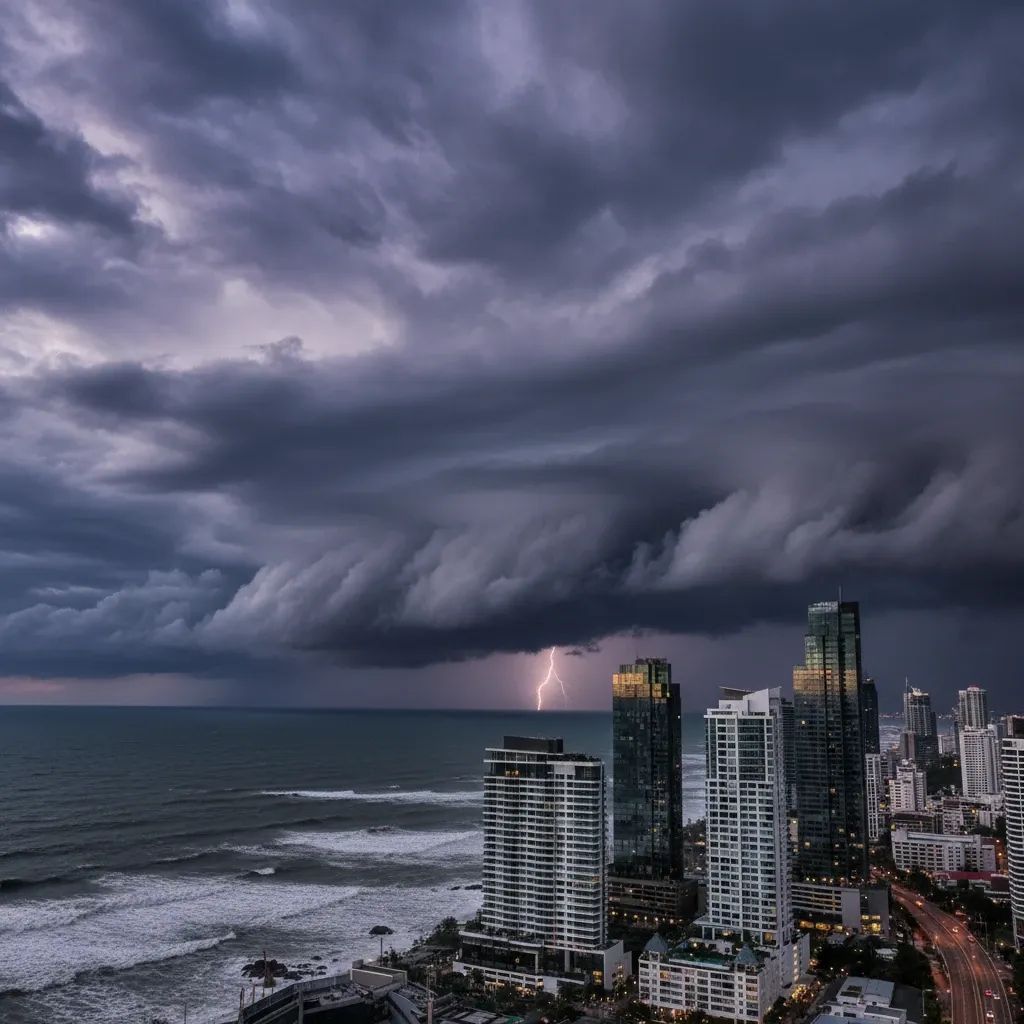
Five days of severe weather sweeps across Thailand starting today—and the timing compounds existing challenges. As families surge home following Songkran celebrations, the Meteorological Department warns of destructive storms that will begin pummeling the Northeast and East before pushing westward toward Bangkok and northern regions. Thunderstorms, hail, and winds exceeding typical seasonal norms coincide with ongoing toxic air pollution, creating a compound crisis that will test emergency response systems already stretched thin.
Why This Matters
• Storm Window: Peak impact occurs April 16–20, with seven provinces at immediate high risk during the first 48 hours as travelers clog highways.
• Agricultural Damage Risk: Fruit orchards in their critical growth phase face potential devastation from hail and violent winds; farmers should reinforce trees immediately.
• Dual Environmental Crisis: Provinces combating PM2.5 haze above safe thresholds must simultaneously activate disaster protocols—a rare coordination challenge.
• Emergency Support: Call the 24-hour disaster hotline 1784 for immediate assistance; checkpoints and service centers operate nationwide.
When and Where: A Five-Day Geographic Sweep
The Thai Meteorological Department issued its fourth official warning Thursday, mapping a predictable but menacing path across upper regions. The storm originates from high-pressure systems pushing down from China, colliding with intense heat already gripping Thailand—conditions that generate severe thunderstorms through unpredictable atmospheric mixing.
The Northeast suffers first. On April 16, Amnat Charoen, Surin, Si Sa Ket, and Ubon Ratchathani face moderate risk, while the eastern seaboard—Rayong, Chanthaburi, Trat—braces for similar conditions. By day two, risk levels spike sharply across expanded zones: Yasothon joins the northeastern high-risk area; the East adds Sa Kaeo, Chachoengsao, and Chonburi to the warning list.
By April 18, nearly the entire Isaan region enters high-risk status, encompassing Mukdahan, Nakhon Ratchasima, and Buriram. Central Thailand responds next: Lopburi, Saraburi, and the Bangkok metropolitan area shift into moderate-risk zones as the system migrates westward. Northern provinces complete the sequence in subsequent days, enduring what meteorologists term a five-day upper country weather event.
Permanent Secretary for Interior Unsit Sampuntharat, coordinating through the National Disaster Prevention and Mitigation Center, has personally instructed provincial governors to activate emergency protocols and maintain continuous weather surveillance. This is not routine seasonal variation—officials acknowledge the intensity exceeds normal parameters.
Agricultural Impacts and Protection Measures
Timing transforms this storm from nuisance into significant concern for Thailand's farming communities. Fruit orchards transitioning from young growth to mature bearing are particularly vulnerable. Coconut palms, mango trees, and other perennials represent months of investment suddenly threatened by hail and unpredictable wind gusts.
The Department of Agricultural Extension recommends immediate, concrete actions:
Prioritize tree reinforcement before winds arrive. Install guy-wire supports for younger fruit trees and prune dense canopy sections to reduce wind resistance. Mature, tall trees benefit from careful topping procedures—lowering the center of gravity prevents catastrophic toppling. Consider establishing living windbreaks using bamboo groves, golden shower trees, or neem—species proven effective across Southeast Asian orchards.
Drainage infrastructure demands urgent attention. Excavate channels to rapidly divert standing water from planting zones. Shape growing beds into subtle "turtle-back" formations—raised centers with sloping edges—to prevent water pooling around sensitive root systems. In rice paddies, reduce standing water to absolute minimums; stressed root systems subjected to prolonged submersion invite fungal diseases and root rot.
Recovery protocols matter equally. Once soil firms sufficiently post-storm, remove snapped branches and toppled timber immediately. For trees that lean but survive, use cables and gentle guidance to restore vertical orientation while pruning approximately one-third of the canopy to reduce metabolic stress during recovery. Apply foliar fertilizers once conditions stabilize, then conduct shallow cultivation to reintroduce oxygen to compacted root zones.
The Thai Meteorological Department specifically warns farmers that rainfall distribution will be unpredictable. Some areas will receive abundant moisture while adjacent non-irrigated zones—already suffering chronic drought—may see minimal precipitation despite the storm system's passage. Water scarcity remains a parallel threat to flood risk, necessitating careful post-storm water harvesting and conservation strategies.
Urban Hazards: Securing the Built Environment
City residents face distinct but equally severe dangers. Flying debris, collapsing billboards, failing utility poles, and toppled roadside trees transform familiar urban landscapes into hazard zones during peak wind events.
The Ministry of Interior has mandated rapid structural audits across municipalities. Building inspectors must prioritize construction sites with inadequate temporary bracing, aging commercial signage, and compromise architectural elements—anything likely to become a lethal projectile. Loose outdoor furnishings, potted plants, and unsecured items can cause injuries or property damage during violent gusts.
Official guidance emphasizes avoidance: stay indoors during active storm periods, away from open areas, large trees, unstable structures, and advertising displays. Lightning poses additional hazard; exposed locations concentrate electrical risk. Schools and government offices have begun reviewing shelter capacity and communication protocols to manage potential injuries from wind-driven debris or electrical strikes.
The Haze Burden: Dual Environmental Threats
While thunderstorms temporarily suppress airborne particulates through precipitation and wind mixing, Thailand's northern and northeastern regions continue grappling with dangerous PM2.5 pollution levels that have persisted since the traditional burning season commenced.
This creates a complex dual mandate for provincial authorities. Simultaneously managing storm response and ongoing air quality crisis depletes resources and attention. Current mitigation efforts include strict agricultural burn bans, enforcement operations against illegal fire-setting, and coordinated aerial and ground firefighting campaigns. Selected provinces have deployed cloud-seeding aircraft to artificially induce rainfall in fire-prone zones, though effectiveness varies with atmospheric moisture availability.
The convergence of extreme heat, toxic air, and violent weather presents compounding public health hazards. Respiratory patients, elderly residents, and young children face particular vulnerability. Medical facilities have increased bed capacity for heat illness, respiratory distress, and trauma cases from storm-related injuries. Some provincial hospitals are pre-positioning additional oxygen supplies and anti-inflammatory medications in anticipation of surge demand.
International precedent suggests cities elsewhere have successfully integrated climate resilience with air quality improvement. Green infrastructure networks—parks, rooftop gardens, urban forests—simultaneously absorb carbon pollutants, reduce urban heat island effects, and manage stormwater runoff, addressing multiple crises through unified planning. Thailand's rapid urbanization makes such approaches increasingly relevant for long-term environmental stability, though implementation requires sustained political commitment and capital investment often constrained during crisis management phases.
Post-Holiday Travel Collision: Safety on Saturated Roads
The storm warning arrives precisely when Thailand's transportation network experiences peak stress. Millions of residents traverse highways between urban employment centers and rural hometowns following Songkran, creating ideal conditions for cascade failures—accidents blocking lanes, rendering roads impassable until debris clearance occurs.
The Ministry of Interior has established 24-hour service points and safety checkpoints nationwide, though enforcement resources are stretched across competing priorities. Traffic safety campaigns continue emphasizing familiar directives: avoid alcohol-impaired driving, maintain adequate rest intervals, observe posted speed limits. Storm conditions compound these challenges with reduced visibility, slick road surfaces, and unexpected obstacles—fallen trees, flooding, debris fields—that drivers cannot anticipate.
Provincial disaster response teams pre-positioned heavy equipment, trained personnel, and medical supplies at strategic geographic locations for rapid deployment when incidents occur. Response time remains the critical variable in remote areas with limited infrastructure and sparse emergency services. Coordination failures between district and provincial authorities have historically delayed assistance—a known vulnerability that officials acknowledge but struggle to resolve consistently.
Broader Climate Pattern Implications
This storm event reflects Thailand's increasingly volatile seasonal transitions. While summer convective storms are annual occurrences, their intensity and geographic scope appear to be intensifying as regional atmospheric dynamics shift. The interaction between cold continental systems descending from China and extreme heat accumulation over mainland Southeast Asia creates conditions for severe weather development.
Current meteorological data shows upper Thailand temperatures reaching 39–41°C before storm fronts arrive—establishing the thermal gradient necessary for violent atmospheric mixing. These temperature extremes stress power grids, water supply systems, and public health infrastructure even before precipitation events commence, often reducing overall system resilience precisely when demand peaks.
Rainfall distribution during such storms exhibits dramatic microclimate variation, creating localized flooding in topographically vulnerable areas while adjacent regions receive minimal precipitation. This unpredictability complicates agricultural water planning for non-irrigated farmers—those already struggling with persistent drought may see insufficient moisture despite the storm system's passage through their province. Water management agencies cannot provide reliable guidance until storm tracks clarify, leaving farmers in position of making rapid decisions with incomplete information.
The Thai Meteorological Department expects rainfall intensity to decline significantly after April 20, though scattered thunderstorms will persist through the traditional monsoon transition period into early May. Residents should maintain active monitoring of official weather updates through government channels and established local media sources as conditions evolve hour by hour.
Coordinated Response Infrastructure
The National Disaster Prevention and Mitigation Center, operating under Unsit Sampuntharat's direct oversight, has activated integrated command structures. Police traffic enforcement units coordinate with highway maintenance crews to clear debris and manage congestion. Electrical utility companies have staged repair crews along vulnerable transmission corridors. Water management authorities prepare for potential flood conditions and contamination scenarios requiring supply interruptions.
Urban fire departments in affected provinces have shifted from routine scheduling to continuous operations, pre-positioning equipment to respond to electrical fires, structural collapses, or rescue situations in accessible time windows. Coordination across these multiple agencies depends on communication systems that have themselves proven vulnerable during previous severe weather events—a persistent institutional weakness acknowledging but not yet resolved.
Medical coordination is particularly critical. Hospitals have established surge capacity protocols, activated emergency department staffing for extended hours, and arranged patient transfers to less-affected facilities if local capacity becomes overwhelmed. Emergency medicine specialists recognize that storm-related trauma will likely coincide with heat-stress presentations and respiratory exacerbations, creating complex triage scenarios with limited resources.
Provincial authorities emphasize that disaster assistance infrastructure remains operational around the clock. Anyone requiring emergency help, reporting hazardous conditions, or seeking official guidance can contact the national disaster hotline at 1784 for immediate connection to appropriate response teams. This centralized number allows rapid routing to specialized resources—medical dispatch, road rescue, shelter services—based on specific incident circumstances. During previous major weather events, however, call volumes have exceeded capacity during peak crisis windows, creating delays that residents should anticipate.
Thailand faces a compressed crisis window demanding coordination across environmental hazards, transportation safety, agricultural protection, and public health. The next five days will test whether integrated planning translates into effective implementation when systems face genuine stress.


