
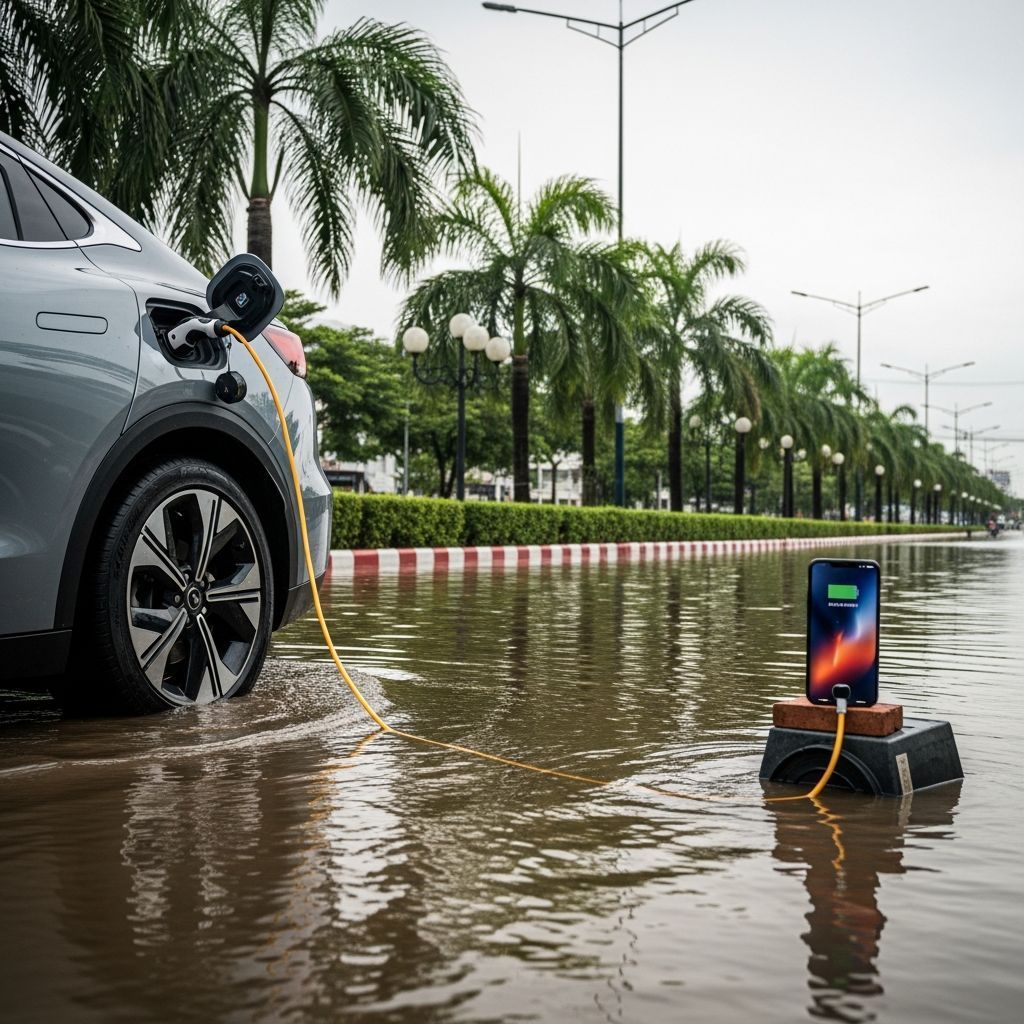
The Thailand Electricity Generating Authority (EGAT) is racing to add 110 new EV charging outlets across the country, a move that underscores the widening gap between the nation's surging electric vehicle sales and the power grid's ability to keep pace. Thailand's EV market share jumped from 1% in 2019 to over 20% by October 2025, yet the fossil-fuel-heavy grid means most drivers are simply swapping tailpipe emissions for coal-fired charging—a reality that extends across much of Southeast Asia.
Why This Matters:
• Grid stress is real: Urban electricity networks risk overload during peak hours as EV adoption concentrates in cities like Bangkok, Hanoi, and Jakarta.
• Charging infrastructure lags: Despite a ninefold increase in charging stations from 2022 to 2024, the ratio of vehicles to chargers remains critically unbalanced—15:1 in Indonesia alone.
• Your electricity bill could rise: The strain on grids, combined with billions in required infrastructure investment, may translate to higher energy costs for residents.
• Range anxiety persists: Charging networks remain concentrated in major urban centers, leaving rural and intercity routes underserved.
The Numbers Behind the Surge
Vietnam nearly doubled its EV market share in a single year, reaching close to 40% of new car sales in 2025—surpassing both the UK and EU. Indonesia hit 15%, topping the United States for the first time. Singapore and Vietnam now claim higher EV penetration rates than most Western European nations. Across Southeast Asia, more than a quarter of new vehicles sold in 2025 carried a plug, a pace driven largely by aggressive government incentives, domestic manufacturing ambitions, and relatively affordable Chinese-made models.
Yet the infrastructure required to power this fleet remains years behind. Thailand's grid is approximately 85% fossil-based, meaning each electric vehicle charged today delivers only a modest 14% reduction in environmental costs compared to conventional cars. The shift is less about eliminating emissions and more about relocating them from the road to the power plant.
What This Means for Residents
If you own an EV or are considering one, the implications are immediate. Thailand had 3,720 charging stations by March 2025, offering 11,622 connectors, including over 6,000 fast chargers. That sounds robust until you compare it to the growth in vehicle registrations, which has outpaced charger deployment by a significant margin. The government now targets 5,000 stations by 2028, but even that expansion may fall short if sales continue at current rates.
In Vietnam, the landscape is dominated by VinFast's V-Green network, which operates 150,000 charging ports across all 63 provinces. The problem? Most are proprietary, accessible only to VinFast owners, effectively locking out international brands and creating a walled garden that has prompted calls for government-mandated universal charging standards by 2027. For expats driving a Tesla or BYD, this means limited options outside private or workplace charging.
Indonesia faces the starkest challenge. The government projects a need for at least 25,364 DC fast chargers and 298,400 Level 2 charging ports by 2030 to support an estimated 7.46 million EVs. As of now, the country has fewer than 5,000 public stations, and the ratio of 15 EVs per public charger creates widespread "range anxiety." Most infrastructure is concentrated in Java, leaving drivers in outlying regions with few alternatives.
Grid Capacity: The Invisible Bottleneck
The deeper issue is not the number of plugs but the wires behind them. An International Energy Agency (IEA) study in early 2026 warned that additional charging loads in urban centers could exceed existing distribution network capacity, particularly during evening peak hours when commuters return home and plug in simultaneously. Energy think tank Ember corroborated this, describing transmission infrastructure across the region as "slow and uneven," causing bottlenecks that delay the integration of renewable energy projects.
Vietnam's grid is plagued by chronic curtailment crises, with output reductions exceeding 50% in some northern industrial regions during summer months. Accelerating EV adoption could require grid investment as much as 28% above current high-growth projections by 2030, according to regional energy analysts. The country's Power Development Plan VIII (PDP8) anticipates electricity demand growth of around 12% per year through 2030, a pace that risks overwhelming the existing infrastructure.
Indonesia's Electricity Supply Business Plan (RUPTL) for 2025–2034 calls for an average annual transmission investment of $2.4 billion, yet realized investment has averaged only $1.4 billion annually since 2019. This structural financing gap constrains both growth and the deployment of renewable energy, leaving the grid vulnerable to spikes in demand from EVs and the region's rapidly expanding data center sector, which is projected to double electricity consumption by 2030.
Charging Network Hurdles
Beyond capacity, bureaucratic and technical barriers slow deployment. In Thailand, the absence of standardized regulations across municipalities complicates station construction, and the coexistence of multiple charging standards—CCS, CHAdeMO, and GB/T—creates compatibility headaches for drivers and operators alike. High upfront capital costs and lengthy certification processes deter private investment, particularly in rural areas where profitability remains uncertain.
Indonesia faces similar red tape. Obtaining licenses for individual charging stations can be as complex as permitting a major power plant, discouraging smaller operators. The expiration of most fiscal EV incentives at the end of 2025 has introduced uncertainty, and the market may slow in 2026 without a new support framework. Coordination between the state utility PT PLN, local governments, and private charging operators remains fragmented, hindering cohesive network growth.
In Vietnam, urban planning for charging stations, parking facilities, and battery-swapping points in residential areas remains limited and inconsistent. Many apartment complexes lack adequate wiring or transformer capacity to support high-powered chargers, raising fire safety concerns and placing strain on internal power systems. The Ministry of Construction has been tasked with finalizing urban planning standards to integrate green transport infrastructure by the second quarter of 2026, but implementation timelines remain unclear.
What Governments Are Doing
Despite the challenges, investment is flowing. Total energy transition funding in Southeast Asia reached $1.8 billion recently, with $1.2 billion allocated to solar projects and $600 million to EV initiatives. Indonesia aims to develop up to 100 GW of solar capacity within two years from March 2026 and is planning substantial Battery Energy Storage System (BESS) deployments. Vietnam targets up to 16.3 GW of BESS by 2030 and aims for renewables to power over 30% of the nation by 2030 under PDP8.
Thailand's Smart Grid Development Action Plan for 2022-2026 focuses on essential infrastructure, effective resource management, and readiness for high EV penetration, including smart charging and Vehicle-to-Grid (V2G) technology. EGAT plans to develop over 45,000 MWh of energy storage capacity by 2037, comprising 20,000 MWh from pumped storage hydro and 25,000 MWh from battery storage. The utility aims to boost renewable energy's share to 51% by 2037 and is investing in grid-scale batteries and AI-powered forecasting centers to manage fluctuations.
The ASEAN Power Grid (APG), a long-standing initiative to link all member states into a single integrated system by 2045, is advancing slowly. The Malaysia-Singapore corridor doubled its interconnection capacity to 1,050 MW in 2025, and the Laos-Thailand-Malaysia-Singapore Power Integration Project (LTMS-PIP) launched Phase 2 in early 2026, expanding capacity to 200 MW. Sub-regional pilot projects for multilateral power trade are planned for 2026 and beyond, aiming to strengthen energy security and create a more stable power market.
The Vehicle-to-Grid Promise
One emerging solution is V2G technology, which allows EVs to return power to the grid during peak demand, effectively transforming parked vehicles into distributed energy storage. Thailand is piloting this approach, and utilities are showing interest in demand-response procurement as EV penetration rises. If scaled successfully, V2G could help flatten peak loads and integrate intermittent renewable energy sources, reducing the need for costly grid upgrades.
However, V2G requires bidirectional chargers, compatible vehicles, and regulatory frameworks that compensate owners for the electricity they supply. China, the global EV leader, is trialing V2G in nine pilot cities, and Europe is incentivizing smart and bidirectional charging through EU-wide communication standards. Southeast Asia is behind on all fronts, though the potential remains significant if governments can coordinate technical standards and pricing mechanisms.
Comparing Regional Approaches
China is leveraging its massive EV adoption to pilot advanced Vehicle-Grid Integration (VGI) solutions and nationwide V2G programs, allowing EVs with bidirectional batteries to sell stored electricity back to the grid. Action plans from 2024-2025 target distribution grid upgrades for distributed PV and EV integration, virtual power plants, and large-scale energy storage. The country's proactive stance reflects both its manufacturing dominance and its need to manage peak loads in a rapidly electrifying economy.
Europe, with its advanced energy transition goals, is focusing on sophisticated grid optimization, smart charging, and policy frameworks that treat EVs as flexible assets for grid stability and renewable energy absorption. Software-first approaches leverage direct integration with vehicle APIs to optimize charging schedules dynamically and aggregate distributed load without requiring new hardware, offering faster scalability and cross-brand interoperability. Streamlined permitting procedures and transparent grid capacity data are accelerating investment in charging infrastructure.
Southeast Asia, by contrast, is still building foundational infrastructure while grappling with existing grid limitations. The region's rapid EV adoption has outpaced its ability to modernize transmission networks, and coordination between state utilities, local governments, and private operators remains inconsistent. Regulatory fragmentation, high capital costs, and the absence of universal charging standards continue to slow progress.
The Path Forward
For residents, the message is clear: Southeast Asia's EV boom is real, but the infrastructure to support it is catching up slowly. If you live in a major city like Bangkok, Singapore, or Jakarta, charging access is improving, though peak-hour grid strain may become more frequent. If you're in a rural or secondary urban area, expect limited fast-charging options and longer wait times as networks expand.
The Thailand Revenue Department and other agencies are under pressure to extend tax incentives and subsidies to keep momentum alive, but fiscal realities and the need for grid investment may limit the generosity of future support. The Thailand Board of Investment (BOI) is offering 8-year corporate income tax exemptions for smart grid infrastructure investments, signaling governmental recognition of the urgency.
Energy costs are likely to rise as utilities pass on the expense of transmission upgrades and renewable energy integration. Residents should monitor electricity tariffs closely and consider time-of-use pricing plans if available, which can reduce charging costs by shifting usage to off-peak hours. The coming years will test whether Southeast Asia can transform its grids fast enough to match its ambitions on the road.


