
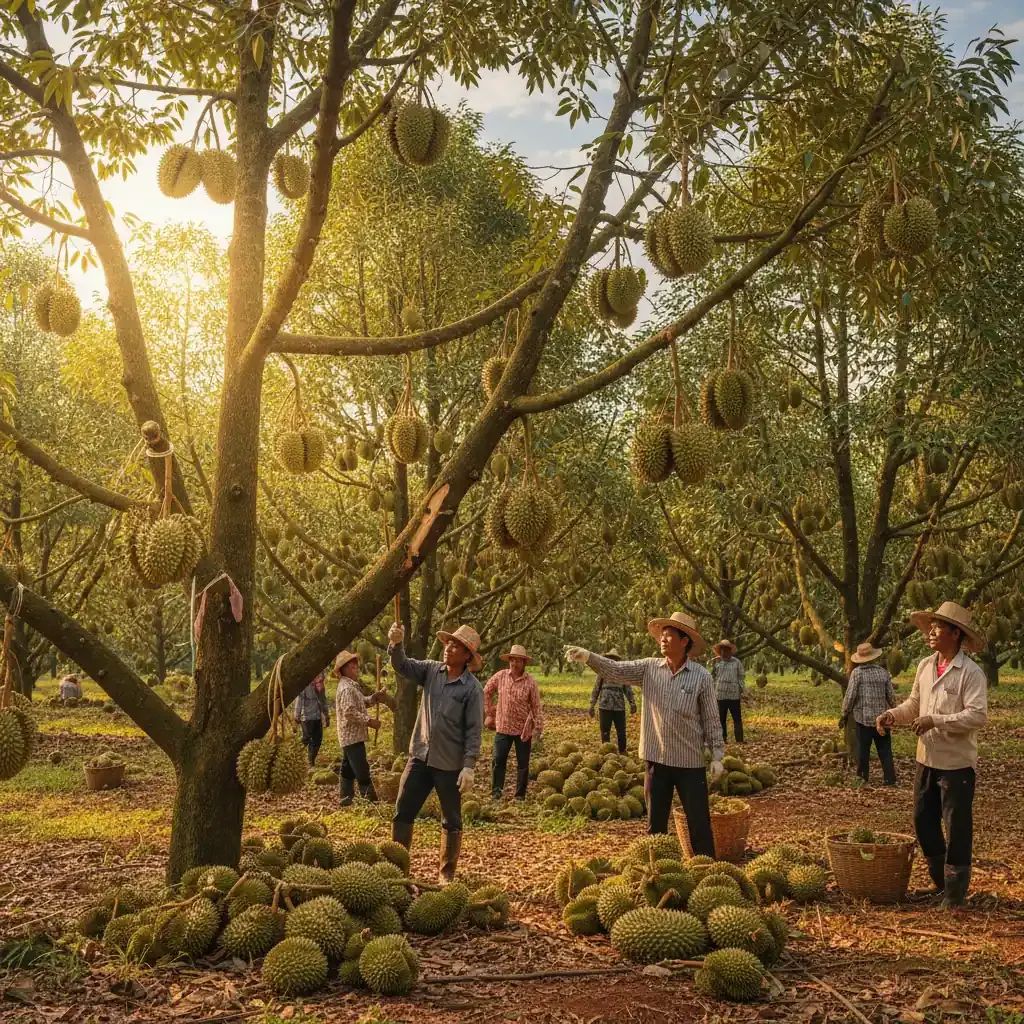
Thailand is about to harvest 2.07 million tonnes of durians—33% more than last year. That's great news for fruit lovers who'll find ฿100 durians everywhere. But for growers? It could be a financial disaster.
Why This Matters
• Durian farmers face squeezed profits: The massive harvest will stress Thailand's ability to store, ship, and sell durians before they spoil. If overseas sales slow down, growers could find themselves selling below production costs.
• The ฿100 promotion targets "ugly but delicious" durians: These are the cosmetically flawed fruits that would normally get wasted. They taste just fine, but they're smaller and oddly-shaped. The government is trying to create a domestic market for them.
• Premium export durians still fetch ฿140-150/kg—for now: The best grades heading overseas maintain their value, at least temporarily. But supply chain strain could destabilize this if not managed carefully.
• Vietnam is stealing Thailand's durian sales: Vietnam's market share in China jumped from nearly nothing in 2020 to 35% by 2025. Cambodia, Laos, the Philippines, and Malaysia are also competing aggressively. This means fewer export opportunities for Thai growers when the harvest surges.
When Abundance Becomes a Problem
Thailand's durian belt—from the eastern plateau down through the southern provinces—is entering 2026 with genuine uncertainty. The Agriculture Ministry and Commerce Ministry are forecasting that the eastern region alone will produce around 1 million tonnes. For farmers used to carefully managing their harvests and commanding premium prices, this volume shift is disorienting.
The anxiety is real at the farm level. Production costs keep climbing: fertilizer prices remain high, hired labor now costs ฿500–600 per day during peak harvest season, and diesel for machinery keeps eating into profits. Experienced growers quietly calculate that they need at least ฿120/kg just to break even—a price that's unlikely to hold when the market is flooded.
What makes 2026 different isn't just the volume—it's the timing crunch. Most durians ripen in May. That concentrated harvest forces farmers into tough decisions fast: hold fruit in inadequate storage (a luxury few have), rush stock to middlemen at disaster prices, or gamble on new sales channels like livestream commerce that the government is hastily setting up.
Pimrypie: Celebrity Influencer as Economic Problem-Solver
The Commerce Ministry's alliance with Pimrypie—the TikTok entrepreneur and livestream sales star—shows how desperate the government has become to manage this crisis. She commands a real operation: logistics networks, registered food and cosmetic subsidiaries, and warehouses employing over 2,000 people. She can actually absorb and redistribute massive volumes quickly.
Her track record is solid. Her mystery-box livestream auctions have generated ฿100 million in sales within minutes, tapping into how Thai consumers love discovery and urgency. When she announced the ฿100-per-fruit durian campaign, it didn't feel like a discount—it felt like an event. Suddenly, secondary-grade fruit became a "bargain opportunity" rather than second-rate goods.
But this partnership isn't without risk. Consumer advocacy groups have previously flagged counterfeit merchandise problems tied to Pimrypie's ecosystem, and recent complaints documented fake social-media pages harvesting deposits under her name without delivering orders. Her team has since emphasized traceability and direct orchard sourcing to rebuild trust. The ministry's close monitoring—publicly committing to real-time quality checks given the media attention—partially hedges this reputation concern.
Deputy Prime Minister Suphajee Suthumpun addressed concerns at a press briefing, clarifying that the government isn't directly endorsing the ฿100 pricing as standard. She called it a "sales-promotion technique" and stressed that secondary-grade stock—smaller, ripened further, cosmetically irregular—still tastes good and is fine for home consumption.
How Secondary-Grade Durians Fit Into the Market
The Commerce Ministry is earmarking approximately 450,000 tonnes for domestic sale through wet markets (which typically move about 38,000 tonnes annually at places like Bangkok Four Corners Market), hypermarkets, Thai Post outlets, and digital channels. This one-fifth of projected output represents a major expansion from what Thailand normally sells domestically—essentially a pressure valve for fruit that won't pass export inspections.
Here's how Thai durian classification works. Grade A and B stock—uniform shape, perfect ripeness, thick flesh, high starch content—sells for ฿140–150/kg and goes into refrigerated containers destined for China, South Korea, and other Asian buyers. Grade C and "secondary" classifications—smaller, late-harvested, cosmetically imperfect but still tasty—historically sold domestically at ฿80–100/kg or got processed into frozen pulp and ice cream.
The ฿100-per-fruit promotion (note: per fruit, not per kilogram) targets this lower tier. A secondary-grade durian weighs about 1.2–1.5 kg, so per-unit pricing effectively means ฿67–83/kg. That's steep discount from fresh-market prices, but it gives growers enough incentive to separate this stock and channel it through Pimrypie's system instead of abandoning it or selling it to brokers at rock-bottom prices.
This stratification protects premium grades, the ministry argues. If secondary fruit absorbs domestic volume, export-grade production avoids the downward price spiral that comes from overall market glut. But critics—including opposition lawmakers—worry the messaging undermines confidence. Past scandals involving immature durians rushed to market have scarred Thailand's reputation with Chinese import inspectors, who enforce strict limits for cadmium and Basic Yellow 2 (BY2) residues. Any perception of weakened quality standards could trigger Chinese retaliation that disrupts premium export pipelines.
Vietnam and Regional Rivals Are Eating Thailand's Lunch
The real pressure driving this domestic strategy is structural. Vietnamese durian acreage has doubled since 2020. Vietnamese growers have shorter shipping distances into southern China and lower wage costs. Thailand's market share in China dropped from 100% in 2020 to 64% by 2025—Vietnam now captures about 35%. The Philippines, Malaysia, Cambodia, and Laos are all expanding acreage aimed at the same Chinese buyers.
The Commerce Ministry acknowledges the shift but defends Thailand's position: the country has more durian varieties (Monthong, Kanyao, Chanee), better cold-chain infrastructure, and stronger premium branding. But those advantages only hold if quality standards stay tight. To enforce this, the ministry has piloted protocols in the eastern region requiring minimum 32% starch content before harvest (a ripeness measure) and GPS-tagged shipments so problems can be traced if quality complaints surface after delivery.
But execution is messy. Refrigerated containers are scarce during May peak season, and border crossings can get backed up for days when volume floods through. The ministry has coordinated with freight operators to pre-position equipment and lobbied for expedited clearance for perishables. Still, some orchards report 10–20% increases in logistics costs tied to diesel prices—squeezing already-thin margins, especially on lower-grade sales.
Processing and Cold Storage as a Long-Term Fix
To handle overflow and extend the season beyond three months, the Commerce Ministry and the Ministry of Agriculture are investing in cold storage, blast-freezing, and downstream product development. Frozen durian segments, ready-to-eat paste, cosmetic extracts, and pulp for industrial uses could turn what would be waste into inventory with real value.
The government is reviving the Chanthaburi Integrated Fruit Hub—a consolidation project that would co-locate sorting, cold chain, and processing in Thailand's durian heartland. According to Kasikorn Research Center estimates, average farmgate prices will probably land near ฿90/kg across all grades in 2026—down from triple-digit levels in better years. But if processing capacity works as planned, it could lift blended returns by capturing value from stock that would otherwise be discarded. Year-round absorption becomes critical if secondary sales channels don't clear domestic inventory.
Labor Shortages Add Hidden Strain
Even with more outlets for durian, the sheer harvest volume creates bottlenecks. Refrigerated logistics are pinched, border congestion persists, and labor scarcity is a real problem. Harvest and grading crews are traditionally staffed by Cambodian migrant workers, but visa delays and compliance barriers are complicating recruitment. Orchards are training domestic workforces instead—a slower, more expensive pivot that adds overhead to an already-stressed operation.
Some estates report difficulty finding enough harvest labor during May's peak weeks, forcing them to accept lower-quality fruit or leave ripe durians unharvested. This inefficiency essentially converts sellable stock into waste, further compressing margins on whatever does sell.
Export Targets and Betting on Secondary Chinese Markets
Despite headwinds, the Commerce Ministry has set an ambitious goal: 1 million tonnes exported in 2026, with a 10% value premium compared to last year. This assumes robust China demand and successful penetration of secondary markets (India, Russia, South Korea) through tourism-driven awareness and trade delegation visits.
To ease congestion at traditional border crossings and reduce dependence on refrigerated trucking, authorities are promoting rail freight corridors into western China. Faster transit, lower spoilage, and reduced fuel costs could make Thai durians economically viable for second- and third-tier Chinese cities—a crucial offset if first-tier markets saturate.
The Commerce Ministry has also stationed "frontline teams" in China to expedite clearance, negotiate buyer relationships, and troubleshoot supply-chain problems in real-time. This on-the-ground presence reflects acknowledgment that volume and price stability now depend on seamless export logistics, not domestic sales alone.
Grower Worries: The Real Fear Beneath Official Optimism
Behind the government's confident messaging lies genuine farmgate skepticism. Growers understand the ministry's months-in-advance planning, but they worry that ฿100-per-fruit pricing might anchor consumer expectations permanently. If buyers get used to ฿100 durians, will they pay normal prices when supply returns to normal in future seasons? Growers fear they won't—leaving them unable to cover costs.
Additionally, some producers question whether secondary-grade channels actually solve the problem or just delay it. If processing capacity remains insufficient to convert surplus into shelf-stable products, the domestic promotion might create a temporary outlet that vanishes when Pimrypie's campaign ends, leaving late-season growers stranded.
The eastern region—which accounts for 48% of national production—faces extra pressure. Small-holder growers here rely heavily on broker networks and wet markets rather than direct export channels. They lack leverage to negotiate with influencer platforms and remain underrepresented in the new domestic commerce infrastructure.
Climate Risk: El Niño Looming
El Niño conditions forecast for the latter half of 2026 add another uncertainty layer. Heat stress and water shortages in rain-fed orchards could crimp yields in subsequent seasons, paradoxically worsening the boom-bust cycle. The Ministry of Agriculture has coordinated irrigation scheduling and reservoir releases to buffer the current glut against future drought, but execution across fragmented orchard landscapes remains uneven.
This long-term vulnerability—mixing commodity-cycle volatility with climate pressure—explains why government intervention focuses on diversifying sales channels rather than price support alone. Spreading demand across livestream, retail, processing, and multiple export tiers reduces the damage if any single market collapses.
What This Means for Thai Residents
For most Thai households, the ฿100-per-fruit campaign translates into unprecedented access to durian at bargain prices. Quality remains debatable—secondary-grade fruit may taste identical to premium stock but comes with cosmetic irregularities and inconsistent ripeness. Smart shoppers will check firmness and aroma before buying.
For growers, the campaign offers a pressure release but not salvation. Success hinges on whether Pimrypie's logistics can absorb promised volumes, whether export corridors clear bottlenecks, and whether processors scale up to extend markets for lower-grade fruit beyond the May rush. If any part fails, growers face the nightmare scenario: a return to distressed pricing and margin collapse.
For the Commerce Ministry, this coordinated push represents a calculated risk: accept moderate short-term discounting and domestic absorption to prevent a deflationary catastrophe that would devastate the sector far worse. Whether this gamble stabilizes 2026 or just stages the next crisis depends on supply discipline in neighboring countries, Chinese consumer appetite in secondary cities, and logistics coordination that has historically been chaotic in Thailand.
The uncomfortable reality is this: Thai durian is shifting from a scarcity-driven premium product to a volume commodity. How well the sector navigates this transition—balancing grower survival, consumer access, and international competitiveness—will determine whether Thailand remains the world's durian king or becomes just another regional supplier.


