
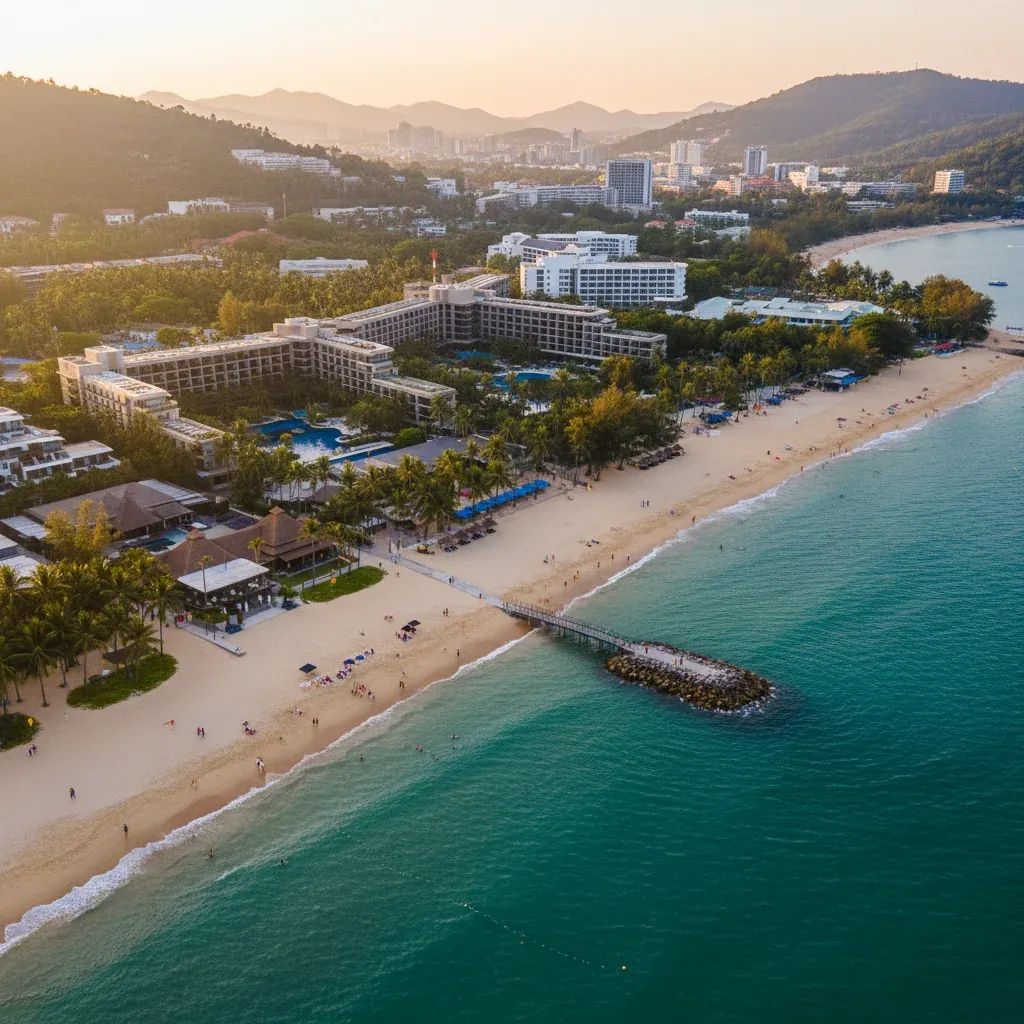
Foreign arrivals through late February have pushed Thailand's tourism receipts to nearly ฿293 billion, yet the distribution of that wealth reveals a starkly uneven landscape where coastal resort cities absorb the majority while inland provinces and secondary hubs struggle for meaningful spillover.
Why This Matters
• Geographic concentration: Nearly 60% of tourism spending concentrates in Bangkok, Phuket, and Pattaya—a pattern that inflates national averages while leaving provincial operators in secondary destinations facing thin margins.
• Entry mechanics shift: Starting in 2026, all foreign travelers must pre-register via the Thailand Digital Arrival Card (TDAC) system up to 72 hours before entry, replacing the ad-hoc paper form. This affects both booking patterns and checkpoint efficiency.
• Spending quality diverges by market: A Malaysian day-tripper at the Sadao border checkpoint contributes ฿2,000 to local commerce; a Russian retiree renting a monthly apartment generates months of economic circulation. Both register identically in official tallies.
The Half-Year Snapshot: Numbers That Hide Texture
Through February 22, 2026, Thailand Immigration recorded 5.947 million foreign arrivals generating approximately ฿293.1 billion in documented spending—placing the nation on track for its government-announced 36.7M visitors and ฿3 trillion target by year-end. The top five origin markets reflect predictable patterns: China contributed 969,505 travelers, Malaysia 573,323, Russia 457,250, India 376,738, and South Korea 283,623.
During the most recent complete week (February 16–22), arrivals totaled 879,587—a technically flat result, declining just 0.34% from the prior week. However, this aggregate obscures sharp divergences. Malaysian traffic accelerated 33% to reach 111,581 visitors, driven by school holidays in both countries. Russian bookings rose 7.57% on similar seasonal factors. Meanwhile, Chinese numbers moderated after the post–Lunar New Year travel surge, yet still maintained a weekly baseline exceeding 200,000 arrivals—testimony to that market's structural importance.
Airin Phanrit, Deputy Spokesperson for the Thailand Prime Minister's Office, attributed this equilibrium to three coordinated levers: the "Trusted Thailand" branding campaign emphasizing destination safety, the new TDAC digital pre-arrival registration protocol, and expanded airline capacity from China Eastern, Air Asia, and regional carriers. Officials additionally noted a behavioral inflection among Chinese travelers, who increasingly favor Southeast Asian alternatives over Japan, citing currency headwinds and visa-application friction affecting the latter destination.
The Ground-Level Disconnect: What Prosperity Actually Looks Like
Pattaya—the coastal service hub anchoring Chonburi Province—epitomizes the tension between macro statistics and lived experience. Foreign residents, bar proprietors, restaurateurs, and hospitality staff there describe rhythms of episodic business: sudden customer rushes followed by prolonged quietude, certain hours thriving while others remain desolate, organized tour circuits profitable while adjacent streets languish.
This skepticism reflects hard memory. The COVID-19 pandemic obliterated decades of accumulated savings, closed businesses permanently, and left surviving operators saddled with lingering debt obligations. For these entrepreneurs, "recovery" is not an annual revenue projection or a quarterly government briefing—it is the accumulation of profitable weeks, honored advance reservations, and suppliers accepting payment on schedule. A ฿293 billion national aggregate cannot be deposited into a restaurant till.
The operational friction remains tangible. Large Chinese charter groups arrive on dedicated coaches, consume meals at operator-designated establishments, follow itineraries choreographed by overseas logistics firms, and depart the same calendar day. Their presence swells weekly arrival counts but delivers negligible benefit to family-run establishments beyond formal tour circuits. When officials cite 879,587 weekly foreign entries, independent proprietors reasonably ask: "How many of those customers walked through my door? How many returned?"
Compounding this skepticism is a procedural reality: the shift to Thailand Digital Arrival Card pre-registration may expedite immigration queues, yet it introduces a new friction layer. Tech-literate travelers and affluent digital nomads navigate the system readily. Older visitors, those from markets with limited smartphone penetration, and individuals unfamiliar with Thai-language government portals face heightened complexity. A single system crash or formatting rejection can cascade into missed flights or border delays—precisely the friction point the initiative intended to eliminate.
Infrastructure Investment, Unequal Returns
Thailand's three-tier tourism hierarchy operates with stark clarity. Bangkok functions as the primary international gateway and commercial nerve center, channeling both foreign currency and domestic capital flows. Phuket has emerged as the archipelago's premium positioning—aggressively constructing 4,700 units of branded luxury residences and over 5,200 high-end hotel rooms through 2029, expanding airport capacity to 18M annual passengers, and securing hosting rights for marquee global conferences including the Global Sustainable Tourism Conference (GSTC), the InterPride General Meeting & World Conference, and the Global Wellness Summit (GWS)—collectively anticipated to inject ฿351 million into the provincial economy and draw thousands of high-spending delegates.
Pattaya has undertaken incremental upgrades: deploying 2,500-plus AI-enabled surveillance cameras, burying overhead power lines, reorganizing Bali Hai Pier, and implementing digital service platforms. Yet infrastructure improvements alone cannot overcome fundamental market positioning. Phuket captures affluent wellness tourists, medical travelers, and convention delegates—segments with elevated per-diem spending and extended stays. Pattaya attracts a heterogeneous clientele skewing toward package tourism, domestic weekenders, and expatriate retirees with more constrained budgets and shorter stays.
Secondary destinations—Chiang Rai, Nakhon Ratchasima, Udon Thani—command a sliver of the national tourism economy despite Thailand Tourism Authority (TA) promotional initiatives. Without targeted interventions—tax incentives for businesses in underserved provinces, subsidized transport corridors, tiered visa privileges for visitors venturing beyond the capital and beach resorts—investment capital gravitates toward existing infrastructure concentrations, brand recognition, and international marketing reach.
The Spend Divergence: One Arrival, Many Outcomes
Official data indicates foreign travelers average approximately ฿48,235 to ฿54,496 in spending per visit—the equivalent of a month's modest apartment rental in Bangkok or Chiang Mai. This aggregate, however, masks dramatic variance across origin markets and traveler demographics.
A Israeli national on 60-day visa exemption might spend ฿150,000–฿200,000 across two months, renting accommodation, engaging domestic staff, dining at mid-range establishments, and purchasing services. A Malaysian border-crossing shopper spends ฿2,000 in a single afternoon on fuel, perfume, and duty-free goods before returning home. A Chinese medical tourist spending ฿500,000 on cosmetic procedures benefits hospitals and clinics acutely, yet may avoid independent restaurants and retail shops entirely. All register equally in visitor tallies, distorting perceptions of spending distribution.
The Thailand Tourism Authority has publicly embraced a "Value over Volume" doctrine for 2026, explicitly targeting high-net-worth individuals, medical travelers, and digital nomads—cohorts whose daily expenditure substantially exceeds mass-market backpackers or charter-group participants. Yet translating this strategic preference into execution requires world-class infrastructure, consistent personal security, and transparent regulatory frameworks. Thailand has struggled on all three fronts: viral social-media videos depicting jet-ski rental cons, taxi meter disputes, and targeted tourist scams inflict disproportionate reputational damage. One trending post can undo months of expensive international promotional campaigns.
The "Trusted Thailand" rebranding initiative addresses this perception gap, yet marketing narratives cannot substitute for systemic operational improvements. Real confidence requires visible enforcement of labor standards affecting foreign service providers, accessible dispute-resolution mechanisms, and demonstrable security enhancements in high-traffic tourism zones.
The Digital Frontier and Its Friction Points
The TDAC system—operational as of January 2026—mandates that all incoming foreign nationals, regardless of entry vector (air, land, or maritime), complete online pre-registration no later than 72 hours prior to arrival. The mechanism replaces the paper Departure Card (TM.6), which had been temporarily suspended for certain air passengers in prior years. Thailand Immigration frames this as part of the "Ease of Traveling" portfolio, arguing that pre-registration data-loading accelerates checkpoint processing and reduces queue congestion at border facilities.
Implementation has proven uneven. Digitally native travelers and affluent business-class passengers complete forms seamlessly from their origin point. Older visitors, individuals from markets with limited digital infrastructure, and persons unfamiliar with Thai-language online portals encounter unexpected friction. The system presumes reliable smartphone hardware and persistent internet connectivity—assumptions that do not universally hold across Thailand's diverse visitor geography.
For the Thailand expat community, the TDAC shift represents a calculus of operational efficiency versus administrative overhead. Should the system prove stable and measurably accelerate immigration processing, it registers as genuine policy success. Should it become another source of frustration—declined submissions, website outages, formatting rejections—it will undermine the very convenience objective it was designed to realize.
Phuket's Upward Trajectory, Pattaya's Steady State
Phuket's strategic positioning has crystallized markedly. The province is actively transitioning from a classical "Visitor Economy" (transient tourism consumption) toward a "Living Economy" framework—recruiting long-term wealthy residents, construction of premium residential communities, and positioning itself as a sustainable international lifestyle destination. The Global Wellness Summit (GWS) 2026 will convene approximately 2,100 global delegates; the GSTC Conference will draw environmental and hospitality professionals; the InterPride event will attract LGBTQ+ travelers and allies. Each generates high-value transactions and extended stays, with spending that penetrates local supply chains rather than concentrating in centralized resort operations.
Pattaya's recovery trajectory remains more tentative. Despite infrastructure investments, the city has not yet stabilized at pre-2020 occupancy benchmarks or sustained table-turnover rates. A fundamental structural issue persists: the city's tourism positioning attracts cost-conscious, shorter-duration visitors. Shifting this demographic profile requires either dramatic repositioning (which risks alienating existing market constituencies) or supplementary demand generation from domestic tourism and remote-work expatriates.
Behavioral Currents: Chinese Travel Patterns Shifting ASEAN-Ward
Officials have noted a behavioral inflection among Chinese source markets. Post–Lunar New Year period, Chinese travelers increasingly select ASEAN destinations—particularly Thailand, Vietnam, and Indonesia—over Japan. Attribution drivers include currency headwinds affecting Japanese yen purchasing power, extended visa-processing delays for Japan, and rising airfare premiums from China to Tokyo/Osaka. By contrast, Thailand offers visa-on-arrival flexibility, accessible charter flight capacity, and competitive accommodation pricing. This macroeconomic shift functions as a structural tailwind for Thailand's tourism sector through the remainder of 2026, though it remains subject to currency fluctuation and global demand volatility.
The Uneven Geography of Recovery
Thailand's tourism rebound in early 2026 is genuine in aggregate yet spatially incoherent. Bangkok maintains its position as the primary international entry and commercial hub, Phuket accelerates toward premium-market positioning, and Pattaya stabilizes at modest recovery levels. Yet this unequal geographic distribution conceals deeper questions about sectoral sustainability.
For independent bar owners, restaurateurs, and mid-market hoteliers—particularly those operating outside the organized tour circuit—recovery measured through daily cash receipts, advance reservations, and supplier payment schedules remains elusive. The ฿293 billion in documented tourism spending circulates disproportionately through branded chains, centralized tour operators, and established high-end establishments. Independent operators, especially in secondary destinations, navigate thinner margins and episodic demand.
What Sustained Recovery Actually Requires
The tourism sector's long-term resilience hinges less on headline visitor counts or annual revenue totals than on achieving three conditions: First, equitable geographic distribution of spending that extends beyond the Bangkok-Phuket-Pattaya axis, generating sustained employment and capital circulation in secondary cities and rural provinces. Second, stabilization of visitor quality through operational consistency—predictable occupancy rates, reliable advance bookings, multi-month commitments from longer-staying cohorts like retirees and digital nomads. Third, systems-level operational improvements: transparent dispute resolution, consistent enforcement of service standards, and demonstrable security enhancements that rebuild international confidence after years of negative viral-media exposure.
Officials' projections of 36.7M annual arrivals and ฿3 trillion in revenue remain mathematically feasible. Whether that aggregate wealth translates into a durable, inclusive tourism economy—one that sustains independent hospitality businesses, anchors permanent local employment, and distributes economic benefits beyond resort chains and tour operators—remains contingent on implementation quality and equitable policy design.


