
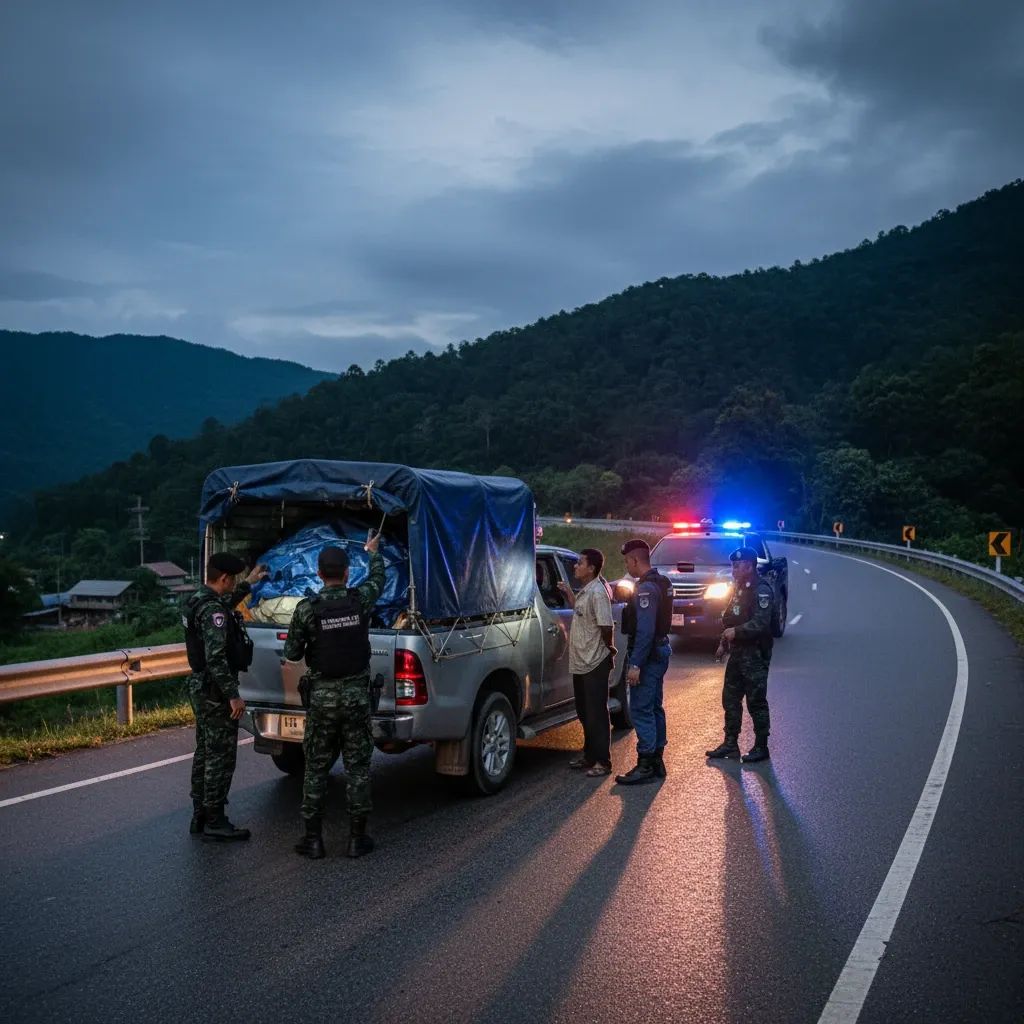
The Thailand Royal Police in Chiang Mai apprehended a 30-year-old Myanmar national contractor hours after his gray Toyota Revo pickup truck struck and killed a 13-year-old boy walking along Ping River Road on the evening of July 23. The driver, identified only as Mr. Joe, recorded a blood alcohol level of 176-178 mg% — more than three times the legal limit of 50 mg% — and faces charges that carry up to 10 years in prison and permanent license revocation under Thailand's zero-tolerance drunk-driving laws.
Why This Matters
• Chiang Mai leads Thailand in drunk-driving arrests during major holiday periods, with 757 cases during the 2025 Songkran festival alone.
• New penalties take effect immediately: No warnings issued; first-time offenders face jail time and fines up to ฿20,000, while fatal crashes carry mandatory 3–10 years imprisonment.
• Zero insurance coverage: Insurers do not pay claims when drivers test positive for alcohol, leaving perpetrators liable for all damages.
• Foreign nationals convicted of drunk driving may face visa cancellation and deportation in addition to criminal penalties.
The Fatal Hit-and-Run
The victim, 13-year-old Boonnam Lungmin — known locally as "Nong Steve" — was walking on the shoulder of the road near Phetmanee Village in Pa Daet subdistrict around 7:30 PM when the pickup truck sideswiped him. Witnesses reported the vehicle did not slow down or stop. The boy sustained critical injuries and was pronounced dead shortly after arrival at hospital.
Thailand Royal Police Chiang Mai Metropolitan Division reviewed surveillance footage from cameras positioned along the riverfront corridor and traced the vehicle's route to a dormitory approximately 5 kilometers from the crash site. Officers arrested Mr. Joe within hours, conducting a breathalyzer test on scene. The recorded alcohol concentration was 176 mg% (milligrams of alcohol per 100 milliliters of blood) in initial testing and 178 mg% on a follow-up measurement, placing the driver in the high-risk impairment category under Thai traffic law.
Police denied bail and have forwarded the case to the provincial court for remand pending trial. Charges filed include driving under the influence causing death, reckless driving causing death, and failure to render assistance — a combination that eliminates judicial discretion for suspended sentences.
What This Means for Residents
Thailand tightened drunk-driving enforcement across all provinces, responding to persistent fatality rates during holiday periods. For anyone living in or traveling through Chiang Mai, the legal thresholds and consequences have become notably more severe:
Blood alcohol limits are tiered by driver category. The standard threshold remains 50 mg% for licensed drivers over age 20. However, provisional license holders, drivers under age 20, unlicensed operators, and those using incorrect license categories face prosecution at just 20 mg% — roughly one drink.
Penalties for fatal crashes are non-negotiable. Conviction on drunk-driving homicide charges mandates 3 to 10 years imprisonment, fines between ฿60,000 and ฿200,000, and immediate permanent revocation of driving privileges. Courts rarely grant probation in these cases, and repeat offenders within two years face doubled jail terms.
Refusal to submit to roadside alcohol testing is treated as an admission of guilt under Thai law, resulting in automatic charges equivalent to first-offense drunk driving: up to one year in jail and fines up to ฿20,000.
For foreign nationals, the consequences extend beyond the criminal justice system. A conviction can trigger visa revocation proceedings and deportation orders, effectively barring re-entry to Thailand for extended periods.
Chiang Mai's Persistent Drunk-Driving Crisis
Despite aggressive enforcement campaigns, Chiang Mai Province continues to record the highest number of drunk-driving arrests in Thailand during major festivals. During the 2025 Songkran period (April 10–16), police logged 757 drunk-driving cases in Chiang Mai alone — the highest in the nation. The province held the same ranking during the New Year's holiday, with significant case volumes recorded in just a five-day period.
The concentration of bars, nightlife venues, and tourist attractions along key corridors — particularly the Old City moat ring and riverside districts — creates predictable enforcement zones. Thailand National Police deploy mobile checkpoints between 4 PM and 8 PM, the window when crash rates peak, and maintain fixed sobriety stations near entertainment districts on weekends.
Technology augments roadside enforcement. The province installed AI-enabled CCTV cameras in five districts — Mueang Chiang Mai, San Sai, Hang Dong, San Kamphaeng, and Saraphi — capable of detecting traffic violations 24 hours daily. Speed cameras along Highway 118 (the Chiang Mai-Chiang Rai corridor) and intersection cameras at major downtown junctions feed violation data directly to ticketing systems, reducing reliance on manual stops.
Community-Level Interventions
Provincial authorities have activated "community checkpoints" staffed by volunteer disaster response teams and village health volunteers (อสม.) in residential neighborhoods. These informal barriers are positioned near village entrances and temple grounds during evening hours, intended to dissuade intoxicated drivers from leaving local drinking establishments.
The Thailand Department of Probation oversees mandatory rehabilitation for convicted offenders placed on probation, requiring attendance at alcohol awareness courses and regular reporting. However, the majority of drunk-driving homicide cases proceed to full custodial sentences without probation eligibility.
Enforcement Reality vs. Behavioral Change
The surge in arrests reflects both increased enforcement capacity and the persistence of the underlying behavior. While enforcement has intensified nationwide, Chiang Mai's numbers remain elevated, suggesting localized cultural and infrastructural factors at play.
Transportation alternatives remain limited outside the city center. Ride-hailing services like Grab and Bolt operate sporadically in suburban districts, with typical fares to the Old City ranging from ฿80–150 depending on distance. Public transit options after 10 PM are effectively nonexistent. This infrastructure gap places greater pressure on personal accountability and peer intervention, neither of which has proven reliably effective in reducing drunk-driving incidents.
Cost comparison: A typical DUI fine starts at ฿20,000 for first offense, with potential jail time adding substantial costs. A taxi ride home from a night out rarely exceeds ฿200, making the economic logic of designated transportation clear.
Local advocacy groups have called for expanded designated driver programs and subsidized late-night transit during festival periods, but provincial budgets have not allocated funding for such initiatives to date.
What Residents Should Know
For those living in Chiang Mai and neighboring provinces, the practical takeaways are straightforward:
One drink can exceed the legal limit for provisional drivers and those under 20. Two standard drinks typically push blood alcohol above 50 mg% for most adults, the threshold for criminal prosecution.
No insurance payout applies if you are involved in a crash while intoxicated, regardless of fault. You become personally liable for all medical expenses, vehicle repairs, and civil damages.
Checkpoints are permanent fixtures, not seasonal. Police maintain rotating checkpoint locations year-round, with intensified patrols during weekends and monthly pay cycles when discretionary spending — and bar traffic — increases.
Foreign license holders are subject to identical standards as Thai nationals. An international driving permit does not provide exemption from local DUI laws or penalties.
If you're facing DUI charges, foreign nationals can contact their embassy immediately. The U.S. Embassy in Bangkok (02-205-4000) and most other diplomatic missions maintain 24-hour emergency lines. Early legal counsel significantly impacts sentencing outcomes.
The death of 13-year-old Nong Steve joins a lengthening roster of preventable road fatalities in northern Thailand, underscoring the gap between enforcement capability and behavioral compliance. Until structural alternatives — affordable late-night transit, expanded ride-sharing networks, or peer-driven accountability systems — take root, enforcement alone will continue to produce arrests without significantly altering the calculus that leads drivers to take the wheel after drinking.


