
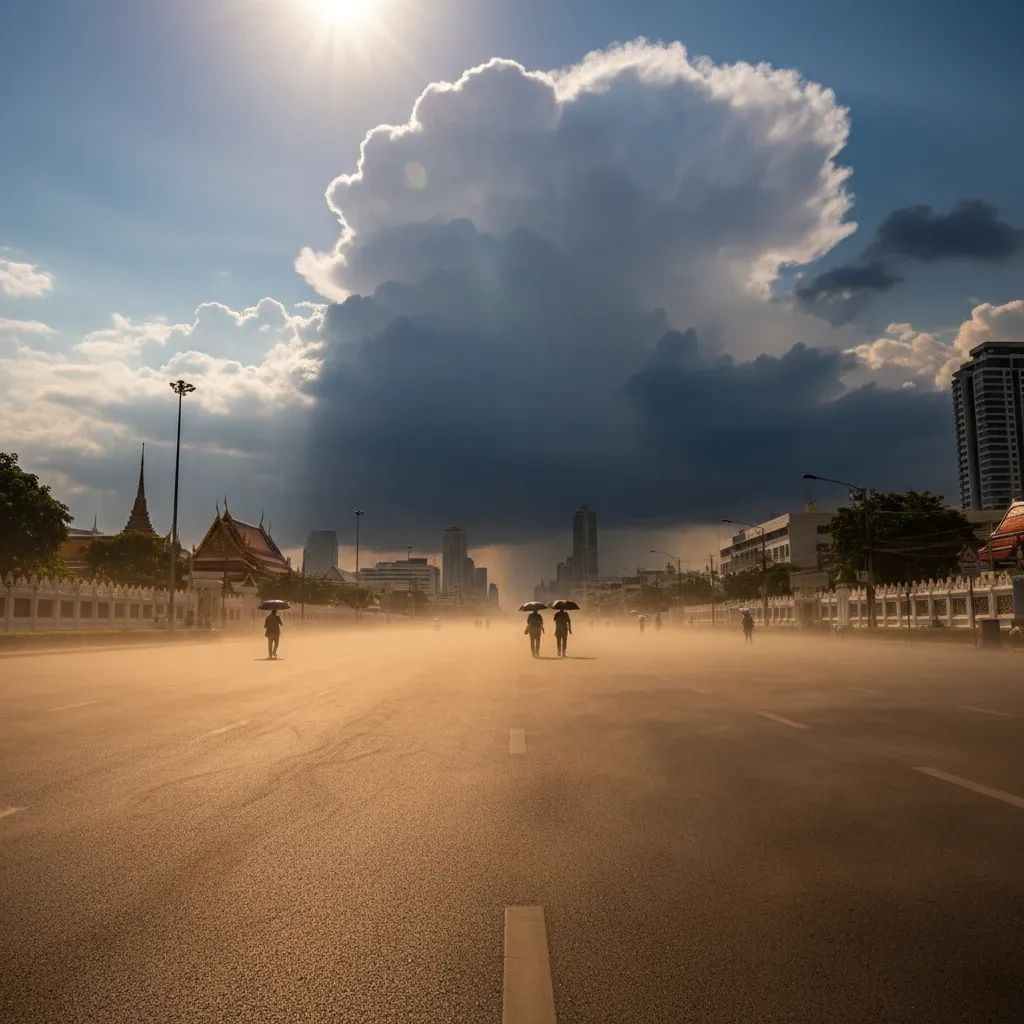
Residents across Thailand's upper regions face a brief break over the next five days. While the Thailand Meteorological Department reports that the most intense storm sequence is waning, the hazard profile is actually shifting rather than disappearing—substituting dramatic afternoon downpours for a more insidious threat: sustained temperatures climbing into the mid-40s Celsius that pose serious risks to vulnerable populations and outdoor workers.
Why This Matters
• Heat index warnings now supersede storm alerts—conditions will feel 5–7°C hotter than actual air temperature due to humidity, creating genuine medical danger for those without air-conditioned shelter.
• Agricultural zones face a narrow compliance window—farmers have approximately 72 hours to secure vulnerable crops and structures before storm activity resumes or dissipates entirely, leaving damage assessments incomplete.
• Marine operations in the South are reversing their restrictions—fishing fleets facing rain intensification from April 19 onward will see economic losses compounded if adverse conditions persist into late April.
How the Week's Weather Unfolded
The interaction of a high-pressure system from mainland China and warm, moisture-saturated air over Thailand's peninsular and plateau regions created favorable conditions for strong thunderstorm development beginning April 16. The Thailand Meteorological Department documented this producing thunderstorm clusters with wind velocities sufficient to snap structural supports and generate hail accumulations in scattered districts.
The storm system's trajectory moved systematically westward. The Northeast region—particularly provinces like Khon Kaen, Udon Thani, and Nakhon Ratchasima—absorbed the initial and most severe activity, with thunderstorm coverage reaching 40% of affected areas. Spillover spread to the East and subsequently the Central Plains, where districts in Phetchabun and Nakhon Sawan experienced isolated lightning strikes and localized power disruptions. Bangkok and its surrounding districts experienced scattered convective cells causing minor street flooding in low-lying neighborhoods near the Chao Phraya and secondary canal systems, but disruptions remained contained.
By contrast, the South remained largely unaffected during April 16–18, experiencing only isolated afternoon showers. However, beginning April 19, this geographic reversal accelerates dramatically. Strengthening southeasterly winds over the Gulf of Thailand and Andaman Sea are introducing more substantial moisture transport and triggering widespread thunderstorm development—potentially covering 30–40% of southern provinces including Surat Thani, Phuket, and Krabi through April 22.
The Heat Crisis That Silently Compounds Risk
What generates fewer dramatic headlines but poses measurable public health consequences is the relentless accumulation of daytime heat stress. Medical facilities across the North and Northeast report 15–20% increases in heat-related emergency admissions compared to the same period in 2025. Provincial hospital data from Chiang Mai, Khon Kaen, and Udon Thani document specific cases: elderly patients admitted for confusion and accelerated heart rhythms, outdoor laborers presenting with muscle breakdown, and infants treated for heat-induced dehydration.
The distinction between simple heat and dangerous heat hinges on the heat index—the temperature the human body genuinely perceives after accounting for humidity. In Udon Thani and Nakhon Ratchasima, calculated heat indices consistently breach 41°C, surpassing the threshold where outdoor exertion becomes unsafe. Construction crews, agricultural workers, street vendors, and anyone engaged in sustained outdoor activity inhabit the highest-risk category.
The Thailand Ministry of Public Health has disseminated guidance emphasizing minimum hydration thresholds (2 liters daily for adults), light-colored and loose-fitting clothing, and temporal restructuring of outdoor work to pre-10 a.m. or post-5 p.m. windows. Yet implementation remains inconsistent in rural zones where agricultural cycles and informal labor structures offer little operational flexibility.
Historical context amplifies concern: 21 documented heat-related deaths occurred in Thailand during April and May of 2025. Current rate of hospital admissions in 2026 suggests this year could see similar or higher numbers without sustained preventive messaging and cooling center accessibility.
Agricultural Impact: Documentation and Recovery Uncertainty
The farmer's dilemma remains: the rainfall provided moisture relief after a drier-than-normal early April, yet the accompanying hail and destructive wind gusts inflicted targeted crop devastation. The Thailand Ministry of Agriculture and Cooperatives has not yet released formal aggregate damage estimates, though provincial extension offices compile scattered reports: mango orchards in Nakhon Ratchasima stripped of immature fruit, chili plantations near Khon Kaen partially flattened by wind, and vegetable plots in upland Phetchabun buried under hail accumulation.
The recovery pathway is procedurally clear but administratively uncertain. Farmers must photograph visible structural damage, document crop losses, and submit claims through provincial agriculture offices. Government compensation mechanisms historically materialize by June but typically involve lengthy approval cycles and modest allocations that rarely reach full-loss replacement. Farmers holding crop insurance occupy a comparatively advantaged position; those without coverage absorb the financial impact independently.
What This Means for Residents
For residents in the North, Northeast, Central, and East regions through April 22, the practical protocol is demanding but straightforward. Afternoon thunderstorms remain climatologically probable between 2 p.m. and 7 p.m.—and residents should rigorously avoid open fields, large isolated trees, billboards, and temporary structures during this window. Lightning casualty risk is documented: the Thailand Department of Disaster Prevention and Mitigation has registered at least two direct lightning strikes in agricultural zones this week.
Construction site operators and outdoor work crews should implement weather monitoring protocols using freely available radar imagery from the Thailand Meteorological Department mobile applications. Establish procedures ensuring 15-minute lead time to relocate personnel indoors when storm cells approach.
Bangkok residents and workers face moderate storm risk but material heat risk. Symptoms of heat stroke—confusion, rapid pulse, loss of consciousness—constitute medical emergencies requiring immediate hospital transport. The Bangkok Metropolitan Administration has activated cooling centers in public parks and community halls specifically designed for residents lacking air-conditioned home environments. Locations are available at bangkok.go.th or by contacting your district office.
For maritime operations, the Thailand Marine Department maintains standing advisories for all vessels in the Gulf and Andaman waters to avoid departure during active storm warnings. Wave conditions averaging 1 meter can locally exceed 2 meters in active storm zones—a threshold marking the operational boundary between manageable and unsafe conditions for small fishing boats and wooden tour vessels.
The Longer Weather Pattern: Persistence of Heat Through Mid-May
The extended forecast reveals a sustained imbalance. Thailand's hot season typically persists through mid-May, when the southwest monsoon delivers sustained precipitation and moderating temperatures. The Thailand Meteorological Department's current April projection indicates above-normal temperatures nationwide and rainfall approximately 30% below typical levels across most regions.
This extended pattern receives partial attribution to moderating El Niño conditions in the Pacific, but urban areas—particularly Bangkok—amplify the sensation through the urban heat island effect, where concrete and asphalt absorb and re-radiate solar energy more intensely than vegetated landscapes. Temperature differentials of 3–5°C between central Bangkok and surrounding rural zones are routine during April afternoons.
Substantive relief awaits mid-May, when monsoon circulation patterns shift definitively. Until then, residents navigate through behavioral adaptation: rescheduled work routines, enhanced hydration protocols, and heightened weather forecast monitoring.
Temperature and Storm Activity by Region: April 18–22 Profile
North: Peak temperatures 36–42°C, with thunderstorm coverage declining from 30% midweek to 10–20% by April 21–22. Eastern provinces like Chiang Rai, Phayao, and Nan remain susceptible to isolated late-afternoon convective cells.
Northeast: Experienced peak intensity April 17–19, with thunderstorms covering up to 40% of the region and documented hail accumulation. By April 21–22, coverage drops to 10–20% while heat remains intense at 41°C. Hospitals in Udon Thani, Khon Kaen, and Nakhon Ratchasima are actively monitoring admission trends.
Central Plains: Storm frequency declines from 30% to 10% by week's end. Peak temperatures could reach 42°C in provinces such as Ayutthaya, Lop Buri, and Suphan Buri. Rice farmers in low-lying districts are assessing seedling damage from early-week wind.
East: Early-week storm coverage of 20–40% diminishes to 10–20% by April 22. Coastal areas like Chon Buri, Rayong, and Chanthaburi experience moderate seas averaging 1 meter but rougher conditions exceeding 2 meters during active thunderstorms. Industrial operations and port logistics have sustained minor disruptions but remain functional.
Bangkok and Surrounding Areas: Scattered storms covering 10–30% of the metropolitan area through April 20, with slight easing afterward. Temperatures hover between 34–40°C. The Bangkok Mass Transit System and major office complexes have maintained cooling systems at elevated operational capacity.
South: Rainfall intensifying from April 19 onward—contrary to northern patterns. Thunderstorms becoming more widespread with 30–40% coverage as southeasterly winds intensify. Both the Gulf coast and Andaman coast experience marine warnings extending through April 22.
Accessing Real-Time Information
Residents seeking weather updates, heat indices, and localized emergency alerts should consult the Thailand Meteorological Department official website (tmd.go.th), the AirBKK mobile application for Bangkok-specific heat index data and air quality information, and provincial disaster prevention offices for community shelter locations and emergency notifications.


