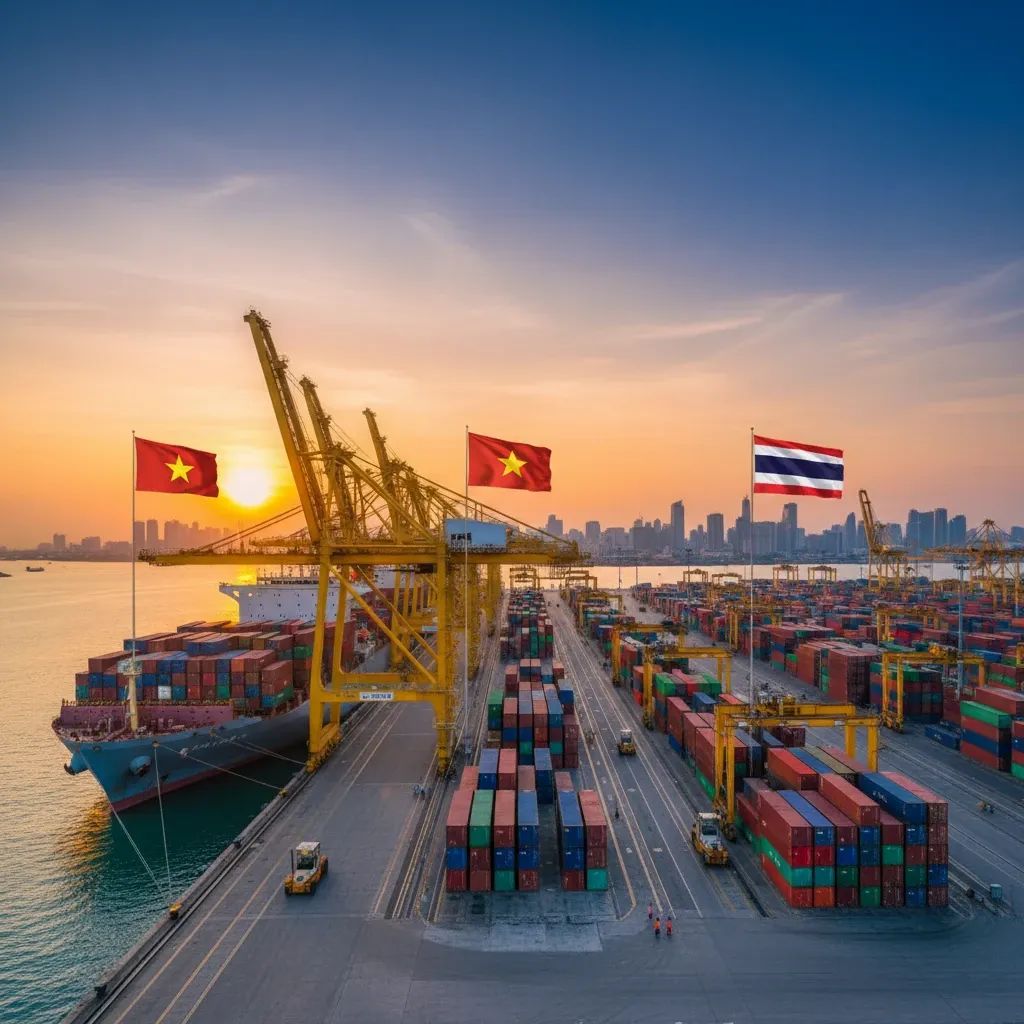
The consumer spending boom unfolding across Southeast Asia is unprecedented in scale. Private consumption across ASEAN's six largest economies—including Thailand—is tracking toward $5 trillion by 2035, fueled by an expanding middle class, rapid digitalization, and demographic shifts that are reshaping how 140 million new consumers will shop, pay, and live. For businesses, investors, and residents across Thailand and the broader ASEAN bloc, this shift is already visible in mobile payment adoption, cross-border e-commerce volumes, and the proliferation of fintech platforms replacing cash transactions at unprecedented speed.
Thailand's Ministry of Commerce and neighboring ASEAN regulators are positioning the region for structural transformation. This isn't speculative—it's driven by tangible factors: income growth, digital infrastructure, and regional trade integration that will touch everything from how you pay for groceries to how your salary transfers across borders.
Why This Matters
• Income growth: Average per capita income in ASEAN will rise from $6,000 in 2025 to $8,000 by 2030—equivalent to a 33% pay raise for the typical household.
• Digital dominance: 90% of Southeast Asian internet connections occur on mobile devices, and video commerce already accounts for 25% of all online sales.
• Regional integration: The ASEAN Digital Economy Framework Agreement (DEFA), expected to conclude this year, will harmonize digital trade rules and unlock smoother cross-border commerce for SMEs and consumers alike. For expats and foreign business owners in Thailand, this means reduced friction for international money transfers, easier cross-border invoicing, and streamlined business registration processes.
• Thailand's role: With private consumption growing 3.2% in Q1 2026 and a luxury market projected at $3.3 billion, Thailand sits at the center of this regional boom.
The Numbers Behind the Opportunity
Southeast Asia is adding 140 million new consumers over the next decade, representing 16% of the global consumer base. By 2030, roughly 65% of the world's middle class—around 3.5 billion people—will reside in Asia, with Thailand, Vietnam, Indonesia, and the Philippines driving the largest absolute increases in affluent households.
ASEAN's economy is forecast to swell to nearly $5.8 trillion by 2030, a 40% jump from the $4.2 trillion recorded in 2025. This expansion is anchored by solid domestic demand and continued investment, even as overall GDP growth moderates slightly to 4.6% in 2025 and 4.2% in 2026 before recovering to an average of 4.6% annually through 2030.
Private consumption, the engine of this growth, is expected to increase at an 8% annual rate through 2035, potentially propelling the region past North America in total consumer spending. The broader Asia-Pacific region is on track to become the world's largest consumer market by 2035, with private consumption growing at a 7% compound annual growth rate (CAGR—a standard measure of long-term growth) to reach $36 trillion.
What This Means for Residents and Investors
For expatriates, digital nomads, and long-term residents in Thailand, the practical implications are immediate and tangible.
Cross-border finances are getting simpler. DEFA's real-time QR payment systems, expected by 2026, mean faster and cheaper international transfers to your home country or to business partners across ASEAN. Foreign residents managing multi-currency finances will benefit from reduced transaction costs and transparent exchange rates that currently embed hidden premiums in traditional banking channels.
Same-day delivery is becoming standard beyond Bangkok. While Bangkok residents already expect same-day delivery, this infrastructure is rapidly expanding to secondary cities like Chiang Mai, Phuket, and Khon Kaen. For expats in these cities, this means faster access to specialty goods previously requiring Bangkok trips or international shipping.
Value-conscious spending is reshaping retail. Consumers are mixing premium treats—organic coffee, imported cosmetics—with lower-priced staples, creating purchasing patterns that reward brands able to justify premium positioning. Health and well-being have shifted from aspiration to routine, influencing purchasing decisions across categories from food to insurance.
Digital-first consumption is now the baseline. Social commerce, shoppable video, and live shopping events have fundamentally reshaped the consumer journey. Gen Z, comprising about 25% of the region's population, relies on social media for 70% of product research and exhibits content-driven purchasing behavior that blurs the line between entertainment and shopping.
For investors and business owners, the message is clear: local brands are gaining share. Affordability pressures, digital disruption, and a preference for authenticity and local flavor are contributing to the rise of regional players, shifting market share away from Western incumbents. This is especially visible in fast-moving consumer goods (FMCG), where agile local startups are leveraging hyperlocal fulfillment and social commerce to outpace legacy brands.
E-Commerce: Mobile-First, Social-Driven, and Relentless
The ASEAN e-commerce market is projected to reach between $215 billion and $230 billion by the end of 2026, climbing to as much as $370 billion by 2030—a 20.83% CAGR from 2026 to 2034. Cross-border e-commerce, a critical enabler for Thai SMEs (small and medium-sized enterprises) looking to export regionally, is expected to grow from $50.37 billion in 2026 to $84.74 billion by 2031.
Mobile commerce is the dominant interface: 68% of shoppers in Southeast Asia have never made a desktop e-commerce purchase. This necessitates mobile-optimized checkout flows, one-tap payments, and app-first strategies. Video commerce alone accounts for approximately 25% of e-commerce gross merchandise value (GMV—the total value of goods sold through e-commerce platforms), leveraging social media platforms to facilitate low-friction sales.
Thailand's logistics infrastructure is adapting to meet these demands. Same-day delivery is already standard in major cities, and bonded-warehouse hubs combined with the ASEAN Customs Transit System are reducing intra-regional delivery times to under three days. The ASEAN freight and logistics market is projected to reach $305.98 billion in 2026, growing to $406.10 billion by 2031.
Fintech: Integrated, Interoperable, and AI-Powered
Digital payment adoption in ASEAN is projected to exceed $1 trillion by 2025, with cash transactions significantly declining. By 2026, Thailand and its ASEAN neighbors are deploying real-time, cross-border QR payments that reduce transaction costs and foster regional trade and financial inclusion. ASEAN aims for a fully integrated QR ecosystem by 2030, with bilateral linkages expanding rapidly.
For foreign residents in Thailand, this means your digital wallet—whether it's Google Pay, Apple Pay, or local alternatives like PromptPay—will work seamlessly across the region, eliminating the friction of currency conversion and multiple payment systems.
AI-driven personal finance tools are managing portfolios, optimizing tax liabilities, and predicting cash flow needs with unprecedented accuracy. Embedded finance—lending integrated into e-commerce platforms, insurance-as-a-service in logistics—is becoming an invisible layer within other industries. Regulators are aligning frameworks for digital banking, open finance, and crypto-assets, reducing barriers to entry for regional expansion and enabling more efficient capital flows.
For Thai SMEs and expat-owned businesses, fintech adoption is accelerating. Peer-to-peer (P2P) lending and streamlined cross-border payments are helping small businesses manage global trade disruptions and access liquidity without the bureaucratic friction of traditional banking.
Consumer Behavior: Cautious but Not Contracting
Despite the structural growth story, consumer behavior in 2026 reflects caution. According to the Milieu 2026 Consumer Study, 54% of Southeast Asian consumers are adopting a "spend wisely" approach. 53% of respondents planned to be more careful with spending over the three months from April 2026, up sharply from 32% in 2025. Spending momentum has softened, with 46% of consumers reporting increased spending compared to three months prior, down from 51% in 2025, while the proportion of those spending less rose from 19% to 24%.
Geopolitical tensions (cited by 51% of respondents) and saving in preparation for global uncertainty (46%) are the primary factors driving reduced non-essential spending. Yet private consumption remains resilient. Thailand's private consumption grew by 3.2% in Q1 2026, consistent with 3.3% in Q4 2025, fueled by increased spending on nondurable and semidurable goods. Indonesia's household consumption, the primary economic driver, grew to 5.52% in Q1 2026, up from 5.11% in Q4 2025, largely due to robust spending during Ramadan and Eid festivities.
This dichotomy—caution paired with continued spending—reflects a sophisticated consumer base that is selectively splurging on products that deliver emotional payoffs or signal belonging, while trading down on everyday items. Thai consumers are particularly adept at navigating this balance, leveraging digital tools to compare prices, access promotions, and time purchases around peak shopping events.
The Road Ahead: Regulatory Alignment and Infrastructure Investment
The ASEAN Digital Economy Framework Agreement (DEFA), expected to be concluded in 2026, is the linchpin of regional integration. DEFA aims to harmonize digital trade rules, reduce barriers, and strengthen cross-border e-commerce by aligning regulations, introducing interoperable digital systems, facilitating smoother cross-border data flows, and strengthening cybersecurity standards.
For Thailand, this means reduced operational friction for businesses, lower costs for cross-border transactions, and expanded market access for micro, small, and medium-sized enterprises (MSMEs). For expats establishing businesses in Thailand, DEFA reduces the regulatory complexity that has historically made cross-border operations challenging. Business registration timelines may accelerate, and compliance costs for international transactions are expected to decline significantly.
Infrastructure investment is also accelerating. Thailand and Vietnam's urbanization rates are projected to rise 7% over the next decade, driving demand for modern logistics networks, last-mile delivery solutions, and digital payment infrastructure. Road freight continues to hold the largest share of revenue and remains dominant for first-mile and last-mile deliveries through 2031, though air freight is forecast to experience the fastest growth rate (7.95% CAGR—compound annual growth rate) between 2026 and 2031.
Implications for Businesses and Brands
Companies operating in Thailand and across ASEAN must adapt to several realities:
Localization is non-negotiable. Tailoring content, marketing, and product offerings to local languages, cultures, and preferences is essential for success. This extends beyond translation to cultural relevance, payment method diversity (digital wallets, buy-now-pay-later options), and channel strategies that integrate social commerce, live shopping, and influencer partnerships.
Sustainability and ethics are built-in. While pragmatism around price, durability, and convenience still filters purchasing decisions, younger consumers—Millennials and Gen Z—are more likely to reward or punish brands based on ethical stances. By 2027, Asian Millennials are expected to be the leading source of incremental demand, with Gen Z becoming the highest-spending generation in Asia by 2033.
Logistics speed is a competitive weapon. Same-day delivery expectations are spreading from primary to secondary cities. Businesses unable to meet these timelines risk losing share to digital-native competitors that leverage micro-hub density and variable-cost delivery fleets.
The $5 trillion opportunity is real, but it belongs to those who can move fast, localize deeply, and integrate seamlessly across digital, physical, and social channels. For Thailand, the stakes are high—and the upside is transformative.