
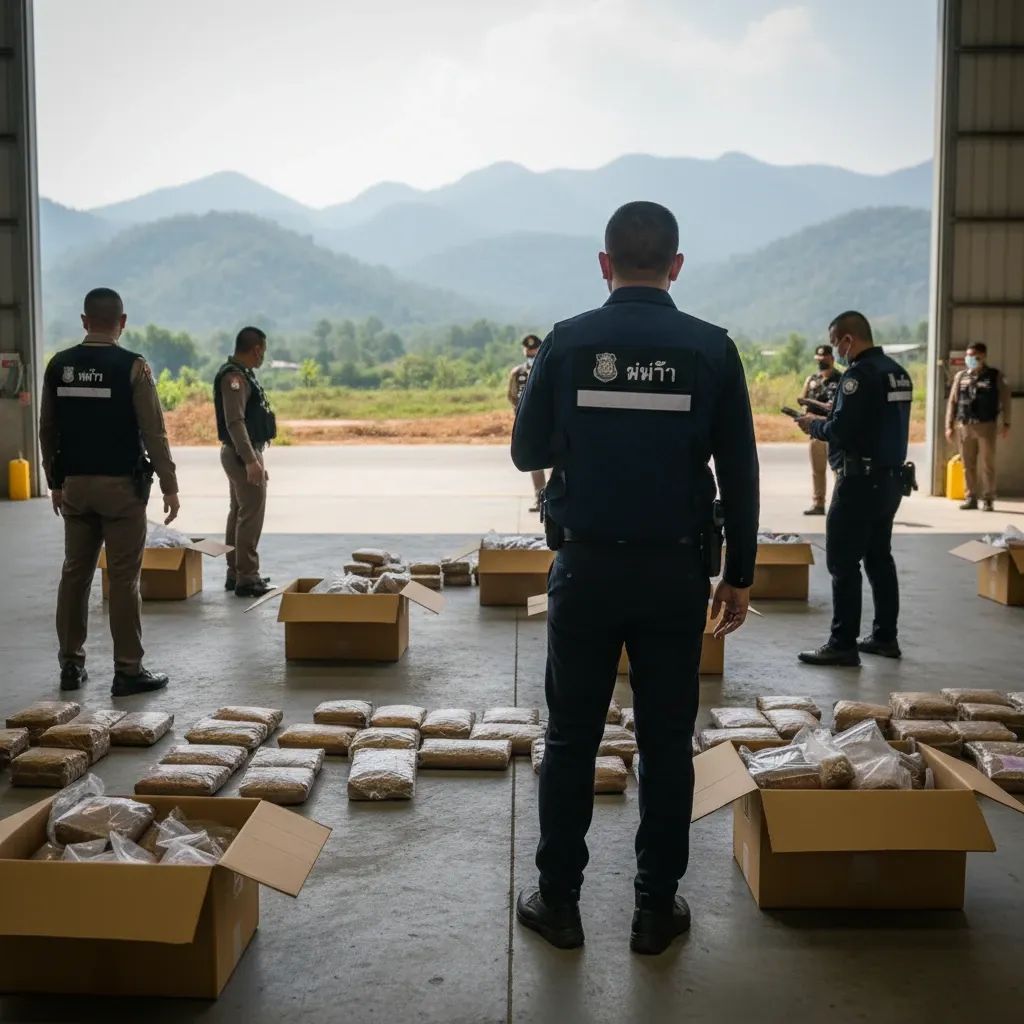
The Royal Thai Police have intercepted 500 kilograms of crystal methamphetamine in a violent highway clash near the Myanmar border, wounding one suspect and signaling an intensifying crackdown on narcotics trafficking through the country's northern corridor. The July 2-3 seizure in Chiang Rai Province marks one of the largest single busts this year and underscores the persistent pressure drug syndicates face as they attempt to funnel product from production hubs in the Golden Triangle toward domestic and international markets.
Why This Matters:
• Half a metric ton of methamphetamine was seized in a single interception—enough to supply millions of doses and valued in the tens of millions of baht.
• Armed confrontations between police and traffickers are becoming more frequent along border routes, raising security concerns for residents and travelers in northern provinces.
• The government has declared narcotics suppression a national priority, with Prime Minister Anutin Charnvirakul personally linking drug enforcement to Thailand's international reputation after a high-profile arrest abroad.
The Chiang Rai Incident: What Happened
Officers from Provincial Police Region 5 established a checkpoint on a highway running through Wiang Chiang Rung District, acting on intelligence that two pickup trucks were transporting a large shipment of methamphetamine from Chiang Saen District—a notorious transit zone adjacent to the Myanmar and Lao borders—toward central Thailand. When the vehicles were flagged for inspection, occupants opened fire on law enforcement, triggering a midnight gun battle that left one trafficker injured and another fleeing into jungle terrain. All officers emerged unharmed.
Inside the trucks, investigators discovered 14 sacks containing 500 kg of crystal methamphetamine, packaged for wholesale distribution. The operation mirrors a pattern seen throughout the first half of 2025: smugglers attempting to move industrial-scale quantities through Chiang Rai's porous border zones, often with armed protection, only to meet increasingly aggressive interdiction efforts.
Northern Thailand: The Pressure Point
Chiang Rai Province sits at the nexus of Southeast Asia's methamphetamine trade. Synthetic drugs manufactured in laboratories across Myanmar's Shan State—where ethnic armed groups and criminal syndicates operate with relative impunity—flow into Thailand via mountain trails, river crossings, and rural roads. From Chiang Rai, shipments disperse to Bangkok, the southern provinces, and onward to third countries.
Recent enforcement statistics paint a picture of overwhelming supply. Between January and June 2025, according to provincial police reports, law enforcement in Chiang Rai conducted dozens of major busts, including:
• June 15: Seven suspects arrested with 540 kg of methamphetamine and 533 kg of ketamine in four separate cases.
• June 8: Border troops seized 669 kg of methamphetamine, 2 million methamphetamine tablets, and 520 kg of ketamine over a two-day period.
• May 6: Ten arrests linked to four trafficking networks, yielding 4.6 million methamphetamine tablets and significant quantities of crystal meth and ketamine. Two suspects were boys aged 14, caught with 25.8 kg of methamphetamine and 4.1 kg of ketamine.
These figures represent only intercepted shipments. Analysts estimate that for every kilogram seized, several more reach the market—a reality reflected in falling retail prices across Thailand, Myanmar, and Indonesia despite record confiscations.
Beyond the Border: African Syndicates and International Routes
The methamphetamine trade is no longer a regional affair. In early July, the Crime Suppression Division announced the dismantling of an international trafficking network led by a Nigerian national, resulting in 13 arrests and the seizure of narcotics worth more than ฿400 M. The operation, dubbed "Take Down Black-Shadow Nana," targeted a sophisticated ring that recruited Thai women through dating apps to smuggle heroin and cocaine concealed in consumer goods—snacks, coffee, pet food—via air and sea routes.
Investigators identified Patrick, a Nigerian kingpin who had lived in Thailand for seven years, as the head of the "Dodorima" gang, which moved an estimated ฿380 M annually through money-laundering schemes disguised as charitable donations. The network's arrest demonstrates how Thailand serves not only as a transit country for Southeast Asian methamphetamine but also as a staging ground for cocaine and heroin shipments originating in Latin America and South Asia.
Government Response: From Rhetoric to Action
Prime Minister Anutin Charnvirakul has made narcotics enforcement a centerpiece of his administration's domestic agenda, particularly following the arrest of a Thai Airways crew member in Australia on heroin smuggling charges—a case he publicly acknowledged as damaging to Thailand's international standing. In response, the government rolled out a "Zero Trust" security protocol at major airports, subjecting all personnel, including pilots and cabin crew, to the same screening as passengers. K9 detection units and redundant inspections at boarding gates for high-risk routes are now standard.
On the ground, enforcement results have been substantial. Between October 2024 and May 2025, the Royal Thai Police reported:
• 180,000+ narcotics cases prosecuted
• 915 million methamphetamine tablets seized
• 34,116 kg of crystal methamphetamine confiscated
• 756 kg of heroin intercepted
• ฿7.1 billion in assets frozen or seized
The Ministry of Interior launched "Operation 90 Days" in July, a blitz campaign demanding provincial governors mobilize all resources to dismantle trafficking networks and arrest high-value targets. The government also reinstated the "one pill" policy, under which possession of even a single methamphetamine tablet triggers criminal prosecution—a move intended to eliminate ambiguity and empower front-line officers.
What This Means for Residents
For people living in Thailand, the surge in drug enforcement translates to heightened security measures and, occasionally, disruption. Checkpoint frequency has increased along highways in Chiang Rai, Chiang Mai, Nakhon Phanom, and other border provinces. Travelers passing through these areas should carry identification and expect delays during vehicle inspections.
The "Zero Trust" airport screening applies universally. Even frequent flyers and airline staff now face mandatory baggage checks and K9 sweeps, which can extend boarding times. The policy aims to prevent internal trafficking—a necessary trade-off after multiple high-profile smuggling cases involving aviation personnel.
More broadly, the government's national agenda classification means drug policy will influence budgets, law enforcement priorities, and diplomatic relations. Thailand has intensified intelligence sharing with Myanmar, Laos, and China, and secured commitments to track precursor chemicals used in methamphetamine production. In June, a joint operation with South Korean intelligence led to the seizure of chemicals capable of producing 1.1 billion methamphetamine tablets at a warehouse in Samut Prakan Province.
The Underlying Challenge
Despite aggressive enforcement, methamphetamine production in the Golden Triangle continues to outpace interdiction. Myanmar remains the world's largest producer of synthetic drugs and the second-largest source of opium. Conflict among ethnic armed groups and the military junta has created governance vacuums where illicit laboratories operate openly. According to the United Nations Office on Drugs and Crime, Thailand seized nearly 130 tons of methamphetamine tablets in 2024—more than half the regional total—yet retail prices fell, indicating persistent oversupply.
Traffickers adapt constantly. When northern routes face increased scrutiny, smugglers shift operations to the northeast corridor, exploiting the Mekong River and rural border crossings into Laos. When land routes tighten, they turn to maritime containers and postal parcels. The arrest of airline crew members highlights another vulnerability: insiders with access to secure zones who can bypass conventional screening.
Rehabilitation efforts are also expanding. Chiang Mai Province reported treating over 5,000 drug users in recent months, with a 76% success rate in sustained abstinence. Nationwide, more than 79,000 users entered treatment programs in the first half of 2025, while prevention campaigns reached 4.5 million young people. The government recognizes that enforcement alone cannot solve the problem—demand reduction and treatment are equally critical.
The Road Ahead
The Chiang Rai shootout and the avalanche of seizures across Thailand reflect both the scale of the trafficking threat and the government's determination to confront it. For residents, the implications are mixed: greater security and a concerted push to dismantle criminal networks, but also a more militarized border environment and the reality that methamphetamine remains cheap and widely available.
Prime Minister Anutin has staked political capital on demonstrating progress. The Operation 90 Days campaign, running through September, will serve as a benchmark. If arrests and asset seizures continue at current rates, the government will claim momentum. If prices stabilize or violence escalates, pressure will mount to reassess tactics.
For now, Thailand's message to traffickers is unambiguous: the era of easy transit is over. Whether that deterrent proves sustainable depends on factors largely beyond Bangkok's control—namely, the political stability of Myanmar and the willingness of regional partners to prioritize enforcement over economic convenience. Until production hubs in Shan State are dismantled, Thailand will remain on the front line of a war it cannot win alone.


