
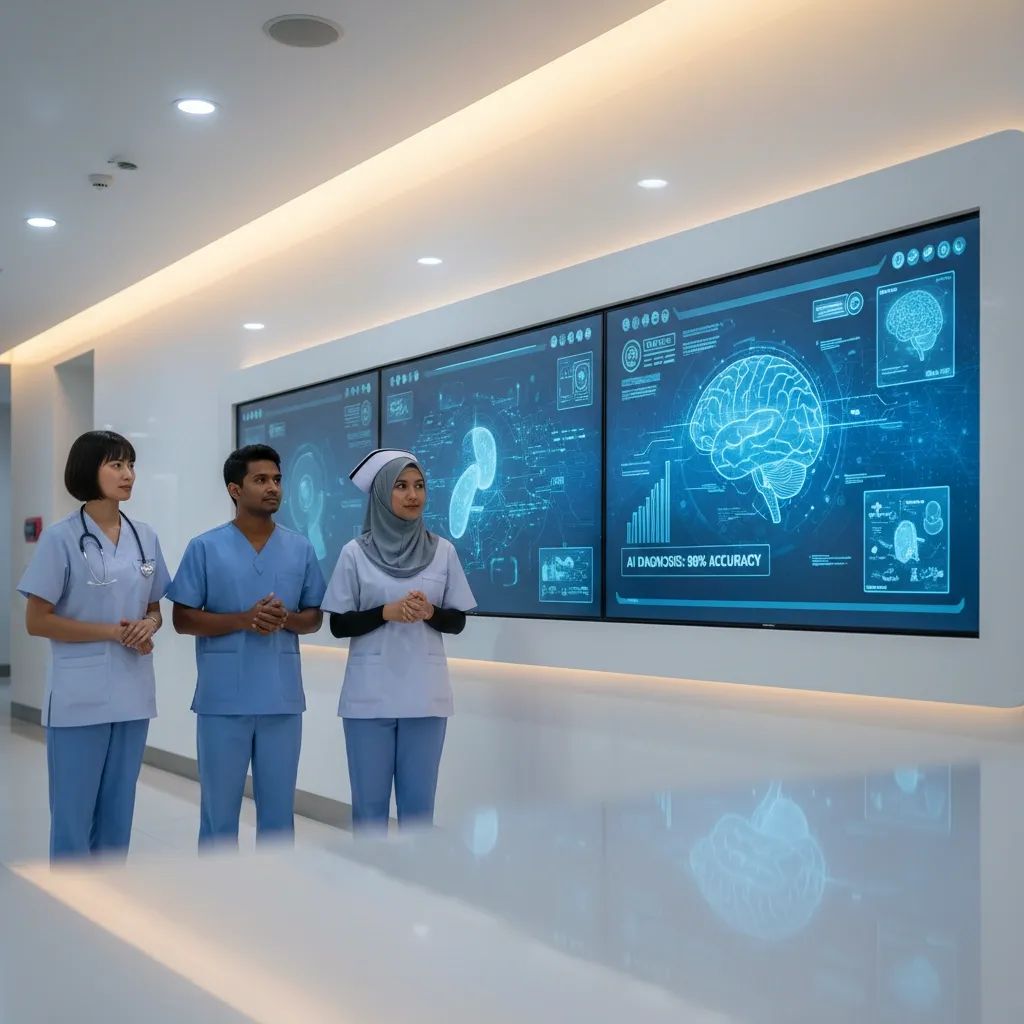
A National Healthcare Infrastructure Is Taking Shape Under Thailand's Largest Telecom
Thailand's digital health ecosystem received a structured boost in early August 2026 when True Corporation, the Thailand-based telecom leader, crystallized a multi-year commitment alongside Thammasat University Faculty of Medicine, its teaching hospital, and data analytics firm EGG Digital. The three parties signed binding agreements to establish a research and implementation center designed not as a laboratory curiosity, but as the operational nerve center for rolling out AI-driven medical services across Thailand's public hospital network. The move represents one of Southeast Asia's more ambitious attempts to combine academic rigor with telecom infrastructure muscle and private-sector data expertise in pursuit of concrete healthcare gains.
Why This Moment Matters
The partnership breaks ground on infrastructure that has been lacking in Thailand's healthcare modernization efforts:
• Workforce readiness arrives in 2027 when Thammasat launches a graduate-level program in Medical Digital Technology—the first formal academic pipeline specifically preparing physicians and technologists to build and operate AI medical systems rather than simply use them.
• Real deployment, not pilot purgatory: Unlike previous innovation hubs that generated research papers and PowerPoint presentations, this initiative explicitly commits to translating successful prototypes into rollout across Thailand's public hospital system, starting with Thammasat's network and expanding outward.
• Data standardization becomes possible: By formalizing Electronic Medical Record (EMR) protocols at a university teaching hospital, the partnership creates a template that other public and private institutions can adopt, unlocking the data integration that AI systems require to function reliably.
How the Three Parties Divide the Labor
Each partner brings a distinct capability to the table. True Corporation furnishes 5G connectivity infrastructure, edge computing capabilities via Intel's OpenVino software, and the ethical AI frameworks that allow sensitive medical data to remain within hospital networks rather than traveling to distant cloud servers. The telecom infrastructure enables what industry specialists call "AI at the edge"—allowing diagnostic tools to process patient imaging and lab results locally, reducing processing delays and addressing privacy concerns that compliance officers and patients increasingly raise.
Thammasat's contribution anchors the initiative to clinical reality. The Faculty of Medicine retains research authority and clinical decision-making oversight, while the teaching hospital provides the real patient populations, medical workflows, and institutional legitimacy that separates serious research from corporate marketing exercises. The university's reputation in Thai medical education also means that graduates from the new Medical Digital Technology program will carry credential weight within Thailand's healthcare establishment—a signal of institutional confidence that matters more than outsiders might assume.
EGG Digital specializes in converting raw medical data into actionable intelligence. The firm's engineers develop the algorithms that transform Electronic Medical Records into risk-scoring systems and diagnostic recommendations. EGG's "Health Score" models—still in development—aim to aggregate a patient's complete medical history, lab results, genetic markers (where available), and lifestyle data to generate individualized health assessments far more granular than traditional annual checkups allow. These models require the kind of data engineering expertise that standalone hospitals rarely maintain in-house.
The Six Structural Pillars
The collaboration organizes its work around six interconnected initiatives, each addressing a specific gap in Thailand's current healthcare-technology ecosystem:
Skills and Training Formation stands as the most immediate priority. Customized curricula developed with True Digital Academy target three audiences: medical students who will practice in an AI-augmented environment, university faculty teaching the next generation, and currently practicing hospital personnel requiring upskilling to manage new systems. Rather than treating AI as an exotic specialty, the programs embed digital health literacy into core medical training—a shift that requires buy-in from tenured faculty accustomed to traditional pedagogies.
EMR Standardization and Integration creates the data foundation. Disparate hospital systems across Thailand currently store medical records in incompatible formats. By establishing unified EMR protocols at Thammasat, the partnership creates a template other institutions can adopt. This uniformity becomes essential when AI systems attempt to identify disease patterns or predict patient deterioration—tasks that require consistent data structure across thousands of patient records.
Research Programs Bridging Academy and Clinic represent the intellectual core. Rather than publishing academic papers destined for specialized journals and citation obscurity, researchers will design studies with immediate clinical applicability. Examples in development include AI systems for radiological image analysis (detecting tumors or fractures faster than human radiologists), risk stratification models predicting which patients face highest complication risk, and decision-support tools suggesting diagnostic pathways based on symptom input.
The Innovation Hub Itself operates as both laboratory and testing ground. New AI systems undergo clinical trials within the hub's protocols before any consideration for broader deployment. This staged approach allows developers to identify failure modes in controlled conditions rather than discovering them when a faulty algorithm reaches dozens of hospitals simultaneously.
Graduate Academic Program Launch marks the concrete, measurable output. Beginning in the 2027 academic year, Thammasat will admit cohorts into a new master's-level degree in Medical Digital Technology. The program accepts both medical graduates seeking technical specialization and technologists pursuing healthcare applications. This institutional commitment signals to Thai students that AI healthcare represents a legitimate, well-funded career path rather than experimental fringe work.
Ethical Translation Protocols embed patient protection and data privacy into every development stage. Before clinical deployment, every AI tool must pass ethical review examining bias potential, informed consent requirements, and data security practices. Thailand has not historically excelled at proactive privacy regulation—the framework remains reactive rather than preventative—so this partnership embeds ethical consideration into product development rather than treating compliance as an afterthought.
What Shifts Operationally for Thai Hospitals and Patients
The partnership's ultimate value depends on how its outputs reach actual clinical practice. Several operational changes become plausible over the next 24 to 36 months:
Diagnostic acceleration addresses a persistent bottleneck in Thai emergency departments. AI systems trained on thousands of radiology images can flag abnormalities in X-rays or CT scans within seconds. While radiologists retain final diagnostic authority, the AI pre-screening reduces time-to-diagnosis from hours to minutes—a material difference when a patient faces acute stroke or internal bleeding.
Preventive health scoring transitions medicine from reactive treatment to risk prediction. Rather than patients arriving at clinics only after symptoms emerge, the Health Score models being developed by EGG Digital can identify individuals at elevated risk for complications like diabetes onset or cardiovascular events. Hospital staff can then initiate early interventions—medication adjustments, lifestyle counseling, closer monitoring—before acute crises demand emergency care.
Administrative automation frees clinical staff for patient-facing work. Appointment scheduling, insurance verification, prescription refills, and billing inquiries consume hospital personnel time while contributing nothing to patient outcomes. AI systems can handle these transactional tasks, reducing the administrative staff required per patient volume and shortening patient wait times as a byproduct.
Data access equity addresses geographical disparities. Rural hospitals and provincial medical centers currently lack access to specialized expertise available in Bangkok institutions. When AI diagnostic tools developed at Thammasat can be deployed via 5G connectivity to regional hospitals, a patient in Khon Kaen or Songkhla theoretically accesses the same diagnostic capability as someone treated at a Bangkok private hospital. True's 5G network rollout becomes the enabling infrastructure layer.
True's Broader Strategic Positioning
This university partnership extends a larger corporate strategy in which True Corporation aims to transition from being primarily a telecom company into what management calls an "AI-First Company" across all business units. Healthcare represents one application domain among several, but one where regulatory frameworks, high reputational stakes, and patient outcomes create opportunity for meaningful competitive differentiation.
The company's prior healthcare initiatives provide context. True has already deployed seven smart healthcare solutions developed in collaboration with Intel, leveraging 5G connectivity for tools like Patient Management as a Service (PMaaS)—a remote monitoring system that creates what technologists call "digital patient twins," continuously tracking vital signs and sleep patterns for high-risk patients. A large language model platform analyzes initial symptom input to suggest potential diagnoses and treatment pathways. These earlier solutions demonstrate that True possesses both the technical capability and market intent to operate in healthcare delivery, not merely supply connectivity to hospitals.
The Mohpromt Super App—developed jointly with the Thailand Ministry of Public Health following True's merger with Dtac—consolidates digital health services into a single interface. Free 5G data access for True and Dtac customers (a benefit lasting one year) reduces economic friction to digital health adoption, an important consideration in a market where bandwidth costs deter lower-income patients from online health services. The app aggregates medical records, appointment scheduling, personal health metrics, and AI-generated health insights—essentially functioning as a patient's digital health companion rather than a standalone hospital portal.
Regional Competitive Positioning
In Southeast Asia's increasingly crowded AI healthcare market, True faces established rivals from other telecoms pursuing similar strategies. Singtel in Singapore operates AI cloud services analyzing pathology images and deploys robot nurse companions in hospitals. Telkomsel in Indonesia has assembled connectivity-and-AI packages targeting healthcare providers, emphasizing generative AI for enhanced customer interactions. Maxis in Malaysia explores remote consultation platforms, surgical robotics, and augmented-reality medical training tools—all enabled by 5G connectivity.
Within Thailand, AIS launched AISpace, a broader AI ecosystem hub, but healthcare-specific applications remain less defined compared to True's explicit partnerships and product deployments. The True-Dtac merger consolidated their healthcare strategies around Mohpromt, providing infrastructure advantages that smaller competitors cannot match.
True's strategy diverges from competitors in one crucial respect: the emphasis on workforce development and academic institutionalization. While Singtel, Telkomsel, and Maxis largely deploy existing AI technologies, True is investing in training the next generation of healthcare technologists to build and refine AI systems themselves. The 2027 graduate program represents commitment to long-term capability development rather than short-term market positioning. If this workforce development succeeds—producing medical technologists with genuine expertise in both medicine and AI systems—True positions itself as the operator of Thailand's AI healthcare infrastructure for the coming decade.
Practical Barriers Remain
Despite ambitious scope, implementation faces real obstacles. Integrating new AI systems into hospitals requires not just technology investment but cultural transformation among medical staff accustomed to established workflows. Asking a radiologist to trust AI flagging on imaging studies challenges professional identity and authority—organizational friction that technical elegance cannot overcome.
Data quality poses technical challenges. Thailand's healthcare system remains fragmented across public hospitals, private facilities, university teaching hospitals, and clinic networks operating with inconsistent data standards. Aggregating sufficient high-quality medical records for AI model training demands standardization efforts spanning institutions with competing interests and limited budgets. Building comprehensive datasets requires years of preparation.
Regulatory clarity still lacks. Thailand has not established clear approval pathways for AI medical devices or decision-support systems. As these tools move from research prototypes into clinical deployment, bureaucratic friction may emerge from health ministry officials uncertain how to evaluate AI systems using assessment criteria designed for conventional pharmaceutical drugs or medical devices.
The Measurement That Matters
Partnership success ultimately depends on whether these AI systems demonstrably improve clinical outcomes when deployed across Thai hospitals. If the Medical Digital Technology graduates prove immediately employable; if diagnostic AI tools reduce misdiagnosis rates or accelerate time-to-treatment; if the Health Score models identify high-risk patients before they experience acute events—then the model will expand to other universities and hospital networks. If implementation stalls due to regulatory friction, cost overruns, or practitioner resistance, the innovation hub risks becoming another well-intentioned initiative that generates impressive presentations but fails to reshape actual healthcare practice.
For now, concrete milestones exist: the hub is operationalizing, the 2027 graduate program has institutional approval, and deployment protocols are being finalized. The real test arrives when these AI systems transition from research environments into busy Thai hospital corridors, where clinical teams must integrate new tools into daily workflows while treating real patients with genuine medical needs.


