
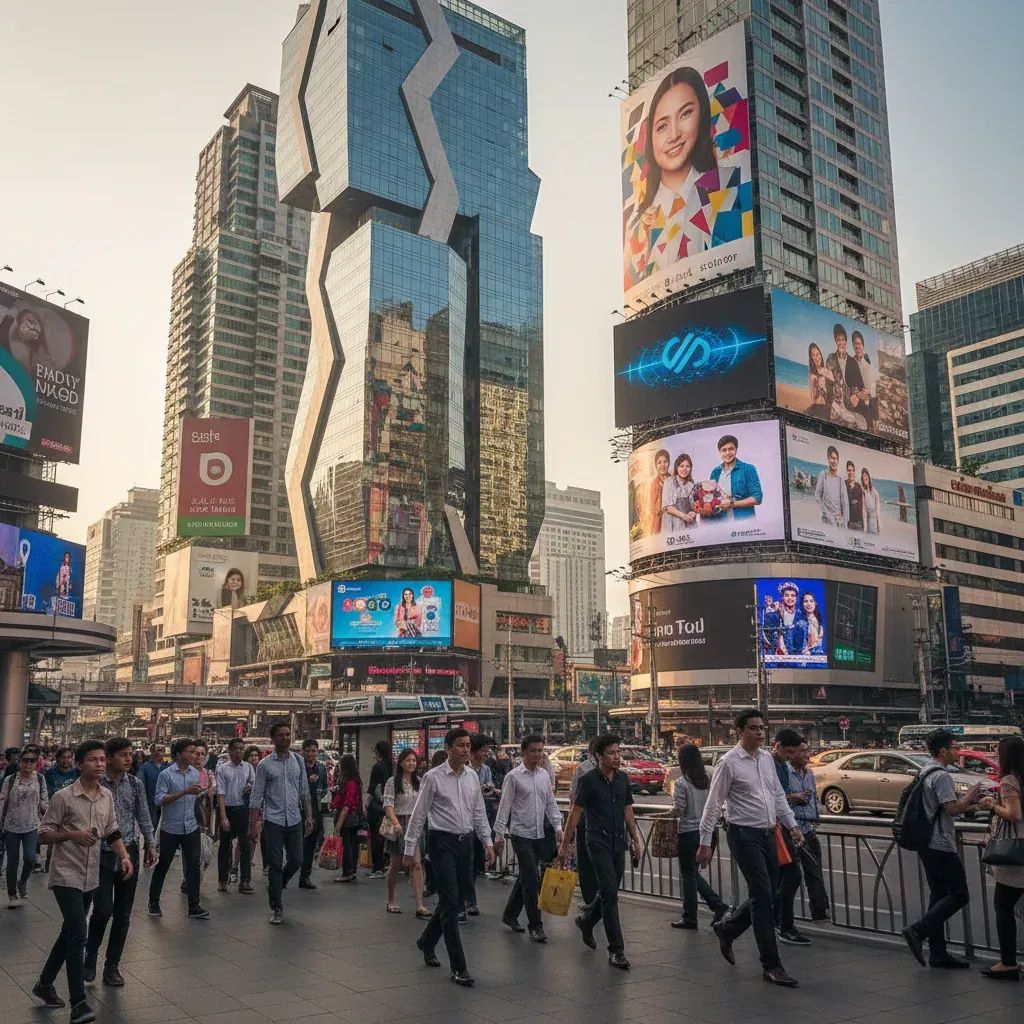
Thailand's advertising sector is set to expand 1.7% this year to ฿87.3B, marking a strategic pivot as brands rebalance spending away from pure short-term conversion tactics toward building lasting equity alongside immediate sales—a shift driven by economic caution, regulatory pressure, and the diminishing returns of digital-only campaigns.
Why This Matters
• Budget reallocation underway: Brands are shifting spending from performance clicks to brand-building channels, with Out-of-Home (OOH) advertising reclaiming strategic relevance after years of digital dominance. Importantly, digital still commands 45% of budgets—growth in traditional media represents integration, not abandonment.
• Real spending higher: Thailand's official ad market projection is ฿87.3B, but when including hard-to-track SME digital spending and influencer marketing, the real market reaches ฿111.6B—28% above official figures—reflecting the invisible spending of small and medium enterprises.
• Economic backdrop: With GDP growth forecast at just 1.6–2%, household debt elevated, and Chinese competition intensifying, advertisers are prioritizing trust and long-term value over vanity metrics.
The Strategy Shift: From Clicks to Confidence
The Thailand advertising ecosystem is undergoing what Media Intelligence Group (MI Group) calls a "structural rebalancing." After years of performance marketing dominance—where brands paid for every click, download, and conversion—advertisers are discovering the strategy's ceiling. Cost-per-click rates have climbed, customer acquisition costs have soared 30–50% for lesser-known brands according to industry benchmarks, and the relentless focus on immediate returns has left many companies without recognizable brand equity.
Modern Thai consumers now demand tangible value, authenticity, and frictionless experiences—qualities that transactional ads struggle to deliver. The shift mirrors broader economic realities: in a year where household spending remains cautious and competition from low-cost imports intensifies, brands need staying power, not just traffic spikes.
Industry specialists recommend a 50–60% allocation to brand-building and 40–50% to performance tactics, a reversal of the digital-first ratios that dominated the past half-decade. This "portfolio ROAS thinking" treats marketing as a diversified investment rather than a direct-response gamble.
Digital's Evolution and Traditional Media's Integration
Online advertising still commands the largest share—projected at 45% of total budgets, up from 38.6% in 2025—demonstrating that digital growth continues, though at a decelerating rate. Television holds 30%, and Out-of-Home claims 25%, with the latter experiencing the most robust expansion.
OOH's resurgence stems from a trust crisis in the digital sphere. Fake news, AI-generated content, and algorithm-driven echo chambers have eroded credibility, making physical, public-facing advertising a credibility anchor. Billboards, transit ads, and street-level placements offer what screens cannot: verifiable, tangible presence in the real world.
Thailand's television industry, meanwhile, is adapting rather than retreating. Networks are integrating with Connected TV platforms and streaming services, blending broad reach with smarter targeting. Channels like One31 and 3 now distribute content on Netflix, while local broadcasters develop proprietary OTT offerings to retain younger viewers who abandoned linear schedules.
Impact on Expats & Investors: Practical Guidance
For foreign-owned businesses and expat entrepreneurs operating in Thailand, this trend has immediate operational consequences:
• Marketing budgets require rebalancing: Relying solely on Facebook Ads or Google search campaigns will yield diminishing efficiency. Incorporating OOH, influencer partnerships, and content marketing becomes essential.
• Brand equity matters more: In a market where AI-powered search summaries reduce website clicks and consumers skim rather than scroll, having a recognized name and trusted reputation directly affects conversion rates—up to 2.5 times higher for established brands versus unknowns, according to industry benchmarks.
• SME spending is invisible but substantial: The ฿24.3B gap between official and real spending reflects micro-enterprises and influencer deals that bypass traditional agencies. Competitors may be outspending you through channels you're not tracking.
Budget Thresholds for Expat Business Owners
When to incorporate OOH into your strategy:
• Monthly ad budget above ฿50,000: OOH becomes cost-effective for small businesses through transit advertising (BTS/MRT carriage ads at ฿15,000–40,000/month) and local billboard placements in secondary markets.
• Budget ฿100,000+: Premium OOH placements become viable—high-traffic BTS stations, shopping mall entrances, and digital billboards in Silom or Sukhumvit offer measurable foot traffic correlation.
• Hospitality/Tourism sector: OOH in tourist districts (Khao San, Phuket Old Town, Chiang Mai Night Bazaar) paired with Instagram Reels delivers 3–5x higher engagement than paid social alone.
• F&B establishments: Micro-influencer partnerships (5,000–50,000 followers) at ฿5,000–15,000 per post outperform ฿10,000 Facebook campaigns for local foot traffic.
• Professional services: Content marketing + LinkedIn thought leadership combined with localized OOH (office tower lobbies, professional district transit ads) builds trust more effectively than PPC.
Retail-facing businesses, particularly in personal care, beverages, wellness products, automotive, and food, are leading the spending surge. These sectors prioritize omnichannel strategies, blending e-commerce performance campaigns with physical presence and community engagement.
AI's Dual Role: Efficiency and Urgency
Artificial intelligence is reshaping Thailand's advertising landscape in two directions. On one hand, it enables real-time data analysis, hyper-personalization, and automated campaign optimization—tools that digital agencies are racing to integrate. On the other, AI-driven search results and content generation threaten to bypass brand websites entirely, making direct consumer recognition more critical than ever.
Short-form video—TikTok, Instagram Reels, YouTube Shorts—remains the dominant content format, with brands deploying full video-first strategies. But even here, authenticity trumps production gloss: micro and nano influencers, who cultivate genuine relationships with niche audiences, outperform celebrity endorsements in driving purchase intent.
Social commerce has transitioned from novelty to norm. A significant portion of Thai consumers now routinely purchase via social platforms, collapsing the funnel from discovery to checkout within a single app session. This behavior reinforces the need for integrated campaigns that span awareness (OOH, TV), consideration (influencer content), and conversion (social checkout).
The Cookie Crumble and Data Sovereignty
Thailand's advertising pivot is accelerated by third-party cookie deprecation and tightening privacy regulations. Brands that built targeting strategies around external data brokers now face blind spots, forcing a pivot to first-party and zero-party data—information customers voluntarily share.
This shift elevates the importance of Customer Data Platforms (CDP) and CRM systems, infrastructure many Thai SMEs have neglected. Businesses without direct customer relationships or data collection mechanisms will find themselves increasingly reliant on platform algorithms they cannot control or interrogate.
What Digital Agencies and Streaming Platforms Face
Digital media agencies in Thailand confront mounting pressure to demonstrate ROI beyond engagement metrics. Clients demand portfolio-level performance, cross-channel attribution, and strategic integration—capabilities that require organizational restructuring, new talent pipelines, and expanded service offerings beyond media buying into pricing strategy, market analysis, and partnership brokering.
Streaming platforms—Netflix, Disney+ Hotstar, Viu, WeTV, and local entrants—are locked in fierce competition for subscribers. Growth remains strong, but converting free-trial users to paying members remains challenging, compounded by piracy and the absence of clear regulatory oversight. Some platforms are adopting hybrid models, mixing ad-supported (AVOD) and subscription (SVOD) tiers to diversify revenue.
The generational divide persists: Gen Z and Millennials pay for premium streaming, while older demographics still favor linear TV. This bifurcation forces advertisers to maintain dual strategies—streaming for youth-oriented products, traditional broadcast for mass-market reach.
The Industries Driving Spending
Personal care products lead sectoral investment, followed by retail, non-alcoholic beverages, pharmaceuticals and vitamins, government-related projects, automotive, dairy and plant-based products, entertainment and leisure, telecommunications, and food.
These categories share common traits: high consumer touchpoint frequency, competitive saturation, and sensitivity to brand perception. In a market where price-conscious consumers prioritize value, differentiation through storytelling and trust-building becomes the deciding factor.
What Comes Next
Thailand's advertising market in 2026 reflects broader economic realities: modest GDP expansion, cautious consumer spending, and structural shifts in how information and trust are distributed. Brands that adapt—integrating physical and digital channels, investing in first-party data infrastructure, and balancing short-term performance with long-term equity—will outperform those clinging to digital-first dogma.
For residents and business owners, the practical takeaway is clear: visibility alone no longer converts. In a landscape saturated with content and skeptical of algorithms, brands need roots—recognition, credibility, and the kind of presence that can't be scrolled past or blocked by an ad filter.


