
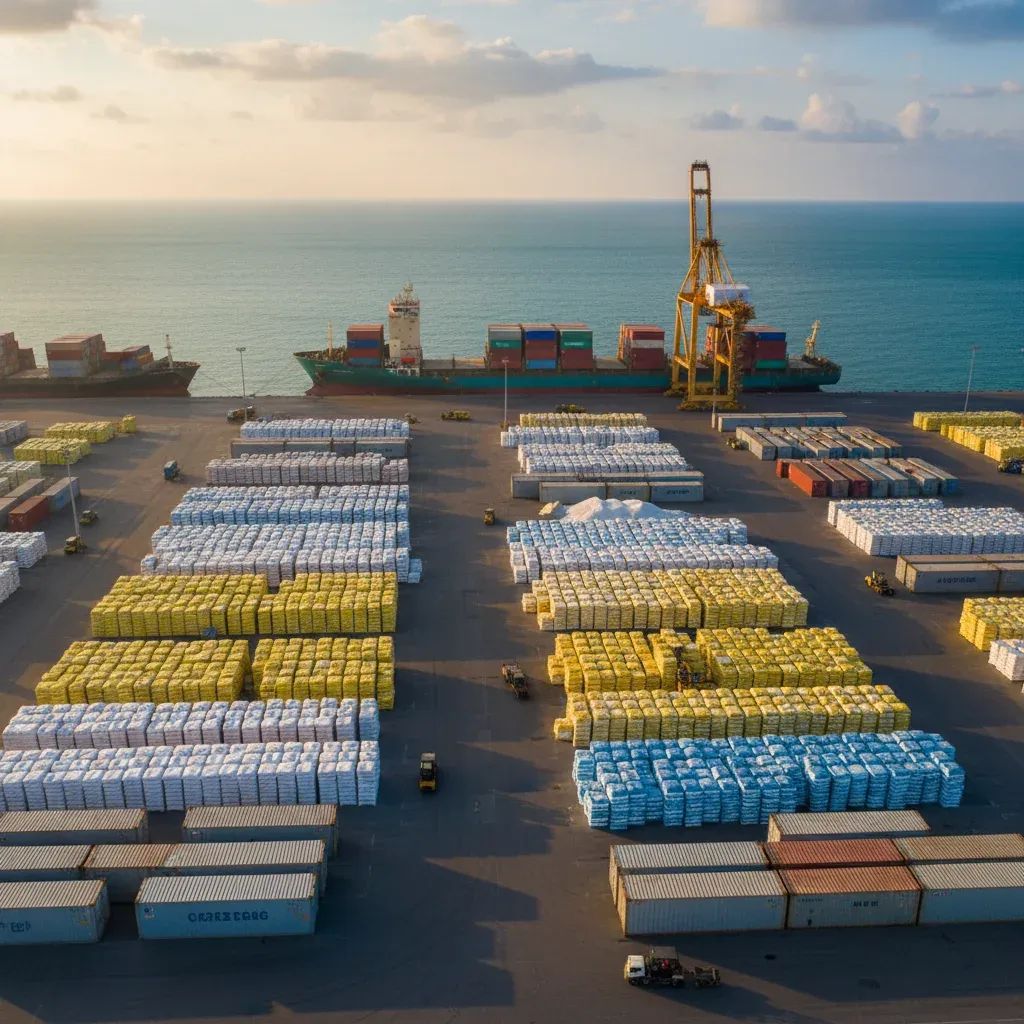
The Thailand Ministry of Agriculture and Cooperatives has secured a preliminary commitment from Russia to supply 1–2M tons of granular urea annually at preferential rates, a deal that could stabilize domestic fertilizer prices and ease the burden on farmers amid a global supply crunch driven by Middle East turmoil.
Why This Matters:
• Fertilizer security: Thailand imports roughly 95% of its chemical fertilizer, and urea accounts for 36% of total fertilizer use—making external supply shocks an immediate threat to crop yields and farmer income.
• Cost relief imminent: With global urea prices surging 50% in five weeks due to the closure of the Strait of Hormuz, the "friendship price" negotiated with Moscow could spare growers from another round of input inflation.
• First shipments by May: If private-sector negotiations conclude swiftly, the inaugural cargo from Russian producers PhosAgro and UralChem is expected to arrive by May 2026.
Russia Emerges as Alternative Supply Route
Thailand's pivot toward Russian urea follows months of price volatility traced directly to geopolitical shocks. In February 2026, U.S. and Israeli strikes on Iran triggered a 50% spike in urea prices within weeks. By mid-April 2026, granular urea had crossed $700 per metric ton, representing an 83% year-to-date increase.
Roughly 40% of global urea exports flow through the Strait of Hormuz, and the standoff has paralyzed shipments from Gulf producers—Saudi Arabia, Qatar, Iran, and the UAE—that collectively export 20M tons annually.
The Diplomatic Push
Against that backdrop, Agriculture Minister Suriya Jungrungruangkit traveled to Russia on April 13, 2026, meeting Deputy Prime Minister Dmitry Patrushev and Deputy Agriculture Minister Maxim Markovich to formalize the urea request. Moscow's readiness to open a long-term supply corridor reflects both commercial opportunity and strategic interest: Thailand and Russia have maintained diplomatic relations since 1897, and both nations view their partnership as foundational to regional stability.
Why Thailand Needs This Urea—And Why Now
Thai farmers consume between 5M and 6M tons of fertilizer per year, predominantly imported. Urea prices in Thailand had remained stable through mid-May 2024 thanks to existing stockpiles, but those inventories are now running thin.
Understanding Thailand's Fertilizer System
The Ministry of Commerce treats fertilizer as a controlled commodity, blocking retail price increases for current stock to protect consumers. New shipments, however, will carry the elevated cost of today's market, meaning future price increases could be significant.
For rice and oil-palm growers—whose margins have already tightened due to low farmgate prices (the base prices paid to farmers at harvest)—another fertilizer price jump could render the 2026 planting season financially unviable.
The Green Flag Fertilizer subsidy program (Thailand's government initiative that provides direct fertilizer cost assistance to registered farmers) may cushion some impact, yet budget constraints limit the government's ability to absorb the full cost differential. Securing 1–2M tons at negotiated rates would cover roughly 20–33% of annual urea demand, buying time for other supply routes—Malaysia, Brunei, and renewed Middle East channels—to stabilize.
How the Deal Will Work
The April 13 agreement sets the framework; execution now rests with the private sector. Russian Ambassador Yevgeny Tomikhin will coordinate Moscow's side, while Thai importers and state enterprises negotiate specifications, pricing, and shipment schedules. Both governments agreed to establish a joint working group tasked with resolving trade bottlenecks and facilitating scientific collaboration, with a three-month deadline to streamline customs and phytosanitary procedures.
Current bilateral agricultural trade stands at $1.6B, a figure both sides describe as far below potential. Russia has expressed interest in expanding exports of wheat, barley, and frozen meat to Thailand, while Thai fruit, seafood, and processed foods enjoy growing demand in Russian retail chains. Agricultural trade rose 15% year-on-year in 2025, and officials expect the urea arrangement to accelerate momentum across the broader trade basket.
What This Means for Residents
Farmers: If negotiations close on schedule, urea availability should improve by late May 2026, coinciding with the onset of the main planting season. Monitor announcements from the Ministry of Agriculture website (www.moac.go.th) and major fertilizer distributors including Thai Farmers Bank, TMMC Fertilizer, and Thai Urea regarding allocation and retail pricing. Those enrolled in the Green Flag program should check with their local agricultural cooperative offices for additional subsidy details in the coming weeks.
Consumers: Fertilizer costs feed directly into the price of rice, corn, vegetables, cooking oil, and sugar—staples that appear regularly in Thai grocery bills. Stabilizing urea supply reduces the risk of a sharp spike in these food prices during the second half of 2026. The Ministry of Commerce will likely maintain price controls on staple foods if input costs remain elevated, though watch local market conditions closely in June and July.
Investors and agribusiness: The Russia deal underscores Thailand's willingness to diversify import channels beyond traditional Gulf suppliers. Companies involved in fertilizer logistics, warehousing, and distribution may see volume growth if the pilot shipments succeed and the arrangement extends into 2027 and beyond.
Global Urea Market in Upheaval
Thailand is not alone in scrambling for alternatives. India, the world's largest urea importer, has been tendering aggressively to secure stocks for its spring planting season. China, the top producer at 76.5M tons in 2026, restricted exports earlier this year to prioritize domestic farmers; some analysts expect Beijing to release limited quotas starting in May. Indonesia imposed its own export curbs in January, tightening supply in Southeast Asia.
Russian producers, meanwhile, have redirected flows toward Asia and Latin America following Western sanctions. While Moscow's urea output remains robust, logistical bottlenecks—shipping insurance, payment rails, port capacity—have constrained deliveries to new markets. The Thailand agreement represents a test case for whether Russia can reliably serve Asian buyers at scale.
Price Outlook and Risk Factors
Market watchers caution that even with Russian supply, Thai importers face a structurally higher cost environment. Average global urea prices are forecast at $0.33–$0.38 per kilogram in 2026, well above pre-conflict levels. Natural gas—the primary feedstock and energy source for urea production—accounts for roughly 55% of manufacturing costs, and European and Asian gas benchmarks remain volatile.
Three scenarios could further disrupt supply:
Prolonged closure of the Strait of Hormuz: Any extension of the blockade into the monsoon season would tighten global inventories and push prices toward $800 per ton.
Chinese export re-opening: If Beijing lifts curbs ahead of schedule, additional supply could dampen the price spike—but India and Brazil are likely to absorb most incremental volume.
Shipping and sanctions friction: Payment mechanisms for Russian fertilizer remain complex; delays in letters of credit or insurance coverage could postpone deliveries even after contracts are signed.
Next Steps and Timeline
The joint working group is expected to convene by late April 2026, with technical teams addressing product specifications—Thai buyers prefer 2.5–5 mm granular urea—and port logistics. Assuming no regulatory snags, PhosAgro and UralChem will finalize pricing and loading schedules by early May. Thai state enterprises and private importers will coordinate with the Ministry of Commerce to ensure orderly distribution and prevent hoarding.
Ambassador Tomikhin has indicated that Moscow views the fertilizer pact as a building block for broader economic ties, with energy, chemicals, and digital technology also on the agenda. A memorandum of understanding between the two countries' industry ministries, signed in 2025, provides the legal scaffolding for expanded cooperation.
For now, the urea deal offers a tangible signal that Thailand's government is willing to pursue pragmatic trade relationships wherever supply security demands it—even as Western allies impose sanctions on Moscow. Whether the arrangement proves durable will depend on execution, logistics, and the trajectory of global conflicts that continue to reshape commodity flows.


