
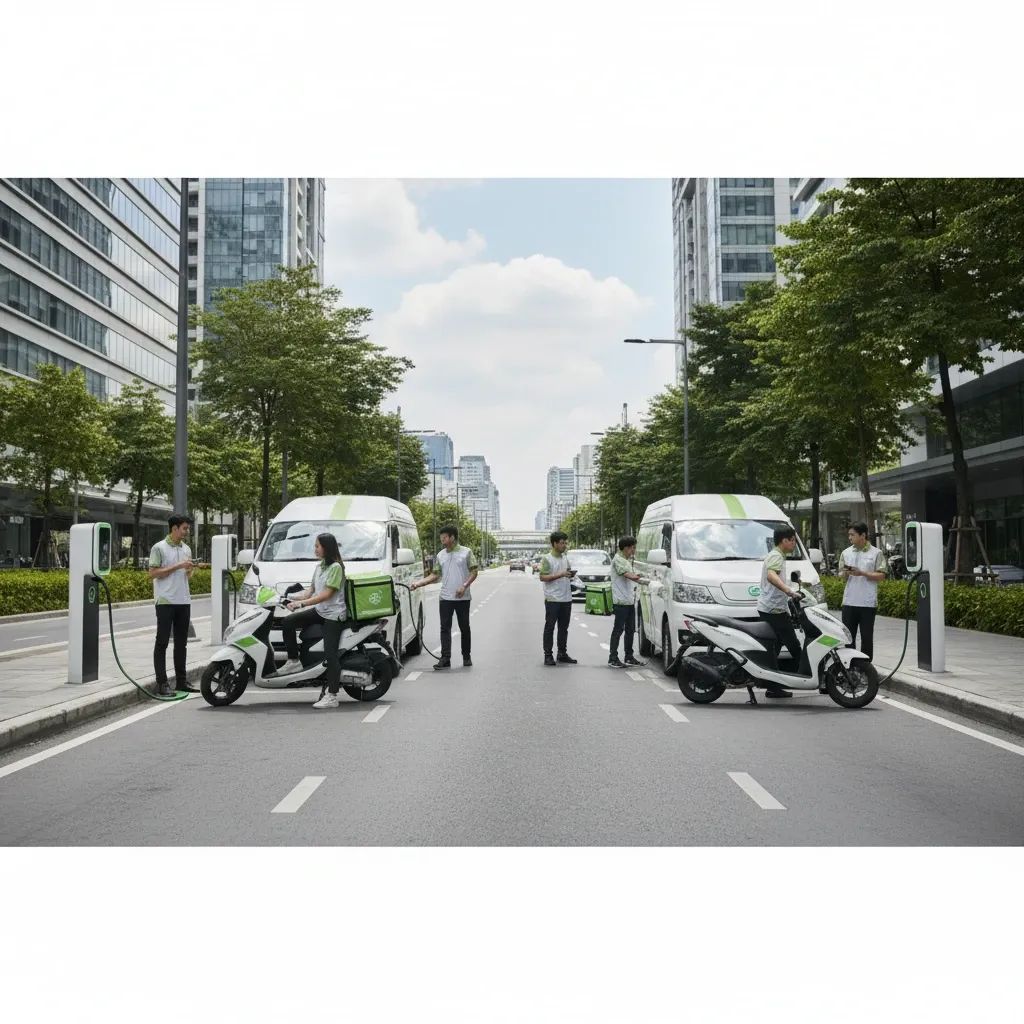
The Thailand Post corporation is accelerating its shift to electric-powered delivery vehicles, a transition driven by fuel costs that typically account for 30%-40% of logistics operators' variable expenses. With crude oil prices spiking to over $100 per barrel in March and global volatility squeezing margins across the transport sector, the government-owned enterprise is ramping up EV deployment to insulate itself from energy shocks that have already pushed Thai goods prices up 3%-5% in recent weeks.
Why This Matters
• Fuel volatility exposure: Without subsidies, diesel at Thai pumps would have hit 54.19 baht per liter this month; the Oil Fuel Fund deficit now exceeds 12 billion baht.
• Timeline: Thailand Post's five-year full-fleet conversion, launched in March 2023, enters its intensive phase in 2026, targeting full fleet conversion by March 2028, with over 100 delivery motorcycles set for electric conversion this year.
• Cost relief: Full electrification is projected to slash energy expenses by at least 30%, offering a hedge against unpredictable global oil markets.
Why Thailand Post Is Betting on Batteries
Thailand's logistics industry faces a cost squeeze not seen in years. Fuel typically accounts for 30%-40% of trucking variable costs, and with Brent crude forecast to average $95-$110 per barrel through 2026, operators are scrambling for solutions. Management at Thailand Post has opted to focus on replacing combustion engines with electric motors before the next price surge.
By the close of 2023, the postal service had deployed 250 electric vans across high-density routes in Bangkok, Phuket, and Chon Buri. Approximately 10% of its delivery pickup fleet now runs on batteries. The agency leases around 3,000 delivery vans and supports roughly 20,000 drivers who own their motorcycles—a sprawling operation that makes any transition complex. Route optimization efforts have already saved over one million liters of fuel in the past year, but management recognizes that sustainable cost control requires a structural shift.
The 2026 Conversion Push
This year marks the transition from pilot phase to scale. Thailand Post plans to convert more than 100 delivery motorcycles to electric models in 2026, a process that will require renegotiating employee benefit terms. Many riders currently receive fuel allowances; under the new framework, the company will lease electric motorcycles to staff, potentially altering compensation structures. The shift demands an "all-round evaluation" that accounts for loading area management, speed, transport routes, and space constraints.
Larger trucks remain a challenge. Limited availability of electric heavy-duty models in the Thai market means Thailand Post must either wait for suppliers to catch up or settle for hybrid alternatives. The revised excise tax structure for plug-in hybrids, effective January 2026, offers some relief: vehicles with a battery range of 80 km or more incur a 5% excise rate, while shorter-range models face 10%. This policy nudge could make certain PHEVs viable stopgaps until fully electric trucks become standard.
What This Means for Residents
Thailand Post's electrification has immediate consequences for anyone relying on parcel delivery, e-commerce logistics, or domestic freight. If Thailand Post passes operational savings to customers—achieving the projected 30% reduction in energy costs—residents could see stable or lower shipping rates, even as competitors pass fuel surcharges to customers. Flash Express and other private couriers have warned they may raise transport fees by 10%-20% to offset diesel price hikes; a state enterprise with locked-in EV costs could enjoy a competitive advantage.
For businesses, especially SMEs shipping goods nationwide, the stability of Thailand Post's pricing model matters. Preliminary estimates suggest that if crude exceeds $100 per barrel for an extended period, production and logistics costs could jump 20%-30%. A major postal carrier insulated from those swings offers a buffer against inflation in supply-chain-dependent sectors like e-commerce, agriculture, and manufacturing.
The transition also signals where Thailand's regulatory momentum is headed. The National EV Policy Committee has set a "30@30" target: 30% zero-emission vehicle production by 2030. Government and public fleets must be fully ZEV by the same deadline. Thailand Post's timeline—complete fleet conversion within five years from March 2023, targeting March 2028—aligns neatly with these mandates, positioning the agency as a test case for large-scale public-sector electrification.
Policy Tailwinds
Thailand's push to become a regional EV manufacturing hub has created a favorable policy environment. The EV3.5 scheme, active through 2027, slashed excise tax on locally built battery electric passenger cars from 8% to 2% and on BEV pickups from 2% to 0% as of January 2026. Imported EVs, however, now face a 10% excise tax, a deliberate move to favor domestic assembly and attract foreign investment.
The Board of Investment offers zero import duty on EV production machinery and corporate income tax exemptions lasting three to eight years. By mid-2025, three projects for electric buses and trucks had been approved, representing an annual capacity of 4,835 units and 2.2 billion baht in investment. For logistics operators, this means a growing menu of locally assembled commercial EVs at more competitive prices.
Infrastructure Gaps
Charging infrastructure remains the critical constraint. The government grants a five-year CIT exemption for operators building at least 40 chargers, but outside Bangkok and major tourist zones, fast-charging networks are sparse. Thailand Post's strategy hinges on optimized routes that align with existing infrastructure, but scaling to rural provinces will require either government investment or private partnerships.
The Oil Fund Dilemma
Thailand's fuel subsidy regime is under strain. The Oil Fuel Fund, which caps domestic diesel around 30-31 baht per liter, has accumulated a deficit exceeding 12 billion baht as of mid-March. Authorities announced a 50-satang hike this month, targeting a new cap of 33 baht per liter to ease fiscal pressure. For logistics companies still reliant on combustion engines, the message is clear: subsidies cannot last indefinitely, and the era of cheap diesel is over.
March 2026 saw sporadic fuel shortages, long queues at petrol stations, and purchase limits, particularly for diesel. Some operators resorted to informal suppliers charging premiums, disrupting delivery schedules and eroding margins. Thailand Post's bet on electrification represents a strategic response to this volatility—every van or motorcycle swapped for an electric model is one less vehicle exposed to pump-price instability or supply bottlenecks.
Broader Economic Implications
Rising fuel costs ripple beyond logistics. Natural gas shortages have driven up electricity generation costs, and a weakening Thai baht makes imported oil even pricier. For households, this translates to higher electricity bills and more expensive consumer goods. For exporters, it means thinner profit margins and tougher competition with regional rivals whose energy costs are lower.
Thailand Post's transition is part of a broader national strategy encapsulated in the Thailand E-Mobility Mission 2025-2035, which identifies "decarbonizing freight and logistics" as a core objective. The mission targets foundational development through 2027, scale-up by 2032, and maturity by 2035, dovetailing with Thailand's pledge to achieve carbon neutrality by 2050 and net-zero emissions by 2065.
For residents and businesses, the takeaway is straightforward: electric logistics are not a distant experiment but an accelerating reality. Whether you're an e-commerce seller, a rural entrepreneur relying on postal delivery, or a consumer watching shipping fees, Thailand Post's fleet overhaul will shape costs, service reliability, and environmental outcomes for years to come. The question is no longer if the transition will happen, but how smoothly the infrastructure and market can adapt to support it.


