
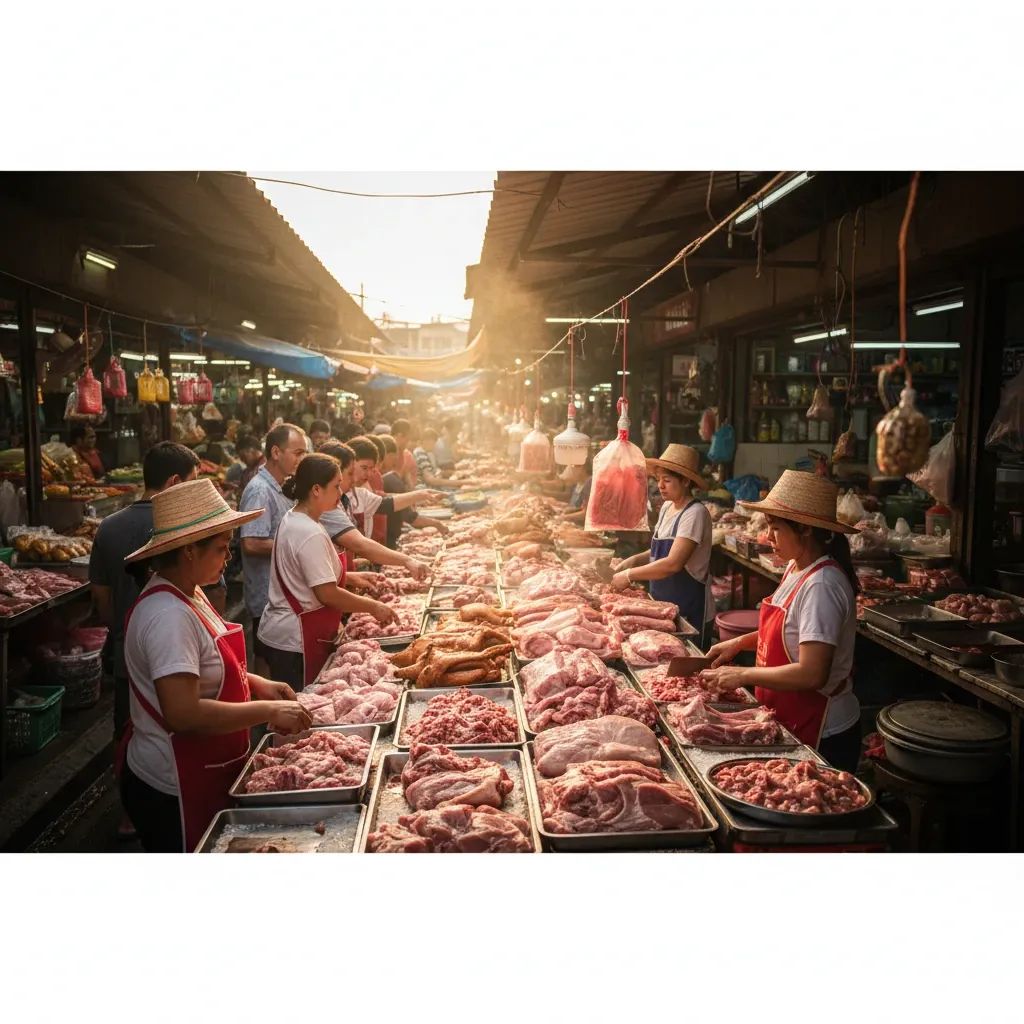
When Thailand's Pig Board announced a two-baht price increase in late March 2026, the news barely registered with international observers. But for residents in Pattaya and across the kingdom, the impact was immediate: farmgate pork had climbed to 72 baht per kilogram, and butcher counters were asking 145–155 baht per kilo for premium cuts—a significant price increase for low-income service workers who depend on daily market purchases.
Why This Matters
• Farmgate prices remain compressed near production cost: At 72 baht/kg (up from 68 baht in late March), farmers are barely covering estimated production costs around 68–70 baht/kg, leaving minimal margin. Weekly swings of 5–10 baht/kg are still being reported.
• Food absorbs 42% of household budgets: For households earning less than 15,000 baht monthly, pork price volatility translates directly into unmet needs—less variety, reduced nutrition, or increased borrowing.
• Seasonal relief expected in May: Agricultural economists anticipate price moderation once cooler weather arrives with the rainy season, which typically boosts livestock growth rates and slaughter volumes.
• Industry consolidation is underway: Smaller farms have been exiting the sector in recent years; production is shifting toward the Northeast, extending supply chains and adding transport costs.
The Convergence of Cost Pressures
The current price floor reflects genuine production pressures. Feed costs have climbed steadily, particularly soybean meal and amino acid supplements, which account for roughly 60% of farming expenses. When combined with elevated diesel prices driven by global energy tensions, transport costs from farm to market have become a significant portion of the final retail price. For a farmer in the Northeast shipping pigs 300 kilometers to Bangkok-area abattoirs, fuel costs represent a real margin squeeze.
Heat stress during summer months compounds the problem. Since late February 2026, Thailand has experienced typical extreme summer heat across northern and central regions. Pigs consume less feed in extreme heat, grow more slowly, and require extended time-to-market—simultaneously reducing output and forcing farmers to invest in cooling systems. Water bills and electricity costs for ventilation equipment have increased, directly absorbing already-thin profits.
Beyond immediate production costs, the Thai farming sector has experienced structural changes. According to industry reports, smaller operations have faced cumulative losses and exited the market in recent years. Meanwhile, larger producers have relocated facilities from Bangkok's increasingly restrictive environmental zones to the Northeast and lower North, extending supply chains and increasing logistics costs that cascade through to consumers.
Market Reality: Price Tags Don't Match Announcements
A critical gap separates announced farmgate prices from actual transaction rates. While the Thailand Department of Internal Trade publishes 72 baht/kg as the current benchmark, farmers report that real-world buying prices hover closer to 68 baht/kg—barely above production cost and insufficient to cover mounting debt obligations. This compression reflects buyer power: large abattoirs and meat processors, facing their own margin pressure, are negotiating downward despite official pricing signals.
For residents shopping at Amorn Market or similar wet markets across Pattaya, the retail reality is clear: pork that cost approximately 135 baht/kg eight weeks ago now ranges from 145–150 baht per kilogram for standard cuts, with premium cuts reaching 155 baht. Vendors report noticeably altered purchasing patterns. Regular customers who once bought 1–2 kilograms per visit now purchase 500 grams or less, or skip pork entirely on certain shopping days.
Immediate Impact on Pattaya Residents and Remote Workers
Tourism-dependent cities face a distinct squeeze. Pattaya's workforce includes seasonal hotel staff, restaurant employees, and service-sector workers whose wages remain relatively fixed while food costs spike. For expatriates on monthly budgets—especially retirees receiving fixed pension income in foreign currency—the erosion of purchasing power is palpable. A 10–15 baht price increase per kilogram over eight weeks translates to 200–300 extra baht per week for a household that previously consumed 20 kilograms monthly.
Dietary adaptation is already visible. Chicken thighs, once a premium alternative, now compete with pork on price, while eggs and tofu surge in popularity. Restaurant operators face significant pressure: absorb higher costs and watch margins decline, pass increases to customers and risk losing price-sensitive diners, or reduce portion sizes and invite complaints. Some establishments have quietly substituted chicken into dishes traditionally made with pork, adjusting their cost structure accordingly.
The household debt context amplifies the pressure. As documented in late 2024, average Thai household debt levels remained elevated, leaving limited financial flexibility when staple prices jump. The Thailand Kasikorn Research Center has documented that low-income residents experienced substantial food inflation during comparable market squeezes in recent years. Current dynamics suggest similar pressure on household budgets, particularly affecting workers in Pattaya whose salaries have not risen proportionally to living costs.
Government Levers: Control and Stimulus
The Thailand Ministry of Commerce, working through the Department of Internal Trade and Department of Livestock Development, has engaged with major producers, feed manufacturers, and farmer associations to address the situation. The toolkit includes supply management, demand encouragement, and border enforcement.
On supply control, the Thailand Pig Board and major producers have implemented agreements to manage breeding populations—an attempt to prevent the cyclical oversupply that typically crashes prices and triggers farmer bankruptcies. Earlier interventions included coordinated piglet reduction programs and cold storage agreements to temporarily manage surplus meat during price troughs.
On demand, the government has organized nationwide price promotion campaigns at major retailers, aimed at maintaining consumption levels. The Department of Internal Trade has also requested that supermarkets and wholesalers exercise restraint during markdown periods—designed to protect farmer income and discourage further farm exits.
Border enforcement remains an ongoing priority. Illegal pork imports—primarily from Vietnam—distort pricing and undercut domestic producers during soft markets. Enforcement inconsistency and corruption remain obstacles. Additionally, the government has encouraged export development for live pigs and processed meat to Japan and other regional markets, a strategy intended to absorb domestic surplus and provide producers alternative revenue streams.
The Thailand Feed Mill Association faces pressure to pass declining raw material costs to farmers, though producers report minimal benefit so far. Global soybean prices have softened in recent months, but feed manufacturers have been slow to adjust retail pricing downward—a market dynamic that widens industry concerns.
When Will Relief Arrive?
Industry consensus points to seasonal weather as the primary price moderator. Once the rainy season begins in May, cooler temperatures and consistent moisture should improve hog growth rates and reduce heat-stress losses. By June and July, slaughter volumes should increase and farmgate prices should ease toward 65–68 baht/kg—still above pre-2024 baselines but more manageable for producers operating at margin. Cooler weather simultaneously reduces farm cooling costs, further improving earnings potential.
Feed ingredient moderation offers a secondary relief channel. If global soybean prices continue their recent decline and stabilize, feed costs should improve by mid-year. A reduction in feed costs would meaningfully expand farmer margins without requiring additional price increases for consumers.
However, structural inflation is unlikely to reverse entirely. The Thailand Ministry of Commerce cautions that baseline pork prices will remain elevated relative to 2023–2024 levels. Energy costs, labor wages, and environmental compliance expenses are sticky; they don't fall easily when commodity prices ease. Residents should calibrate expectations: prices will remain higher than previous years.
Adapting to Persistent Pressure
For Pattaya residents and longer-term expats, several practical strategies help manage the squeeze. Wet markets remain more price-competitive than supermarkets, though quality and hygiene vary. Shopping early in the morning yields fresher cuts and sometimes better prices before vendor markups accumulate. Home cooking beats restaurant dining when possible—prepared meals carry built-in retail margin, while self-prepared dishes offer direct cost control.
Monitoring announcements from industry associations provides leading indicators of price trends. Prices typically reach retail markets with a lag, allowing shoppers to anticipate likely movements and adjust purchasing accordingly. During weeks when farmgate prices are reported stable, retail prices may soften slightly; during weeks of announced increases, retail movement typically accelerates.
Protein diversification is practical and necessary. Chicken thighs and legs, still cheaper per kilogram than pork, offer nutritional similarity. Eggs provide affordable protein for multiple meals. Fish and seafood, while subject to seasonal volatility, occasionally drop below pork when supply is high. Legumes and soy products stretch protein intake affordably, though cultural preferences influence their adoption.
Locating the Broader Story
The pork price episode illuminates a larger vulnerability in Thailand's food system. The economy remains dependent on climate-sensitive commodity production, energy imports, and smallholder agriculture. When multiple pressures align—seasonal heat, global fuel disruption, feed cost inflation—the system has limited buffer capacity. The structural changes underway may eventually stabilize supply, but the transition creates temporary pressure and highlights inequality. Residents with capital can weather price shocks; those living paycheck-to-paycheck face genuine hardship.
For expats on fixed incomes, the lesson is direct: currency movements, purchasing power erosion, and food inflation are interconnected risks that merit ongoing attention. Monitoring local price trends, maintaining flexible protein sourcing, and resisting assumptions about cost stability become essential components of financial planning in Thailand's evolving economic landscape.


