
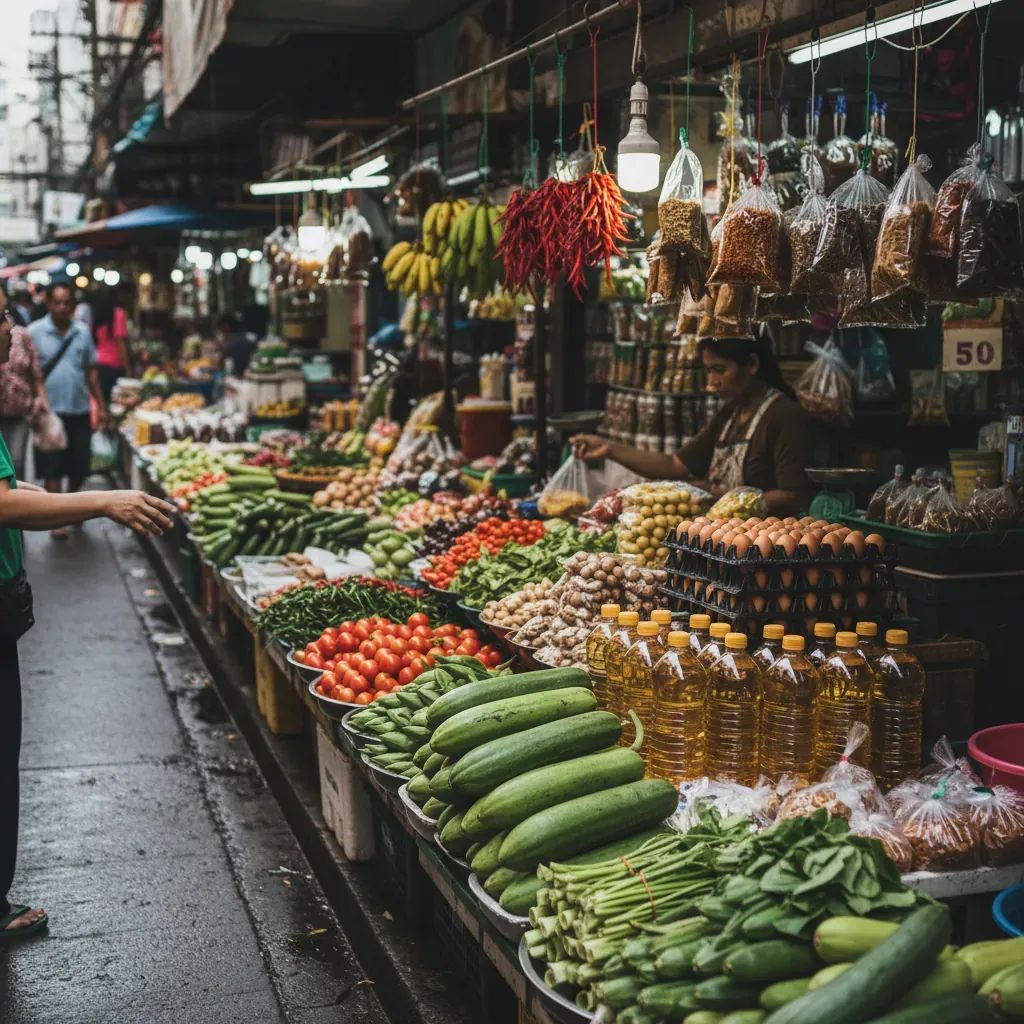
Fresh Protein Prices Jumped 12-15% Across Thailand in March Despite Government Controls
Fresh protein prices jumped 12-15% across Thailand in March despite government price controls, with pork, chicken, and eggs all rising sharply. Lean pork that cost ฿145–150 per kilogram earlier in the month now trades at ฿150–165. Chicken drumsticks jumped from ฿80–85 to ฿90–95. Eggs, a dietary staple for millions of Thai households and migrant workers, have climbed ฿0.20 per piece—a seemingly small fraction that adds up to a ฿180 monthly premium for families consuming two dozen weekly.
Budget-conscious residents, expats, and local families should allocate an extra ฿500–800 monthly for protein purchases based on typical consumption patterns.
Why This Matters
• Protein costs are rising faster than government can contain them: Pork increased ฿5–15/kg in two weeks; chicken drumsticks climbed roughly 12% in the same window.
• Farm-level cost pressures confirm the squeeze is real, not just retail opportunism: Live pig prices in Nakhon Pathom (Thailand's largest pork-producing region) rose ฿6/kg in mid-March, with producers announcing another ฿2/kg increase effective March 23.
• The Middle East conflict is the upstream trigger: Brent crude oil surged from $72 to $103.50 per barrel in three weeks, driving shipping premiums 200–500% higher and forcing reroutes that add 50 days to supply chains.
• Substitution is becoming harder for low-income households: Street-food vendors and small restaurants operating on razor-thin margins face a real choice—shrink portions, raise prices, or exit the market.
The Mechanics of Upstream Pressure
To understand why The Thailand Commerce Ministry cannot simply decree prices flat, it helps to trace a single egg or kilogram of pork backward through the supply chain.
For eggs, the story begins with heat stress on layer flocks (large groups of chickens kept for egg production). Record temperatures across central Thailand in March triggered physiological strain, reducing egg production below seasonal norms precisely when demand typically peaks. Simultaneously, farms were scheduled for age-based culling—standard practice before restocking with younger, more productive birds. The Office of Agricultural Economics confirmed that daily collection volumes fell measurably below trend. The Thailand Poultry Association responded by raising farm-gate prices (prices paid to farmers) ฿0.20 per egg on March 16, lifting prices from ฿3.20 to ฿3.40. Retailers, absorbing this increase while covering higher refrigeration costs (electricity bills spike during hot season), passed the bump to consumers. Grade 3 eggs, the middle market, now sell for ฿3.70–4.00 per egg in chains; street vendors report tray prices climbing ฿16.
For pork, the mechanism mirrors upstream. Feed costs, the largest single expense for swine farmers, absorbed a two-front shock in March. First, soybean meal (the critical protein additive for animal feed) remained stuck under a 10% import tariff—double the usual 2% WTO preferential rate—because Thailand's caretaker government failed to approve the 2026–2028 import policy framework. At the same time, new corn-import regulations requiring burn-free certificates constrained volumes, even though The Thailand Cabinet approved a 1-million-ton duty-free quota from the United States for February–June 2026. The gap between demand and available supply grew. Industry analysts estimate that sustained tariff gridlock could push feed prices up 10–15% over the coming quarter—a cost farmers cannot absorb without reducing herd size or raising gate prices (wholesale prices offered by farmers to traders).
The Thai Swine Raisers Association announced a ฿2/kg price increase for live pigs effective March 23, bringing farm-gate values to ฿70–72 per kilogram. That signal—the market telling producers "we cannot carry higher input costs alone"—ripples instantly to butchers and wet markets, where consumers encounter the new floor price within days.
Global Shocks Arriving Locally
The immediate trigger binding all three commodities is energy cost. When U.S. and Israeli forces struck Iranian targets on March 16, Brent crude surged from approximately $72 to $103.50 per barrel—a 44% spike in a single session. That price movement, while distant geopolitically, landed immediately in Thai ports.
Shipping insurance premiums in the Persian Gulf jumped 200–500% during the escalation. Thai importers sourcing corn, soy, wheat, and fertilizer from global markets faced bunker-adjustment surcharges (fuel cost supplements added to shipping fees, typically ฿100–150 per container) layered atop freight rates that had already multiplied six- to sevenfold due to Red Sea disruptions. Vessels forced to reroute around Africa added 50 days to transit time, increasing financing costs and spoilage risk.
Fertilizer, which Thailand imports at 95% dependency, climbed 55.3% on global markets. For farmers already contending with drought stress and high-heat conditions, the compounding pinch of expensive feed, expensive fertilizer, and expensive fuel left little room to absorb costs without passing them forward.
The Gap Between Policy and Practice
The Thailand Commerce Ministry oversees 59 categories of designated controlled goods, including 22 essential consumer items: instant noodles, canned fish, milk powder, chemical fertilizer, pesticides, animal feed, rice, and condiments. Any producer wishing to raise prices on a controlled item must submit an application to The Thailand Internal Trade Department for approval. Between March 17 and 19, ministry officials confirmed that no applications for price increases on controlled goods had been filed.
The contradiction is that fresh meat and eggs—while not always formally on the controlled-goods roster—are subject to intense monitoring under "Project Blue Flag (Thong Fa)," a government initiative in vulnerable districts aimed at preventing profiteering. Yet market data show these very items moving sharply upward.
The divergence raises a question that economists, traders, and residents all ask in private: Is enforcement weak, or are free-market dynamics simply overwhelming the regulatory perimeter?
Economists caution that prolonged price controls, however politically necessary, generate distortions that eventually backfire. When retail price caps prevent producers from covering input costs, the rational business response is to shrink supply—farms cull breeding stock, hatcheries delay expansion, traders divert goods to less-regulated channels or neighboring markets where margins exist. Short-term relief for consumers morphs into medium-term scarcity and even sharper price spikes once controls finally lift, as happened during multiple commodity cycles in Thai history.
Narrowing Margins in the Food Chain
Small restaurants and street-food vendors—the backbone of Thai dining culture—are being compressed from both ends. Their input costs (chicken, pork, eggs, oil, delivery charges) are climbing. But many operate in neighborhoods where customer loyalty depends on stable pricing; raise menu prices too aggressively, and regulars migrate elsewhere.
Some operators are quietly shrinking portion sizes. Others are holding prices but working longer hours to maintain turnover. A few are contemplating menu rotation, cutting dishes with elevated protein costs and substituting vegetables or starches. This squeeze, while less visible than retail sticker shock, carries social weight—it tilts food culture away from balanced protein toward carbohydrate-heavy meals, a shift with implications for nutrition and long-term health spending in lower-income communities.
Vendors report that a tray of eggs (30 eggs) now costs ฿6–16 more than it did two weeks ago. For a shop making 50–100 egg dishes daily, this represents a margin erosion of ฿300–1,600 per operating day—meaningful in a business that might generate only ฿500–1,000 total profit.
What Residents Can Do Now
Shopping strategies can help stretch your protein budget:
• Shop at morning markets (5-7 AM): Early markets typically offer 5-10% lower prices than afternoon markets as vendors clear stock and avoid spoilage costs.
• Check Blue Flag program locations: Project Blue Flag periodically offers government-subsidized protein sales below market rates in designated districts. Monitor local community boards or ask at your nearest subdistrict administrative office for participating vendors and timing.
• Consider protein substitution: Tofu costs roughly 30-40% less than pork per serving while providing similar protein content. Canned fish (sardines, mackerel) costs ฿15-25 per tin and delivers protein comparable to fresh chicken at a fraction of the price.
What the Coming Weeks Likely Hold
The Thailand Internal Trade Department data and trader reports point toward a plateau rather than a spike, but not toward relief. Pork is forecast to hold at current levels or edge higher into the Songkran festival period (mid-April), when traditional demand surges. Egg prices may stabilize if temperatures moderate and new layer flocks come into production; any further heat waves will re-tighten supply. Chicken is likely to remain elevated unless Brent crude dips below $95 per barrel—a scenario most energy analysts consider unlikely while Middle East tensions persist.
Households should budget an extra 10–15% for fresh protein through mid-April at minimum.
The Real Question Ahead
The Thailand Cabinet's duty-free U.S. corn quota and ongoing negotiations with major producers to secure discounted retail offerings are tactically sound but do not address structural vulnerabilities: near-total import dependence for key inputs (95% of urea, majority of soybean meal and corn), limited domestic storage and refrigeration infrastructure, and thin fiscal buffers to cushion global shocks.
If Brent crude remains above $100/barrel—increasingly likely given Middle East dynamics—transport and refrigeration costs will stay elevated indefinitely. If the soybean-meal tariff impasse drags on, feed formulators will either substitute lower-quality proteins (degrading animal nutrition and long-term productivity) or push costs entirely through to livestock farmers, who will push back to wet markets and dinner tables.
For residents, the practical calculus is simple: protein inflation is real, not imaginary, and the gap between government assurances and market prices reflects genuine supply-side constraint, not merchant greed. Adjust household budgets accordingly, shop strategically, and watch the Gulf. Every tanker delayed, every insurance surcharge imposed, and every barrel of oil escalated eventually arrives, in baht increments, at the neighborhood market counter.


