
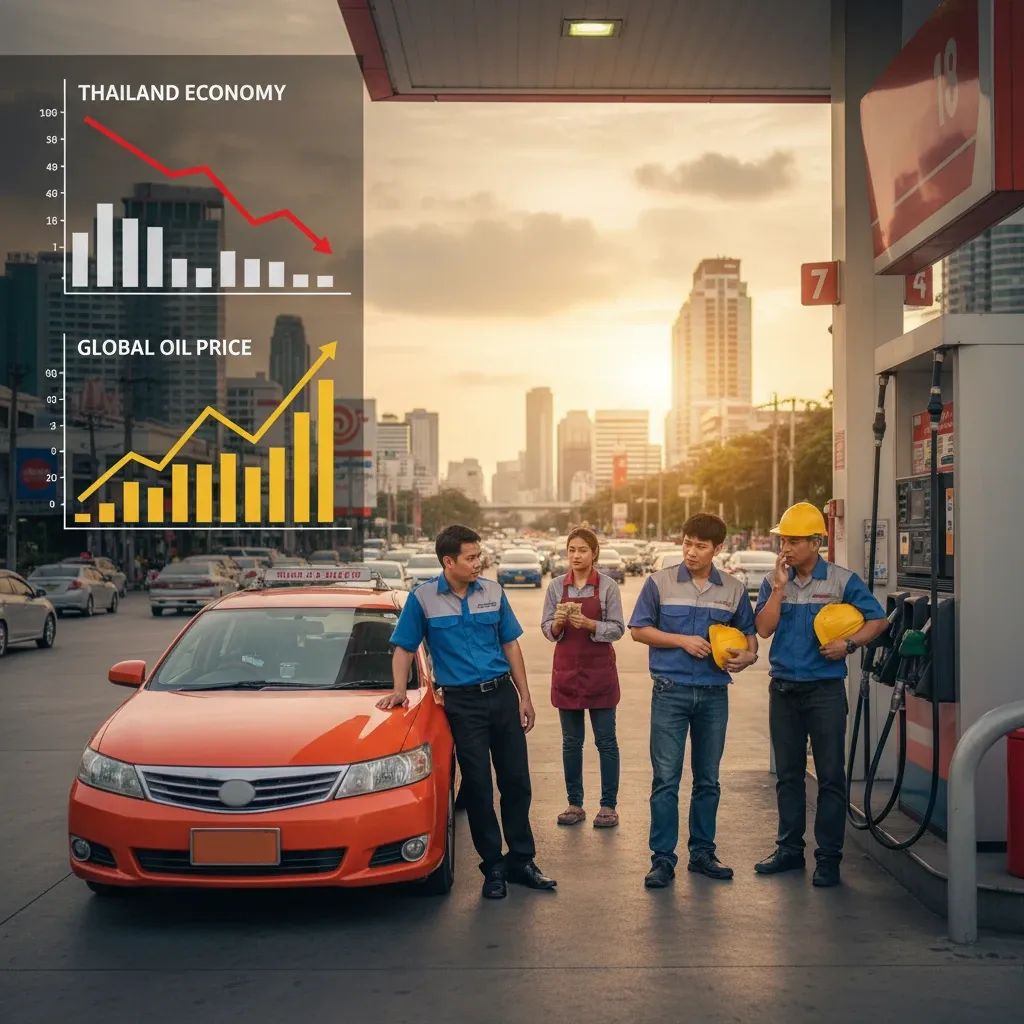
Thailand's Economic Struggle Deepens as Middle East Turmoil Ripples Through Supply Chains
Thailand is facing mounting pressure on its economy, with energy costs climbing and investors moving money elsewhere. The Ministry of Commerce convened a review on March 4 after escalating tensions in the region pushed crude oil past $80 per barrel—a level that will affect household budgets, factory margins, and government fiscal planning over the coming months.
Key Takeaways
• Fuel prices climbing: Pump prices reset every 2 weeks based on global benchmarks; diesel could reach 35-36 baht per liter if Brent crude sustains $100+, adding pressure to household costs for drivers and transport-dependent businesses.
• Currency under pressure: The baht may weaken toward 33 per USD if crude stays elevated, making imported goods more expensive and reducing remittances from Thai workers in the Gulf.
• Tourism declining: Middle Eastern visitors—who spend significantly more than average tourists—are reducing travel to the region; hotel occupancy in luxury segments could fall to 55-65% by Q2.
• Export logistics facing disruptions: Rerouting shipments around Africa adds 15-20 days and 7,500 kilometers; freight surcharges of $400-600 per container are affecting margins for Thai canned fruit, automotive parts, and rubber exporters.
The Energy Cost Transmission Mechanism
Brent crude's jump to $81-83 per barrel in early March marks the start of energy-cost inflation that will spread through the economy in distinct phases. The Bank of Thailand has modeled the impact: each $10 rise above the pre-crisis baseline of $56-60 reduces projected GDP growth by approximately 0.10% to 0.15% while lifting headline inflation by 0.4% to 0.5%—pressures that challenge the central bank's policy response.
Diesel and petrol prices reset every other Wednesday and Saturday, announced by the Energy Policy and Planning Office. Unlike many developed markets, Thailand maintains subsidized fuel pricing that absorbs some international volatility. However, that buffer has limits. Once crude approaches $95-105 per barrel, the government's ability to shield consumers becomes constrained. Current pump prices hover near 33-34 baht per liter for diesel; a sustained $100-barrel environment could push this to 35-36 baht—a significant burden for taxi drivers, delivery workers, and transport-dependent households.
Industrial consumers face more acute pressure. The PTT Plc, Thailand's state-controlled oil giant, hedges against volatility but cannot fully protect end-users. Manufacturing plants—particularly ceramics, textiles, and food processing—operate on floating energy-cost contracts indexed to Brent futures. With LNG prices rising alongside crude, electricity generation costs will climb within 1-2 billing cycles. Factories drawing power from Thailand's grid report utility costs rising 8-12% in a sustained $100+ scenario, according to the Thai Industrial Development Agency. That pressures factory competitiveness, especially for operations with thin margins already affected by logistics disruptions.
The Baht's Structural Vulnerability
The Thai currency's weakness reflects a mechanical imbalance rather than temporary market sentiment. Higher oil import bills widen Thailand's trade deficit at the same moment when foreign investors are rotating out of emerging-market equities into US Treasuries and Japanese government bonds. Geopolitical risk is driving capital outflows. The Bank of Thailand could intervene to defend the currency, but that depletes foreign reserves better preserved for genuine systemic emergencies.
Kasikorn Research Center warned plainly: if conflict persists and capital continues leaving, the baht could trade beyond 33 per USD—reversing appreciation gains from late 2025 when gold inflows and current-account surpluses had pushed the currency to 31.3 per USD. The Fiscal Policy Office had projected a baseline of 31.8 per USD for the year; that assumption is weakening.
A weaker baht creates winners and losers—but the distribution is uneven. Thai exporters enjoy a temporary competitive boost when selling abroad, but this benefit is limited. Exporters with dollar-denominated debts and importers purchasing foreign materials lose margin. Tourism operators who quote prices in baht while paying suppliers in foreign currency face reduced profitability. For rural households dependent on remittances from the Gulf, the impact is immediate and measurable.
Consider the arithmetic: a Kuwaiti dinar or Saudi riyal paycheck transferred home at 33.5 per USD versus 31.8 per USD represents a 5% reduction in purchasing power. For a nurse sending home 800 USD monthly, that translates to 500-800 baht in lost monthly income—amounts that matter in rural provinces where agricultural income is volatile and a single remittance often finances school fees and emergency medical care.
Tourism Sector: Revenue Facing Decline
The Stock Exchange of Thailand (SET Index) declined in early March as investors reduced tourism and hospitality holdings. The rationale is straightforward: the Middle East cohort—comprising a substantial share of premium international arrivals—is declining.
These are not budget travelers. Gulf nationals spend significantly more per night than average Asian tourists. They book luxury accommodations, dine at premium restaurants, purchase high-end goods, hire private guides, and commission spa services. A 30% to 50% decline in their numbers represents not just fewer room bookings but a 15% to 25% revenue reduction for the hospitality sector. The Joint Standing Committee on Commerce, Industry and Banking (JSCCIB) revised its tourism forecast on March 5, now projecting long-haul arrivals to fall short of 2025's 10 million benchmark—a forecast some analysts consider conservative.
Flight routing is the primary factor. Dubai, Doha, and Kuwait have curtailed aircraft schedules as airspace concerns affect operations and jet fuel supplies tighten. European and American tourists normally routed through these hubs now face additional routing costs. Some regional carriers have canceled services. Budget-conscious travelers are deferring plans or remaining within Asia. Families are adjusting trip duration or staying in the region.
Hotels in Bangkok's Sukhumvit and Silom districts, where Middle Eastern clients historically concentrated, are reducing nightly rates by 20-30% to fill inventory. The Thai Hotel Association warned members to prepare for occupancy dips to 55-65% by Q2, down from the 75-80% average. This margin compression translates immediately into employment decisions: payroll adjustments, reduced shifts, hiring freezes—already underway at major chains. Guides, drivers, and small operators dependent on commissions face income volatility. Rural homestays in Chiang Mai and Krabi are pivoting to domestic promotions at lower rates.
Shipping Disruptions and Export Margin Pressure
Thailand's direct trade exposure to Iran, Iraq, and Yemen remains minimal—less than 1% of total exports. But the kingdom's role as a critical supply-chain node means indirect effects are significant and already underway.
Rerouting vessels around the Cape of Good Hope—necessary since the Strait of Hormuz chokepoint tightened—adds 7,500 kilometers and 15-20 days to transit times from the Middle East to European ports. Fuel consumption rises for longer voyages. War-risk insurance premiums have doubled on affected routes. Shipping lines have imposed surcharges of $400-600 per TEU (twenty-foot equivalent container). Thai exporters of canned fruit, frozen fish, rubber, automotive parts, and machinery—operating with thin margins in competitive markets—are absorbing costs or passing them to buyers, risking order cancellations if prices become uncompetitive versus Vietnamese or Indonesian competitors with better logistics timing.
The Thai National Shippers' Council (TNSC) quantified the impact: a two-month sustained disruption of sea and air routes could inflict a 60 billion baht loss on Middle East-bound shipments—equivalent to 1-2 months of operating profit for mid-sized exporters. Working capital is now tied up for 50+ days instead of 30 days, forcing production schedulers to announce partial shutdowns to manage cash flow.
Automotive suppliers face particular exposure. Japanese and German car manufacturers order components from Thai tier-two and tier-three suppliers under just-in-time inventory models. Delayed shipments affect assembly-line scheduling. Factory orders for Q2 are already being delayed as production planners announce partial stoppages. Thai agribusiness—canned pineapple, frozen fish, dried fruit producers—navigates the same logistics pressure. A canned pineapple exporter sending containers to European distributors now waits 45-50 days instead of 30 days, tying up working capital and forcing difficult decisions about production volume and pricing.
The Gulf Employment Pipeline Under Pressure
Thailand has positioned itself as a labor exporter to the Gulf for decades. Communities throughout the Northeast (Isan) and Northern provinces depend on remittance income. Maids, construction workers, nurses, and hospitality staff send money home to support land purchases, education spending, and consumer demand in rural economies.
The conflict and regional economic slowdown now threaten this pipeline. Kuwait, Bahrain, and the UAE are tightening hiring and accelerating automation in hospitality and construction. Saudi Arabia, pursuing diversification, is prioritizing Saudi citizens in public-sector roles. Some employers have announced temporary or permanent layoff plans. The Ministry of Foreign Affairs activated a crisis hotline to monitor Thai nationals' safety and prepare repatriation contingencies.
An evacuation scenario remains unlikely, but gradual workforce reductions are probable. Workers facing wage cuts or job loss will return home, increasing Thailand's domestic unemployment. Regional economies will feel the ripple: construction materials suppliers, vehicle dealers, and consumer goods retailers in provinces dependent on remittance inflows will see demand soften.
GDP Growth and Inflation Scenarios
The Bank of Thailand's Governor Vitai Ratanakorn stated on March 4 that economic growth could decline by 0.1 to 0.2 percentage points in 2026 due to the conflict. More pessimistic analyses factoring in a 30-50% decline in regional tourism and sustained $100-120 per barrel crude project a 0.5% to 0.8% reduction in headline growth.
The JSCCIB maintained its baseline GDP forecast at 1.6% to 2% on March 4 but flagged that prolonged conflict could reduce growth to 1.3% to 1.6%—levels not seen since the pandemic recovery. The National Economic and Social Development Council (NESDC) outlined two stress scenarios: a contained escalation pushing oil to $95-105 per barrel, or a full Strait of Hormuz closure lifting prices to $115-125 per barrel. At those levels, Thailand's inflation could exceed forecasts by 1-2 percentage points, triggering policy response from the Bank of Thailand—either rate cuts that weaken the baht, or rate holds that suppress demand.
If oil prices stabilize in the $100-120 range and regional tourism declines by 30-50%, the combined effect could reduce Thai GDP by 0.5-0.8 percentage points. That would move the year's growth toward 0.8% to 1.5%—the lowest in a decade—triggering significant policy adjustments.
What This Means for Residents
Weekly diesel and petrol price resets from the Energy Policy and Planning Office are now a critical indicator. Any sustained move above 35-36 baht per liter signals elevated pricing and warrants household budget review. Motorcyclists and taxi drivers should expect operating costs to rise 5-10% if oil sustains above $95 per barrel.
Monthly inflation data released by the Ministry of Commerce should be monitored closely. If headline inflation exceeds 2.5-3% by May, the Bank of Thailand's room for dovish policy narrows. Food and energy prices will dominate; core inflation will follow. Grocery costs will feel measurably higher, particularly for imported goods and transport-intensive products.
Bank deposits and savings rates warrant attention. If the Bank of Thailand cuts rates to support growth (likely if the conflict persists), deposit yields will decline, making saving less attractive. Savers should consider fixed-rate instruments before rates fall.
Employment in tourism and export sectors will show strain by April-May. Hotel announcements about hiring freezes or layoffs typically precede visible staff reductions by 4-6 weeks. Workers in transportation, logistics, and hospitality should monitor industry developments and prepare for potential wage adjustments or reduced overtime.
Remittance-dependent families in Isan and Northern provinces should consider diversifying income sources. A 5-10% reduction in monthly remittances from Gulf workers is a realistic planning scenario if conflict persists into Q2. This could translate to 500-1,000 baht monthly shortfalls for affected households.
Stock market investors should recognize that tourism and hospitality sectors face headwinds through at least Q2. Oil stocks typically benefit from price spikes but are trading lower as investors focus on margin compression across industrial producers. Defensive sectors with stable cash flow and low import exposure offer more attractive valuations.
Government Response: Constrained by Fiscal Limits
The Ministry of Commerce rolled out six support measures:
Price oversight through the Bureau of Trade Control aims to prevent opportunistic markups on essential goods. Real-world enforcement remains challenging when supply constraints are genuine and costs are rising.
Raw-material diversification directs trade offices abroad to identify alternative suppliers of crude oil and LNG outside the Middle East, tapping West African producers and Southeast Asian neighbors. This requires months to negotiate and implement.
Exporter assistance expands credit lines through the Export-Import Bank of Thailand and defers collateral requirements for firms facing temporary cash-flow strain. This helps mid-sized exporters survive the logistics disruption but doesn't address the underlying structural challenges.
Shipping coordination with the Ministry of Transport attempts to secure container capacity and negotiate freight-rate moderation, protecting Thai-origin cargo from extreme surcharges.
Commercial intelligence directs Thai trade attachés to provide real-time supply-chain information, flagging delays and route optimization opportunities.
Inflation monitoring will review impacts monthly and brief the Cabinet on whether additional measures are warranted.
A hotline—1169—opened for entrepreneurs seeking emergency consultation.
Response capacity is limited by fiscal constraints during government transitions. Emergency spending requires parliamentary approval, which takes time. Political uncertainty about coalition stability adds hesitation to aggressive fiscal moves. The Bank of Thailand, meanwhile, faces competing priorities: cutting rates supports growth but risks further baht depreciation and imported inflation; holding steady risks demand compression and lower earnings.
The Baseline Outlook
The consensus among analysts is one of "managed adjustment": absent a sudden de-escalation, Thailand is likely to post below-target growth in 2026, elevated inflation, and currency pressure—but not collapse. The kingdom has weathered oil shocks before. Its diversified economy includes manufacturing, agriculture, and financial services beyond tourism. Foreign reserves, while under pressure, remain substantial. But the margin for error has narrowed. The next three months will define whether the year is remembered as a brief slowdown or the beginning of an extended downturn.


