
The Thailand Royal Thai Navy has deployed 30 patrol boats and a command vessel to intercept fuel smugglers in the Gulf of Thailand. The crackdown targets networks diverting diesel to Cambodia, with Prime Minister Anutin Charnvirakul calling it a matter of national security. Smugglers now face potential treason charges with fines exceeding 3.85M baht.
What This Means for Your Wallet Right Now
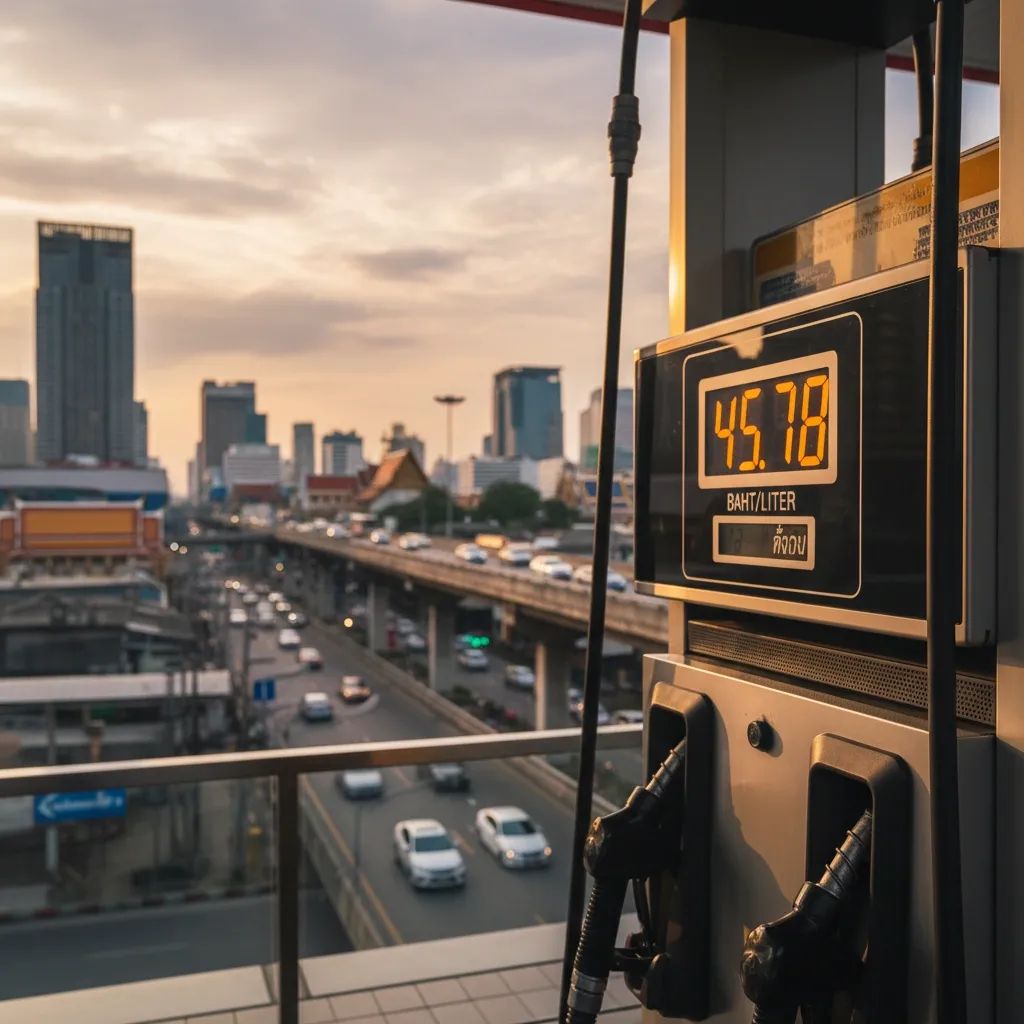
Diesel prices have jumped sharply, hitting 50.54 baht per liter on April 5—a 2.80-baht increase that directly impacts your daily life:
• Monthly transport costs: A household using 100 liters of diesel monthly (typical for pickup truck owners) will pay an extra 280 baht—roughly equivalent to two meals at a street vendor.
• Grocery bills rise: Trucking costs flow into food prices; vendors and small businesses absorb higher transport fees, passing them to shoppers.
• Taxi and tuk-tuk fares: Already rising, with diesel at 50.54 baht, comparable to a taxi fare across central Bangkok.
• Public transport squeeze: Bus operators and delivery services face margin pressure, potentially leading to fare increases or reduced routes.
For context, Gasohol 91 now costs 43.58 baht per liter, and standard gasoline hits 52.54 baht—roughly $1.44, or about 3% of Bangkok's daily minimum wage. For lower-income households, this represents a meaningful monthly expense.
Why Diesel Prices Are Surging: The Smuggling Crisis
Cambodia's diesel costs 8,100 riel per liter, compared to Thailand's 50.54 baht (approximately $1.38)—a difference of roughly $0.65 per liter that has turned fuel into one of the region's most lucrative contraband commodities. The price disparity widened sharply after Cambodia suspended official fuel imports from Thailand in June 2025, when bilateral tensions escalated into a territorial dispute. Cambodia historically sourced 90% of its diesel and 80% of its gasoline from Thailand, so the cutoff triggered immediate shortages and a scramble for alternative supply routes.
Smugglers have adapted by exploiting maritime loopholes. Thai Maritime Enforcement Command Center data reveals that fuel tankers ostensibly bound for Singapore or other third countries are slowing to "abnormal voyaging speeds" in the Gulf of Thailand, where smaller vessels pull alongside for ship-to-ship transfers before continuing to Cambodian ports. Other shipments are diverted overland through Laos, concealed in agricultural trucks or rerouted through depots that capitalize on rising spot prices.
"Evil" and "National Traitors": The Government's Language
Prime Minister Anutin has used unusually stark language, calling smugglers "evil" and warning that their actions could amount to treason. The rhetoric underscores the government's concern that unchecked fuel diversion could leave Thailand vulnerable to domestic shortages. Deputy Prime Minister Pirapan Salirathavibhaga emphasized that irregular practices—including depots refusing to supply retailers and maritime operators gaming delivery schedules—have contributed to localized fuel scarcity in border provinces.
The Excise Department has already imposed fines exceeding 3.85M baht in one seizure alone, involving 85,000 liters of smuggled diesel. Fuel companies found complicit face license revocation, while any civil servants or armed forces members involved will be immediately terminated, a measure aimed at deterring corruption within enforcement agencies.
Multi-Agency "Hunting Units" and War Rooms
Thailand's response involves overlapping enforcement layers. Central and provincial "war rooms" track fuel from refineries to retail pumps, cross-referencing Excise Department inventory data with GPS logs from the Ministry of Transport. The Royal Thai Police, Customs Department, and Department of Energy Business conduct joint spot checks, while the Anti-Money Laundering Office pursues financial trails linked to suspected smuggling rings.
Along the border with Myanmar, Provincial Internal Security Operations Command (ISOC) units have already identified fuel stations engaged in hoarding and cross-border diversion. The navy's enforcement is particularly intensive: the "Chaijinda" command ship and 30 patrol boats are tasked with intercepting mid-sea fuel transfers to fishing vessels, a tactic commonly used to disguise contraband shipments. Since March 6, naval inspections have flagged numerous tankers for "abnormal voyaging patterns," including slow speeds and loitering in international waters.
A public hotline (1599) and the LINE account @promchuay encourage residents to report suspicious activity, with the Royal Thai Police promising confidentiality for tipsters.
Refinery Margins Under Government Review
Officials are reviewing refining and marketing margins, using a five-year average benchmark of 2.43 baht per liter as a baseline to identify "excessive profiteering." The government has floated the idea of reclaiming "windfall profits" from refineries, though no formal mechanism has been announced. For ordinary motorists, this review could signal future price relief by mid-to-late May 2026—or at least a cap on further increases. Monitor official announcements from the Excise Department and Ministry of Energy for updates on the margin review timeline.
Border Volatility and Regional Impact
The closed land crossings with Cambodia remain a flashpoint. Although a ceasefire was brokered in late 2025, humanitarian and economic disruptions persist, affecting cross-border labor flows and trade in rubber, rice, and other commodities. The naval enforcement in the Gulf of Thailand has also raised concerns in Phnom Penh; Cambodia ratified the UN Convention on the Law of the Sea (UNCLOS) in January 2026, partly in response to a "threat assessment" that the Thai navy might obstruct supply routes.
Cambodian Prime Minister Hun Manet has ordered a nationwide investigation, pledging severe legal repercussions for companies and officials found facilitating smuggling. In Phnom Penh, the Ministry of Commerce set diesel at 8,100 riel ($2.03) per liter—more than double the 3,850 riel ($0.96) charged in late February. For context, 8,100 riel buys less than a kilogram of rice in Cambodian markets, underscoring the financial strain on households and small businesses across the border.
Regional Context and Broader Anti-Smuggling Efforts
Fuel smuggling affects the entire region. Malaysia grapples with subsidized RON95 petrol being smuggled into southern Thailand, where it sells at a premium. The Philippines loses an estimated $750M annually to fuel adulteration and smuggling. In the maritime "triangle" anchored by Thailand, Vietnam, and Singapore, organized crime groups siphon fuel from storage tanks, hijack tankers, and resell contraband at black-market prices—a trade estimated to be worth billions of dollars each year.
Experts recommend fuel marking programs with invisible chemical tracers blended at refineries to track products through the supply chain and detect smuggled products at retail stations. Other proven tools include Smart Under Vehicle Robots with AI-enabled imaging at border checkpoints and transnational legal frameworks for intelligence sharing with Cambodia, Laos, and Malaysia.
What's Next: Your Timeline for Relief
Immediate (April-May 2026): The crackdown will continue indefinitely, with Anutin promising "uncompromising law enforcement." Expect continued daily price fluctuations at the pump.
Short-term (May-June 2026): The Excise Department is reconciling multi-agency data to quantify smuggling scale before announcing further measures. The refinery margin review should yield preliminary findings by late May; watch for government announcements on potential price caps or windfall profit reclamation.
Longer-term: Whether Thailand and Cambodia forge a cooperative framework to address smuggling without escalating tensions remains uncertain. Until official trade channels reopen or alternative diplomatic solutions emerge, fuel smuggling is likely to persist—and pump prices may remain elevated.
For residents: Track fuel prices through the Ministry of Energy's official price dashboard and the Excise Department's updates on margin reviews. Budget an extra 250-300 baht monthly for transport and food costs. If the margin review succeeds by June, expect modest relief; if not, plan for prices to remain at current levels through mid-2026.


