
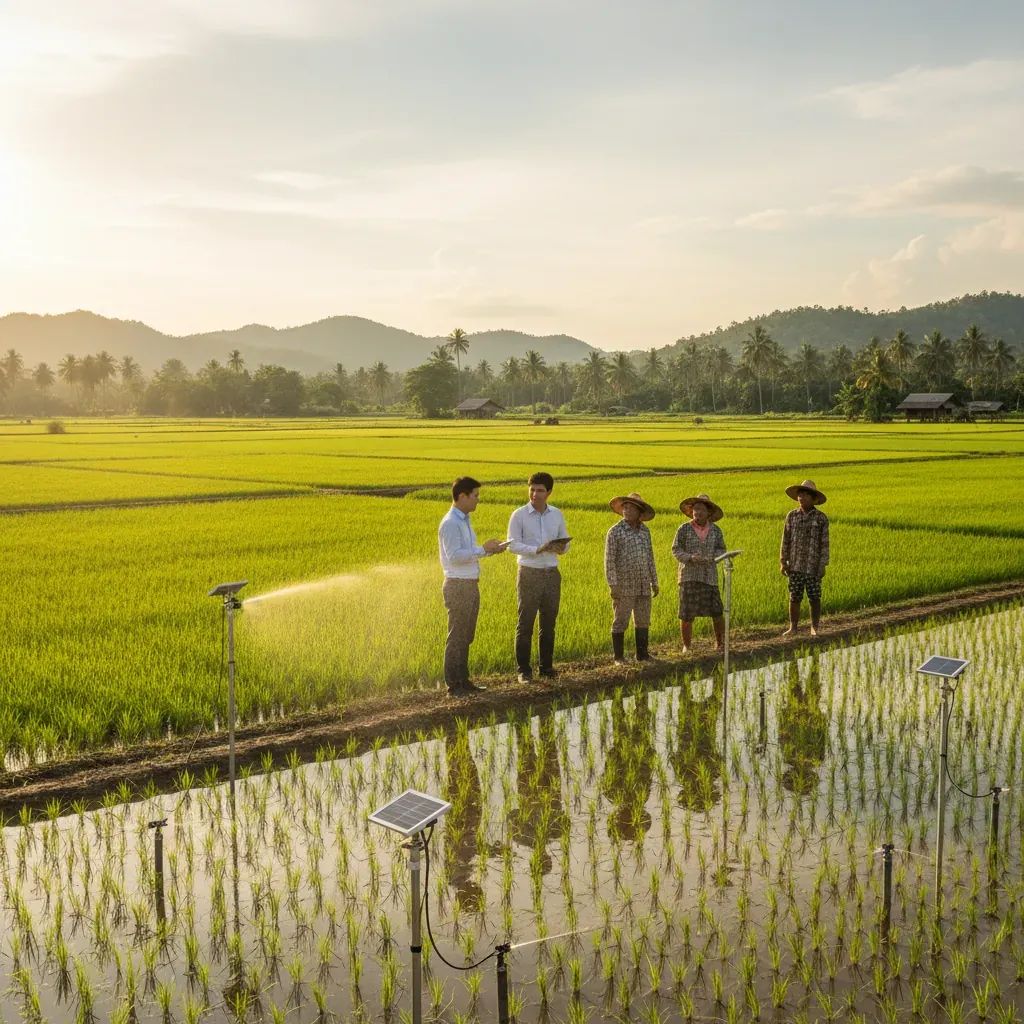
Regional Food Systems Face Growing Pressures: Thailand's New South Korea Partnership
Thailand is deepening agricultural cooperation with South Korea through a comprehensive five-year partnership aimed at protecting rice supplies and stabilizing food prices amid growing climate and geopolitical challenges.
The ASEAN-South Korea Comprehensive Strategic Partnership Plan (2026-2030), formalized in 2025, brings emergency rice reserves, smart farming technology, and research collaboration to Thai farmers—changes that will affect food security and costs for millions of residents.
Southeast Asia's food production faces mounting pressure from multiple challenges. Middle Eastern tensions are disrupting fertilizer supplies that ASEAN nations depend on. El Niño weather patterns have made harvest seasons less predictable. Trade routes that once felt stable are now uncertain. These pressures convinced the Thailand Ministry of Agriculture and Cooperatives and its ASEAN partners that technology and regional cooperation were no longer optional—they were essential.
Why This Matters for Thailand Residents
• Emergency rice access: The ASEAN Plus Three Emergency Rice Reserve (APTERR) now guarantees faster access to stockpiled grain, with South Korea contributing 2,000 metric tonnes annually. During crises, this means prices stabilize faster and supplies reach markets more reliably.
• Smart farming technology: Thai research institutions are testing low-emission rice techniques in pilot programs across the country. Farmers adopting these methods can access premium export markets paying 5-10% above standard commodity prices, creating incentives for adoption.
• Market opportunities for Thai businesses: Eighty ASEAN food companies, including Thai exporters, accessed Korean buyers at the 2025 trade fair. Small and medium Thai enterprises are now establishing direct relationships with Korean distributors and retailers—bypassing middlemen and expanding market reach.
Thailand's Specific Role in the Partnership
For Thailand specifically, rice is central to this partnership. The country is a major rice exporter, but extreme weather can still disrupt supplies and affect domestic prices. Thai research institutions are collaborating with South Korean experts on precision farming methods suited to tropical conditions and irregular rainfall.
Low-emission rice cultivation reduces methane from paddy fields while maintaining crop yields—a balance that addresses both climate goals and farmer incomes. For Thai farmers willing to adopt these practices, European and North American buyers increasingly demand carbon-neutral certifications, creating opportunities for premium pricing as environmental standards tighten globally.
How Smart Farming Works in Practice
In pilot programs across the region, smart greenhouse systems with environmental sensors and automated irrigation are reducing post-harvest losses—currently wasting an estimated 10-15% of regional production annually. The technology translates directly to more food reaching markets and more stable prices for consumers.
Thailand's contribution focuses on rice cultivation through precision farming methodologies. These include improved irrigation timing, soil monitoring, and pest management tailored to local conditions. South Korean experts have shared techniques refined over decades of agricultural modernization in Korea.
The Asian Food and Agriculture Cooperation Initiative (AFACI), anchored by South Korea, coordinates research across multiple countries. Member nations share datasets and verified techniques, accelerating learning that would otherwise require years of independent trial and error.
Supporting these initiatives is the ASEAN Food Security Information System (AFSIS), built with South Korean technical expertise. This platform monitors crop production, tracks commodity prices in real time, and flags emerging supply disruptions—allowing officials to coordinate responses before shortages develop.
Direct Benefits for Thai Farmers
For individual Thai farmers, participation in the low-emission rice program unlocks several advantages:
• Technical training: Access to expertise on new cultivation methods from proven programs
• Export opportunities: Premium certification for carbon-neutral production opens higher-value markets
• Emergency insurance: The rice reserve mechanism ensures government can access emergency stocks without lengthy negotiations, protecting domestic prices if regional supplies tighten
Thai food and beverage companies—particularly smaller enterprises lacking international networks—have already benefited from the 2025 ASEAN Trade Fair, where they established direct relationships with Korean distributors. These connections often evolve into technology licensing agreements and quality control knowledge transfers that create downstream employment.
Realistic Challenges Ahead
The partnership faces real obstacles. Technology adoption remains uneven, particularly among smallholder farmers who comprise most of Thai agriculture. A smart irrigation system or soil sensor represents upfront capital costs many farm households cannot afford, even with government subsidies.
Extension services struggle to deliver training at scale. A single agricultural officer typically manages 50-100 farmers, making intensive technical support difficult. Many rural areas experience intermittent electricity supply and limited broadband connectivity—requirements for data management platforms and precision farming applications.
Land fragmentation, where holdings shrink to subsistence size over generations, constrains mechanization economics. Insecure land tenure discourages long-term soil conservation investments. Limited rural credit access prevents farmers from financing equipment upgrades.
There is also the question of dependency. As ASEAN integrates more deeply with South Korean systems—adopting Korean seed varieties, purchasing Korean equipment, licensing Korean platforms—nations must carefully manage the risk of over-reliance. Diversifying technology sources and building domestic research capacity are essential hedges.
Five-Year Timeline for Measurable Results
The partnership establishes a realistic five-year horizon through 2030 for progress measurement: new research centers operational, farmer adoption rates exceeding 30%, trade flows expanding year-over-year.
The ASEAN Food, Agriculture & Forestry Sectoral Plan (2026-2030), endorsed by agriculture ministers in October 2025, includes specific carbon reduction and climate resilience targets. South Korean assistance on emissions monitoring will be essential to meeting these benchmarks. For Thailand, where agriculture employs millions and climate variability directly affects harvests and rural incomes, this alignment creates accountability.
What Success Requires
Whether this cooperation achieves its goals depends on factors beyond formal agreements: expanding rural credit access, improving land tenure security, building extension service capacity, and investing in rural infrastructure. The partnership provides enabling conditions, but success requires simultaneous progress on deeper institutional and economic foundations.
Regional cooperation reflects pragmatic necessity. As climate change accelerates and traditional suppliers become unreliable, ASEAN nations must develop internal capacity through collective action. The partnership framework reflects this realistic assessment—leveraging complementary strengths and building resilience through diversified partnerships rather than dependence on single suppliers or technologies.
For Thai residents, the immediate implications are straightforward: access to emergency rice reserves that stabilize prices, emerging technologies that improve agricultural productivity, and market opportunities that benefit exporters and create broader economic benefits across rural communities.


