
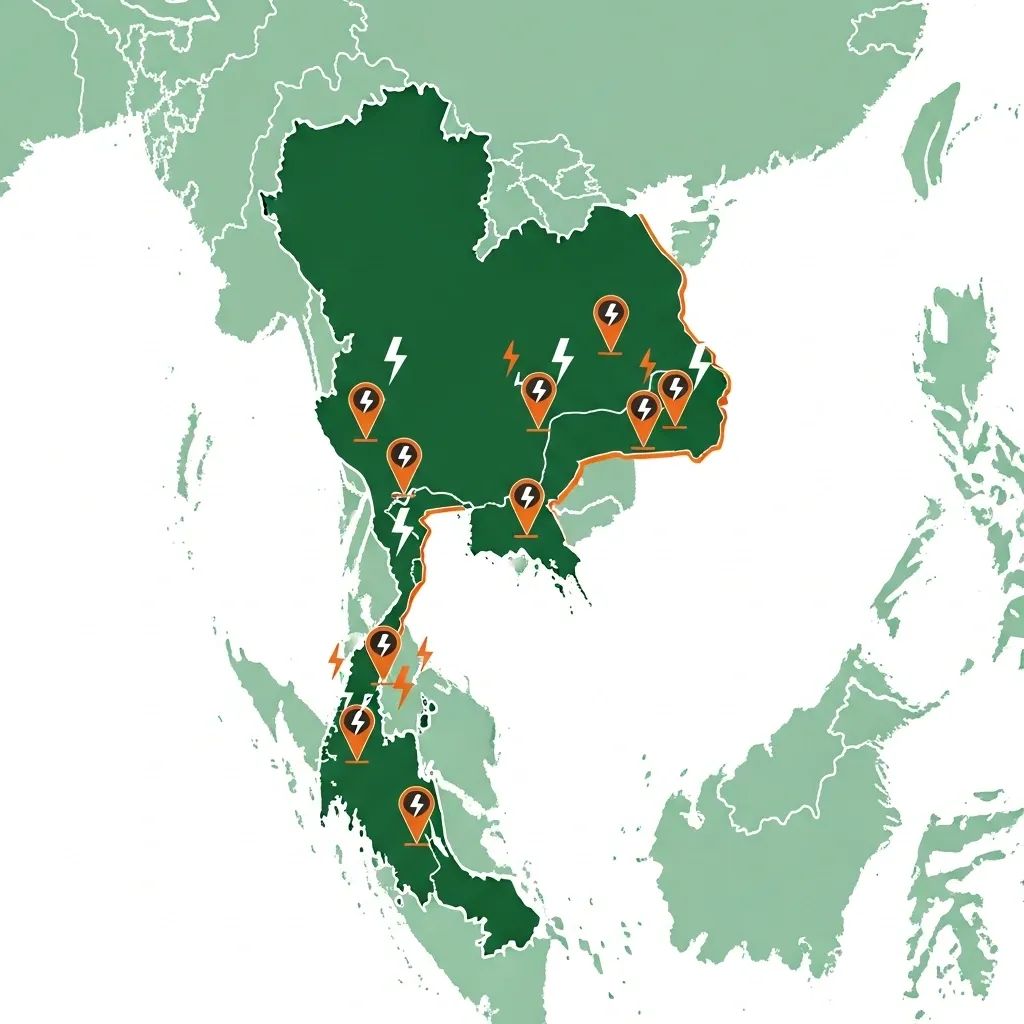
Thailand and China have formally locked in a multi-sector partnership framework that prioritizes tangible economic outcomes over ceremonial diplomacy. During Wang Yi's April 24 visit to Bangkok, the People's Republic of China's Foreign Minister and Thai Prime Minister Anutin Charnvirakul outlined cooperation mechanisms designed to address three immediate crises threatening Thailand's economic stability: volatile agricultural input costs, strategic shipping vulnerability, and organized crime networks that continue draining household wealth through fraudulent schemes.
Why This Matters
• Fertilizer imports face structural relief: China accounts for 30% of Thailand's compound fertilizer supply—approximately 13 billion baht annually—and discussions centered on expanding volumes. For Thai farmers already spending 29% of production costs on fertilizers, increased shipments could reduce grocery inflation by late 2026, though formal supply commitments remain unconfirmed.
• Malacca Strait toll risks accelerate Landbridge: Indonesia's signals of potential transit fees have shifted the 1 trillion baht Landbridge corridor from strategic curiosity to operational necessity. Construction bidding begins this year, with first-phase operations targeted for 2030—a 15-year timeline reshaping Ranong and Chumphon's economic profiles and projected to create 200,000 to 280,000 jobs.
• Crime repatriation mechanisms mature: Broader regional cooperation has facilitated over 57,000 arrests since early 2023, with China repatriating approximately 53,000 suspects in 2024 alone, yet hundreds of daily scam cases persist across the kingdom, indicating that law enforcement operations continue functioning unevenly across jurisdictions with weaker governance capacity.
Setting the Strategic Terrain
Wang Yi arrived at Government House not to exchange pleasantries but to operationalize a relationship increasingly defined by mutual vulnerability. Thailand faces import dependence across energy, fertilizers, and raw materials. China seeks regional stability, trade route alternatives to the Strait of Malacca, and commitment from Southeast Asian partners willing to absorb Belt and Road investments. This dynamic—neither party driven purely by ideology—creates space for pragmatic cooperation on issues where both nations face genuine constraints.
The bilateral agenda reflects this calculus precisely. Discussions bypassed ceremonial matters, focusing instead on supply chain resilience, infrastructure architecture, law enforcement mechanics, and investment frameworks. Both sides committed to developing a Joint Action Plan with measurable deliverables across sectors, marking a shift from diplomatic visits that produce photographs to visits that produce implementation schedules.
Agricultural Vulnerability and the Fertilizer Equation
Thailand's agricultural system operates within structural constraints that domestic policy alone cannot resolve. The kingdom imports nearly 99% of its chemical fertilizer—a dependency unmatched among regional peers—and China supplies roughly 30% of those imports through compound formulations essential for rice cultivation, vegetable production, and export crops like rubber.
When Beijing tightened exports between 2022 and 2024 to protect domestic reserves amid global supply disruptions, Thai farming communities absorbed the consequences. Input prices climbed, forcing difficult choices: absorb higher production costs, reduce fertilizer application and accept yield losses, or exit farming altogether. For smallholders operating on margins of 3-5%, these were binary decisions. The financial toll remains visible in regional agricultural credit defaults and abandonment of marginal land.
Anutin raised this crisis directly with Wang Yi, framing fertilizer supply not as a transactional commodity ask but as a regional stability issue. The Prime Minister indicated that sufficient Chinese fertilizer volumes, combined with parallel negotiations that Agriculture Minister Suriya Juangroongruangkit was pursuing with Russia, would provide farmers relief from production-cost compression. Wang Yi's response—assurances that Thai-Chinese relations resembled "sibling ties" and that Thailand "should not worry"—carried diplomatic reassurance but lacked specificity regarding volume commitments, pricing mechanisms, or delivery schedules.
The practical implications for Thai households hinge on whether promises translate into shipments. If China extends fertilizer supplies by the third quarter of 2026, rice and vegetable prices—now inflated due to production-cost pressures—could stabilize. If commitments remain rhetorical, agricultural inflation will persist, with impacts concentrated among low-income households where food consumes 40-50% of household budgets.
Monitor announcements from the Thailand Ministry of Agriculture regarding Chinese fertilizer shipment schedules as an early indicator of whether this cooperation moves beyond diplomatic courtesy to concrete trade flows.
The Shipping Dilemma and Landbridge Acceleration
For years, Thailand's proposed corridor linking the Andaman Sea port of Ranong with the Gulf of Thailand port at Chumphon—creating a 1 trillion baht overland alternative to the Strait of Malacca—existed in strategic limbo. Planners recognized its utility: shaving approximately four days off shipping times and reducing transit costs by an estimated 15%. Yet absent an immediate trigger event, the project remained a long-term hedge against hypothetical future disruptions.
That calculation shifted when Indonesia began signaling interest in imposing transit tolls on vessels traversing Malacca—a waterway handling roughly 25% of global traded goods. Although Jakarta has not yet implemented such fees, the mere possibility concentrated Thai strategic attention. Any new cost structure imposed unilaterally would disrupt shipping economics for Thailand's export-dependent economy, particularly vulnerable given reliance on commodity exports (rice, rubber, electronics) where margin compression rapidly translates into lost competitiveness.
Anutin communicated to Wang Yi that the Landbridge project now required "more intensive review," signaling that Thailand was treating it as urgent infrastructure rather than speculative mega-project. The strategic reframing has accelerated timelines: the Thailand Office of Transport and Traffic Policy and Planning (OTP) is finalizing tender documents, with private-sector bidding targeted for 2026, construction commencement this year, first-phase operations by 2030, and full completion by late 2036.
The project's anticipated impact is substantial. Reducing shipping times and costs for regional trade creates direct benefits for Thai exporters and foreign companies operating distribution centers in Thailand. Job creation projections—200,000 to 280,000 positions across construction, port operations, logistics, and supporting services—represent the employment equivalent of a medium-sized Thai province. Property values in Ranong and Chumphon will likely experience speculative pressure as investors anticipate logistics hub development.
Yet skeptics remain unconvinced regarding demand. Shipping companies have shown reluctance to divert established cargo flows unless cost advantages are demonstrably superior and service reliability proven. DP World from the UAE, New World Development from Hong Kong, China Harbour Engineering Co (CHEC), Evergreen Line, and Mediterranean Shipping Company have all expressed interest in bidding, suggesting investor appetite—though interest in contracts differs fundamentally from confidence in consumer demand.
Environmental groups and southern peninsula fishing communities have raised concerns about ecological disruption to marine ecosystems and local livelihoods, though these constituencies typically carry marginal influence in infrastructure decisions driven by government strategic priorities and international capital. The 15-year timeline means the project's financial returns lie well in the future; near-term disruption and displacement are more certain than near-term economic gains.
Crime Cooperation Shifts From Aspiration to Infrastructure
One area where Thai-Chinese partnership has genuinely matured beyond rhetorical commitment is law enforcement cooperation against transnational crime networks, particularly organized scam and human-trafficking operations that extract substantial wealth from regional residents.
The operational machinery is increasingly sophisticated. The Lancang-Mekong Integrated Law Enforcement and Security Cooperation Center (LMLECC), led by China and involving Thailand, Cambodia, Laos, Myanmar, and Vietnam, coordinates joint operations, intelligence sharing, and repatriations through formalized protocols established in 2023. In November 2025, this trilateral framework facilitated Myanmar's repatriation of over 5,500 criminal suspects to China. More broadly, regional collaborations between Chinese and law enforcement partners—with Thai participation—have produced over 57,000 arrests of individuals involved in cybercrime since early 2023, with China repatriating approximately 53,000 suspects in 2024 alone.
In February 2025, Thai and Chinese authorities jointly dismantled a 12-member human trafficking gang that was luring victims into online scam operations—a case exemplifying how cooperation extends beyond simple extradition to coordinated transnational investigation.
Anutin emphasized Thailand's role as a credible enforcement partner, stating that Bangkok had taken "decisive action at every level" of scam networks, from organizational leaders to street-level operatives. This framing carries diplomatic value: signaling to Beijing that Thailand will not become a safe haven for Chinese criminal fugitives seeking to operate from Thai territory—a concern Beijing has repeatedly raised in regional forums.
Yet the operational reality remains messier than arrest statistics suggest. Thailand continues experiencing hundreds of scam and fraud cases daily, resulting in substantial financial losses for victims. Scam operations have concentrated in zones with weak governance—particularly border regions and special economic zones—where enforcement capacity and political will remain inconsistent. Mae Sot in Tak Province, border areas of Mukdahan, and special zones in Songkhla have emerged as clusters of scam-related activity despite intensified law enforcement attention.
For residents, this means that while bilateral cooperation has matured operationally, individual vulnerability to fraud remains high. Victims of cross-border scams should expect repatriation and prosecution mechanisms to operate through diplomatic channels requiring months to resolve. Financial recovery remains unlikely; most victims absorb losses entirely.
What This Means for Daily Life in Thailand
For farmers and rural households: Watch for announcements regarding Chinese fertilizer shipment volumes and pricing. If imports accelerate by mid-2026, expect gradual stabilization in agricultural input costs and, by consequence, slower growth in rice and vegetable prices at the retail level. If supply commitments remain rhetorical, agricultural inflation will persist.
For businesses operating in southern Thailand: The Landbridge project's advancement will create logistics employment opportunities and property appreciation in Ranong and Chumphon, but disruption and construction-related transportation delays will precede benefits. Investors positioning for port and warehouse development should monitor the bidding timeline (targeting 2026) and construction contracts—typically awarded by late 2026 or early 2027.
For financial security: Continue vigilance regarding unsolicited requests for personal data or financial information, particularly from callers or messages claiming official status. Law enforcement cooperation has intensified, but daily scam cases persist due to structural vulnerabilities in financial regulation and communication security. Report fraud immediately to local police and the Thailand Cyber Crime Investigation Bureau rather than relying on international repatriation mechanisms to recover funds.
For investors and business operators: Thailand's deepening alignment with China—evidenced by Anutin's invitation to November's APEC Leaders' Meeting in China and the planned visit by Chinese Premier Li Qiang—signals recalibration in regional power dynamics. Chinese capital is flowing into infrastructure projects (Landbridge, transportation networks) and manufacturing clusters. Western businesses should anticipate visa policy adjustments, potential licensing complications for certain sectors, and increased scrutiny of technology transfer requirements. Simultaneously, Thai government support for Chinese investment may create friction with Western trading partners, particularly regarding technology supply chains and industrial cooperation agreements.
The Architecture of Strategic Partnership
Both governments committed to developing a Joint Action Plan establishing cooperation frameworks across multiple sectors with measurable deliverables. This represents substantive evolution from diplomatic visits centered on state-level symbolism toward operational frameworks tied to sectoral outcomes.
The exchange of high-level invitations—Anutin attending APEC in November and Premier Li Qiang visiting Thailand at an undetermined date—reflects this new tempo. Unlike previous state visits structured as ceremonial events, these engagements are explicitly tied to cooperation agendas covering fertilizer supply, infrastructure investment, crime cooperation, and energy security.
Anutin's gesture of personally driving Wang Yi to lunch in his private electric vehicle—departing from standard diplomatic protocol where security details handle transportation—carries symbolic significance in Chinese diplomatic culture. Such informal gestures are interpreted as signals of genuine personal rapport rather than transactional convenience, potentially influencing Beijing's willingness to prioritize Thai interests in subsequent regional negotiations.
Decoding the Partnership's Real Interests
The language of "family-like ties" and "sibling relations" obscures a partnership fundamentally grounded in hard-edged strategic calculation rather than historical affinity or cultural kinship. Thailand requires Chinese investment capital for infrastructure, trade access for agricultural exports, energy supply security, and supply-chain reliability that reduces exposure to international market volatility. China requires a stable, cooperative mainland Southeast Asian nation capable of anchoring Belt and Road projects, managing cross-border security externalities (crime, trafficking), and providing counterweight to Western influence and alliance structures in the region.
Each element addressed during Wang Yi's visit serves both parties simultaneously, creating alignment without requiring ideological agreement. Agricultural supply cooperation addresses Thailand's immediate vulnerability; infrastructure partnership serves China's energy security and trade diversification. Crime cooperation reflects mutual interest in domestic stability and cross-border control, particularly regarding the externalities of organized crime that destabilize both nations' financial systems and social cohesion.
What remains genuinely uncertain is whether this partnership will translate into sustained economic gains for ordinary Thais or deepen structural dependencies on Chinese supply chains, investment, and technology. The Joint Action Plan—once publicly released—will signal specificity regarding measurable outcomes versus aspirational cooperation language. Until then, the Wang Yi visit indicates that Thailand's economic and security calculus increasingly centers Beijing, with implications extending across agriculture, infrastructure, employment, and geopolitical positioning that will unfold over the next 5-15 years.


