
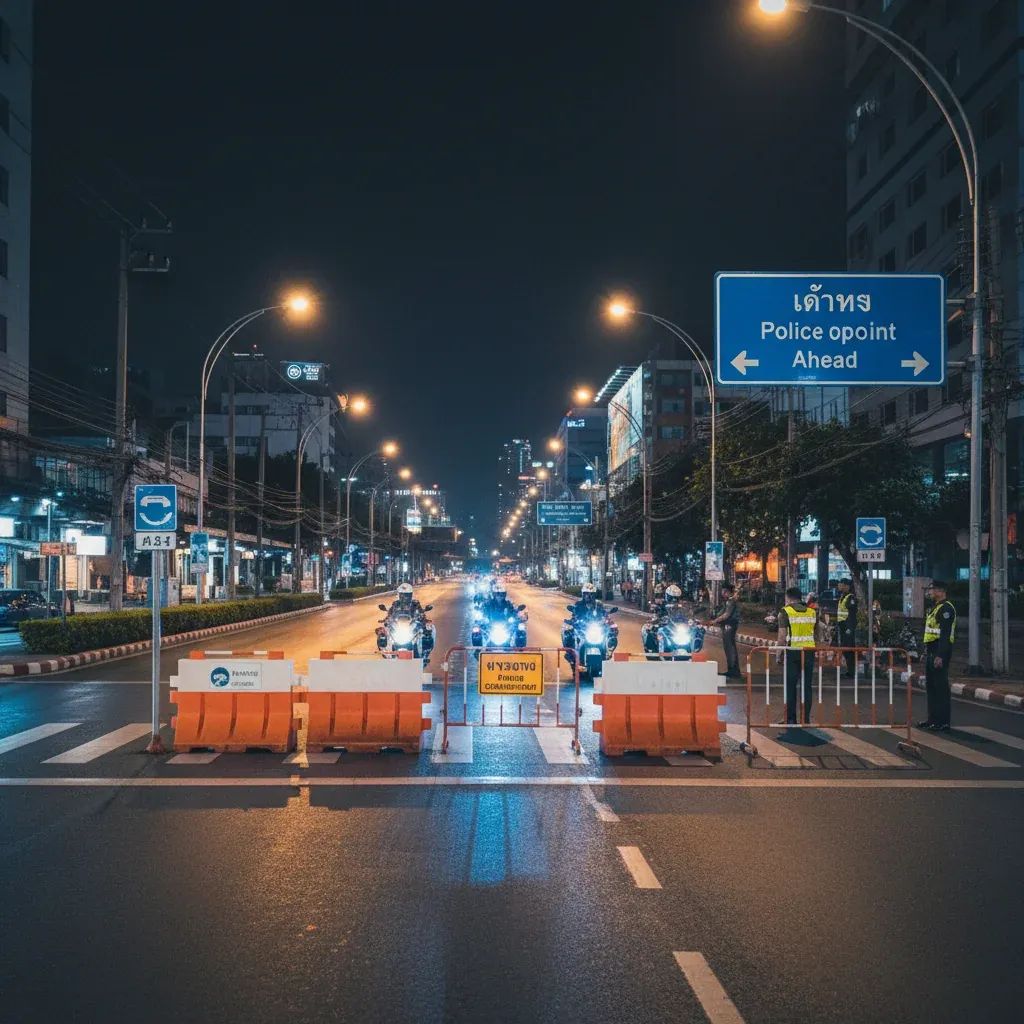
The Royal Thai Police have arrested eight youths and seized four motorcycles in Samut Prakan's Bang Phli district after plainclothes officers disguised themselves as locals grilling "moo krata" — a Thai-style BBQ — on a road island to observe illegal street racers without detection. The unconventional stakeout, which took place on the night of Saturday, August 15, marks the latest in a series of creative enforcement tactics aimed at curbing a persistent public safety problem that has drawn hundreds of complaints from residents and motorists.
Why This Matters:
• Penalties are escalating: Illegal racers now face up to 1 year imprisonment and fines between ฿5,000–฿20,000 if reckless driving endangers others, with vehicles subject to confiscation.
• Parents are liable: Guardians of minors caught racing can be fined up to ฿30,000 or jailed for up to 3 months under the Child Protection Act.
• Undercover infiltration is the new norm: Bang Phli police have also posed as racers themselves, riding motorcycles alongside teenage groups before making arrests.
The BBQ Surveillance Operation
A team of 16 officers from the Bang Phli Police Station set up their roadside barbecue on a traffic island adjacent to Chalerm Phra Kiat Road in Nong Prue subdistrict, an area that had become a known gathering point for young motorcyclists. The officers, dressed in plain clothes, grilled pork and acted as casual diners while monitoring a crowd of teenagers assembling for what appeared to be an organized race. Spectators were reportedly placing illegal bets on the outcome.
As riders prepared to launch, the undercover team radioed nearby uniformed units, who moved in quickly to block escape routes. The operation, dubbed "Camping: Sending Kids Back into Their Parents' Arms," resulted in the detention of eight youths aged approximately 14–15. All four motorcycles involved were impounded, and the suspects were handed over to investigators for formal charges. Authorities plan to notify the parents of each minor and pursue additional penalties under parental responsibility statutes.
Police later extended the operation to Leab Klong Song Nam Suvarnabhumi Road, another hotspot for illegal racing in the district. In a statement, the Bang Phli station emphasized that the barbecue was purely a surveillance tactic and that the site was cleaned immediately after the sting concluded.
A Pattern of Creative Enforcement
This is not the first time Bang Phli authorities have deployed unconventional methods. Earlier in August, around the 10th and 11th, officers executed an operation titled "Younger Racers, Older Racers Join In," in which police disguised themselves as street racers and infiltrated a group of teenagers on Bang Phli-Tamru Road. Riding motorcycles alongside the suspects, the officers gathered photographic and video evidence before revealing their identities and making arrests. The teenagers were charged with reckless driving and driving without regard for safety.
In a public warning issued after that operation, police cautioned that future participants in illegal races might unknowingly find themselves racing alongside an undercover officer.
Both operations were launched in response to a surge in complaints from local residents and motorists about the noise, disruption, and danger posed by nighttime motorcycle races. The tactics reflect a broader shift in enforcement strategy as traditional patrols have proven insufficient to deter organized racing groups, many of whom use social media to coordinate gatherings and quickly disperse when police approach.
Legal Framework and Escalating Penalties
Thailand's traffic enforcement landscape has shifted significantly as of April 1, 2026, with a nationwide push for stricter penalties now in effect. Under the current law framework, individuals caught street racing face imprisonment of up to 3 months and fines ranging from ฿5,000 to ฿10,000. Organizers, supporters, or promoters — including vehicle modification shops that prepare motorcycles for racing — face harsher consequences: up to 6 months imprisonment and fines between ฿10,000 and ฿20,000.
Even attempted street racing is now an offense. Gathering five or more vehicles with the intent to race, or demonstrating preparation to race with modified bikes, carries penalties of up to 2 months imprisonment and fines from ฿3,333 to ฿6,666.
If the racing involves reckless driving that endangers others, the penalties escalate further: up to 1 year imprisonment and fines between ฿5,000 and ฿20,000. Courts are also empowered to confiscate vehicles used in illegal activities, a measure that has been applied in multiple cases throughout 2026.
Perhaps most significant for families, parents of minors involved in racing can be prosecuted under the Child Protection Act, facing up to 3 months imprisonment or fines of up to ฿30,000, or both. This provision has been invoked in several cases this year, including a February arrest of 17 racers in Bangkok — 10 of whom were juveniles — on Vibhavadi Rangsit Road. That operation demonstrated early enforcement of the new parental liability standards. Adult offenders in that case were sentenced to one month in jail, suspended for one year, and fined ฿10,000 each. All 14 confiscated motorcycles were destroyed.
What This Means for Residents
For those living in areas frequented by illegal racers, the crackdowns offer a measure of relief but also underscore the scale of the problem. Samut Prakan, particularly the Bang Phli and surrounding districts, has emerged as a focal point due to its proximity to Suvarnabhumi Airport and its network of wide, relatively quiet roads that are ideal for high-speed racing.
Residents are encouraged to report suspicious gatherings to the Royal Thai Police hotline or local stations. Authorities have indicated that tip-offs from the public were instrumental in planning both the "moo krata" stakeout and the undercover infiltration operations.
For parents, the legal exposure is real. The Child Protection Act liability means that even if a minor is caught in the early stages of organizing a race — before anyone hits the throttle — guardians can face criminal charges. Legal observers note that this provision is being enforced more aggressively in 2026 as part of a broader deterrence strategy.
Broader Enforcement in 2026
Bang Phli is not the only jurisdiction experimenting with creative tactics. In March, Phuket police arrested two foreign nationals for performing dangerous wheelie stunts on large motorcycles on a public road, charging them under reckless driving statutes. In August, Pattaya police conducted early morning checkpoints targeting potential foreign racing groups. While no illegal weapons were found, officers issued fines for 5 cases of not wearing a helmet, 14 cases of not possessing a driver's license, and 5 cases of incomplete vehicle equipment.
The uptick in enforcement reflects mounting public frustration. Street racing is not merely a nuisance; it poses genuine danger to motorists, pedestrians, and the racers themselves. The use of undercover officers — whether grilling pork or riding motorcycles — signals a willingness by the Royal Thai Police to adapt tactics in response to an evolving problem.
As the crackdown continues, the message from authorities is clear: whether you're a participant, a spectator, or a parent, the legal consequences are significant and increasingly enforced. Police operations like the one in Bang Phli demonstrate that law enforcement will deploy innovative methods to identify and apprehend those involved in illegal street racing.


