
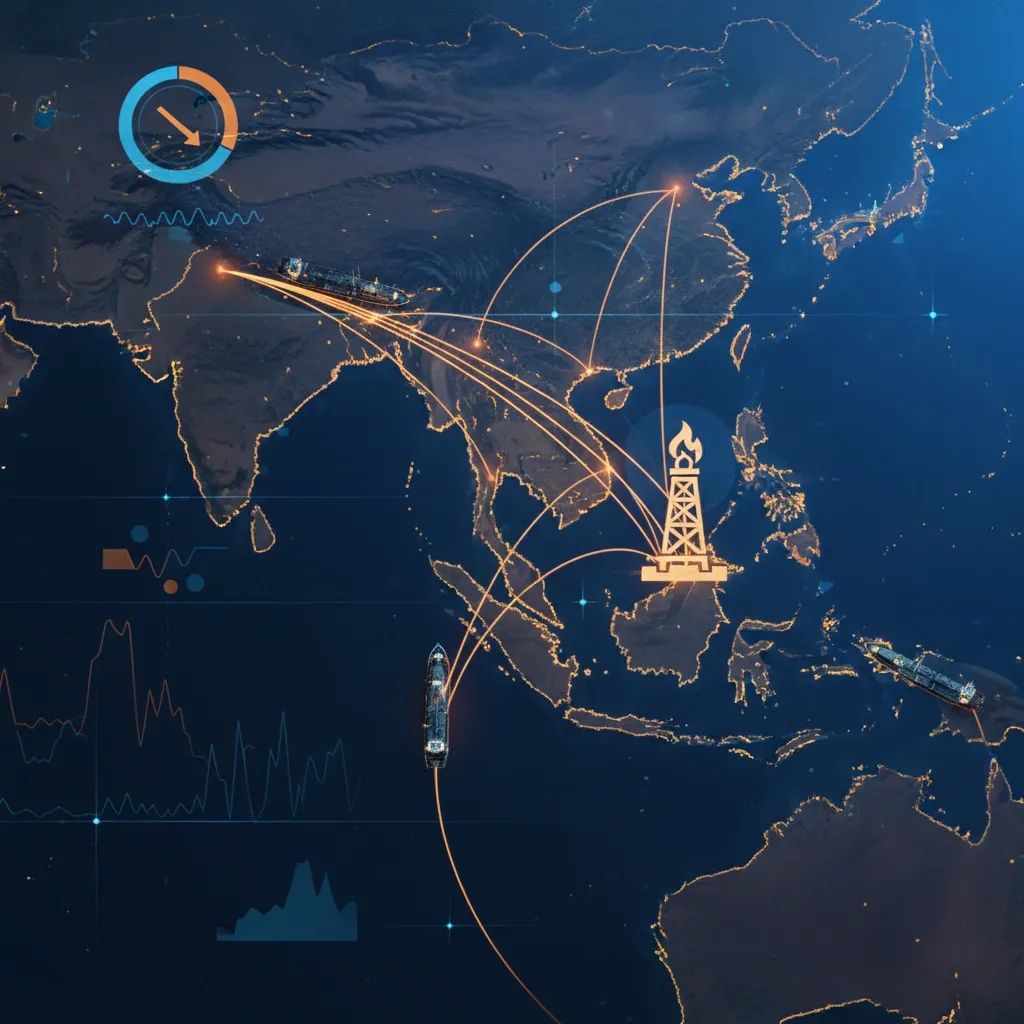
Thailand's energy economy faces a prolonged supply crisis even if diplomatic efforts succeed in stabilizing the Strait of Hormuz. The practical reality is far grimmer than any headline suggesting the waterway will simply "reopen"—the damaged infrastructure, lingering mistrust, and geopolitical stalemate mean that full restoration of normal oil and gas flows will stretch into 2027 or beyond, imposing sustained pressure on household budgets, industrial costs, and the baht's stability.
Why This Matters
• Thailand imports roughly 50% of its crude oil and liquefied natural gas from the Middle East, with Hormuz serving as the primary transit corridor
• Diesel prices at the pump could remain at or near ฿50 per liter if the blockade continues, adding 20-40 baht to every full tank
• Alternative pipeline routes collectively handle only 9 million barrels daily—less than half the pre-crisis flow of 20 million barrels—leaving a 11-million-barrel daily gap with no quick fix
• Recovery timeline: Even optimistic scenarios suggest 12-24 months minimum before normal operations resume, factoring in mine clearance, infrastructure repair, and the restoration of shipper confidence
How Thailand Got Here: A Rapidly Escalating Crisis
The Strait of Hormuz remains one of the world's most fragile economic lifelines, and in early 2026 it became a focal point of Middle East instability. On February 28, Iran's Islamic Revolutionary Guard Corps (IRGC) imposed a sweeping blockade in direct retaliation for U.S. and Israeli airstrikes that resulted in the assassination of Iran's Supreme Leader, Ali Khamenei. The move severed the passage carrying approximately 20% of global seaborne oil trade—nearly 20 million barrels daily under normal circumstances.
For Thailand, the immediate impact was sharp. Brent crude surged past $100 per barrel (approximately ฿3,500-3,600 per barrel) on March 8, then spiked to $126 (roughly ฿4,400 per barrel) on March 15. Diesel prices at Thai pump stations climbed steadily. Within weeks, the cascading effects reached fertilizer suppliers, petrochemical manufacturers, plastics producers, and even semiconductor assembly plants that depend on stable, affordable energy to remain competitive.
The blockade wasn't a single event but a pattern of escalating actions. The IRGC issued blanket warnings against transit, deployed sophisticated sea mines, and carried out attacks on at least 21 commercial vessels. By early April, maritime traffic through the strait had collapsed by 70-90%, with over 150 vessels anchored outside in a holding pattern, awaiting clarity that never came. Daily flows plummeted to 3.8 million barrels—a level not seen since the 1970s oil crisis.
The Damage That Bypasses Political Rhetoric
This disruption ranks as the single largest energy supply shock in five decades. For context: the 1973 Arab-Israeli war embargo reduced flows by roughly 5 million barrels daily. The 2011 Libya crisis cost the world 1.5 million barrels daily. The Hormuz blockade removed 16 million barrels from the market overnight—more than three times worse than any recent precedent.
What makes Hormuz irreplaceable is geography. The strait is only 21 miles wide at its narrowest point. Nearly all oil leaving the Persian Gulf must pass through it because alternative routes—pipelines running overland to the Red Sea or the Gulf of Oman—exist but operate at a fraction of capacity. Saudi Arabia's East-West Crude Oil Pipeline (Petroline) can handle a maximum of 7 million barrels daily during emergencies, routing crude to Yanbu on the Red Sea. The UAE's Abu Dhabi Crude Oil Pipeline (ADCOP) manages roughly 1.5 million barrels daily to Fujairah. Combined, all alternate routes handle approximately 9 million barrels daily at absolute maximum capacity—leaving a permanent shortfall of 11 million barrels that cannot be shipped anywhere except through Hormuz.
Iraq, Kuwait, Qatar, and Bahrain lack meaningful bypass options. Iraq's Kirkuk-Ceyhan pipeline to Turkey provides modest relief, but it operates independently and cannot absorb the gulf's combined export volumes. The math is unforgiving: there is no realistic workaround.
For Thailand, this constraint translates into direct economic pressure. PTT (Petroleum Authority of Thailand) operates Thailand's primary refineries at Map Ta Phut in Rayong and Sriracha in Chonburi. These facilities depend on specific crude blends from the Persian Gulf. Spot-market purchases at inflated prices erode profit margins and increase production costs. Alternative suppliers exist—from Russia, west Africa, and the Americas—but they command premium pricing or contractual commitments that disrupt supply planning and require refinery modifications. PTT's power generation facilities and LNG import terminals, designed for gulf-sourced liquefied natural gas, cannot easily switch to different suppliers without terminal modifications that take months and cost billions of baht.
Why Diplomatic Openings Won't End the Chaos Quickly
Japan's Foreign Minister Toshimitsu Motegi and British Foreign Secretary Yvette Cooper met in Tokyo this week and reiterated calls for the strait's opening and freedom of navigation. Both nations emphasized the interconnectedness of Indo-Pacific and Euro-Atlantic security, a diplomatic acknowledgment that energy disruptions abroad destabilize alliances at home. Bilateral cooperation on protecting nationals abroad and accelerated development of next-generation fighter jets underscored the broader point: strategic competition and economic resilience are now inseparable.
Yet diplomatic statements cannot immediately clear seabed mines or restore terminal infrastructure damaged in months of conflict. The new Supreme Leader of Iran, Mojtaba Khamenei, has declared Hormuz will remain a "pressure tool" against Washington and its allies until the U.S. lifts its naval blockade of Iranian ports. This creates a cyclical stalemate: the U.S. imposed the blockade to cut Iranian oil revenue and force a nuclear agreement; Iran retaliated by closing Hormuz; neither side will back down without concessions it perceives as intolerable losses.
Temporary ceasefires have collapsed repeatedly. In April 2026, a brief reduction in tensions allowed flows to creep back to 5 million barrels daily. But trust remains absent. Ship owners and insurance underwriters have not returned to normal risk assessments. War risk premiums on tankers remain elevated. Even with political agreement in principle, the operational machinery is too damaged and the psychological scars too fresh to permit a sudden normalization.
The Infrastructure Rebuild That Will Take Years
Physically restoring Hormuz requires a sequence of steps, each time-intensive:
Mine clearance represents the first major hurdle. The IRGC deployed sophisticated, remotely-triggered naval mines across the shipping lanes. Clearing them requires specialized mine-sweeping vessels, sonar surveys to ensure all devices are detected, and meticulous documentation. International naval forces typically progress at roughly 20-30 nautical miles of cleared channel per week under optimal conditions. The entire Hormuz passage spans approximately 21 miles width and is navigable through multiple channels—some of which must be surveyed for obstruction or new mines. A conservative estimate places mine clearance at 6-9 months minimum.
Port facility reconstruction constitutes the second phase. Iranian, UAE, and Saudi terminals sustained damage from missiles and drone strikes. Loading docks, storage tanks, pipeline connections, and administrative infrastructure require repair before commercial operations can resume at full capacity. This work overlaps with mine clearance but typically lags behind it. Historical precedent from the 2003-2011 Iraq conflict suggests 12-18 months for comparable port infrastructure restoration.
Insurance normalization is the third, often-overlooked factor. Underwriters will demand months of incident-free operations before premium rates return to pre-crisis levels. During the blockade, war risk insurance for vessels transiting the strait soared to 3-5% of cargo value—adding $300,000 to $500,000 (approximately ฿10-17 million) to the cost of a standard tanker load. Even after formal reopening, underwriters will likely require a 6-12 month "proof of safety" period before normalizing rates. Until then, shipping companies absorb elevated costs, passing them downstream to refiners like PTT.
Shipper confidence recovery is the final, most intangible barrier. Ship owners, charterers, and petrochemical traders will test the waters cautiously, starting with smaller, less valuable cargoes. This gradual restart mimics market behavior after other prolonged disruptions—confidence rebuilds incrementally, not instantly. The 1990-1991 Gulf War disrupted flows for months, but confidence took an additional 18-24 months to fully normalize as traders confirmed the security environment was genuinely stable.
Combining these factors, industry analysts estimate 12-24 months minimum before Hormuz handles pre-war volumes consistently. Under less optimistic scenarios involving renewed tensions or another military escalation, the timeline could extend to 2028.
What This Means for Residents
Thai households and businesses face structural, not temporary, energy cost increases. The practical implications are immediate and persistent:
At the pump: Diesel fuel, which powers the country's trucking, taxi, agricultural sectors, and fishing fleets, will sustain higher prices. Even if global crude stabilizes at $85-95 per barrel (approximately ฿2,975-3,325 per barrel)—well above the 2024 baseline of $70-75—Thai retail diesel will remain elevated relative to historical norms. Motorists should budget for sustained pump prices in the ฿45-50 range rather than the ฿30-35 seen in 2024. For a typical truck driver, agricultural equipment operator, or fishing vessel owner relying on daily fuel purchases, this translates to an additional 5,000-10,000 baht monthly in operating costs. Agricultural machinery costs will increase as well, impacting farm profitability across Thailand's northeast and central regions.
In grocery aisles: Higher transport costs ripple through supply chains. Food prices, already pressured by inflation, will see upward movement as the cost of moving produce from farms to markets rises. Imported goods—from consumer electronics to agricultural chemicals—face similar margin compression. Early inflation indicators from March-April 2026 already showed transport-driven price spikes in Bangkok and provincial markets. Tourism-related transport costs will increase, affecting hotel operations and domestic tour operators.
Electricity and household bills: PTT's power generation tariff structure incorporates fuel costs. While Thailand's Energy Fund historically absorbed some cost volatility, sustained higher oil prices may reduce government subsidies or require electricity rate adjustments. Residents in Bangkok and major cities should monitor PTT announcements regarding household electricity pricing, which could rise 2-4% annually if global crude remains elevated.
For industrial competitiveness: Thai manufacturers, from textile mills to electronics assembly plants, face margin compression. A factory importing petrochemical feedstocks sees raw-material costs climb while export prices remain locked into pre-crisis contracts. Medium-sized firms with thin profit margins (3-7%) may struggle. Some will relocate production to Vietnam, Indonesia, or India where energy costs are lower or diversified. This employment risk is real though not imminent, particularly in Rayong's industrial estate and the Laem Chabang area, major manufacturing hubs.
On currency markets: Thailand's baht has already weakened modestly against the U.S. dollar as energy import bills balloon. Thailand spent an estimated $20-22 billion (approximately ฿700-770 billion) annually on crude and natural gas imports in 2024. A sustained $20+ per-barrel premium on the historical average adds roughly $1.5-2 billion (฿52-70 billion) to annual import costs—a material drain on foreign reserves. This pressure weakens the baht's trading value, raising the cost of dollar-denominated debt servicing and imported consumer goods priced in foreign currency.
For foreign investors and residents: Expatriate workers remitting salaries home see the effective value of their baht transfers decline. Real estate investors in Bangkok face cooling demand if prolonged inflation erodes purchasing power among Thai middle-class buyers. Multinational corporations with Thai manufacturing bases—notably in petrochemicals, automotive, and industrial machinery—have signaled contingency planning. While Thailand remains politically stable and foreign investment remains welcome, the economic headwinds create marginal pressure on employment and workforce planning.
Preparing for Sustained Higher Costs
While Thailand's government and PTT work on energy diversification strategies, residents can take practical steps to adapt:
Transportation options: Electric vehicles (EVs) become more economically attractive as diesel prices remain elevated. With government EV tax incentives and improving charging infrastructure, switching from diesel to electric vehicles for urban commuting could reduce personal transport costs by 40-50% over five years, despite higher initial purchase prices. This is particularly relevant for Bangkok and Chiang Mai residents.
Energy efficiency: Upgrading to LED lighting, installing solar panels on residential or commercial properties, and improving air conditioning efficiency reduce overall electricity consumption. While upfront costs are significant (often 50,000-150,000 baht for residential solar systems), payback periods of 5-7 years become attractive given sustained energy price inflation.
Government assistance: Monitor announcements from Thailand's Energy Ministry regarding potential fuel subsidies, utility rate controls, or targeted assistance programs for vulnerable populations. Historical precedent suggests government intervention to protect lower-income households during energy crises, though policy details remain fluid.
Business adaptation: Small businesses should review supply chains and explore long-term fixed-price contracts with suppliers to hedge against further cost volatility. Agricultural cooperatives may benefit from group purchasing agreements for diesel fuel.
The Geopolitical Stalemate Behind the Blockade
Understanding why Hormuz remains vulnerable requires acknowledging the underlying conflict, which shows no signs of immediate resolution. The February 28 airstrikes killing Iran's Supreme Leader represented a major Israeli and U.S. escalation. Iran's response—missile and drone barrages against Israeli territory, U.S. military bases in the region, and Arab Gulf allies—was swift and coordinated.
Mojtaba Khamenei's declaration that Hormuz serves as a "pressure tool" reflects Iran's assessment that it holds asymmetric leverage. In conventional military terms, Iran cannot match U.S. or Israeli firepower. But by controlling a critical chokepoint, Tehran imposes economic pain globally, particularly on U.S. allies in the Middle East, Asia, and Europe. This asymmetric bargaining power gives Iran negotiating strength disproportionate to its conventional military capacity.
President Trump's strategy of imposing a naval blockade on Iranian ports aims to economically strangle Tehran, forcing nuclear concessions. Yet this approach has backfired economically: by blockading Iran, the U.S. invited retaliation that blocked Hormuz, causing far greater global economic damage than sanctions on Iran alone would inflict. The cycle has created a prisoner's dilemma where both sides lose more from continued escalation than from negotiated settlement, yet neither can afford to appear to capitulate domestically.
This dynamic has produced multiple ceasefire announcements, most of which collapsed within days or weeks as one side perceived bad faith by the other. Without a genuine diplomatic resolution addressing underlying grievances—particularly Iran's nuclear program, sanctions architecture, and regional security concerns—the Hormuz crisis will remain a recurring vulnerability.
Regional Cooperation as Economic Insurance
Thailand's challenge is navigating this environment as a non-aligned nation. Unlike Japan or Britain, which can coordinate closely with the U.S. and other developed democracies, Thailand must maintain relationships with multiple stakeholders: the U.S., China, the Gulf monarchies, India, Japan, and ASEAN partners.
Motegi's emphasis on Indo-Pacific security convergence signals Japan's view that energy security is now inseparable from military alliances. Tokyo depends on Middle East oil and LNG for roughly 90% of its energy imports—making it exceptionally vulnerable to Hormuz disruption. The UK, similarly, depends on Gulf oil indirectly through global energy markets. Both countries are investing in regional partnerships and accelerating military technology development (the fighter jet program with Italy exemplifies this) to ensure long-term strategic influence.
Thailand's position is more complex. The kingdom benefits from economic relationships with both Gulf producers and developed markets dependent on Gulf energy. The Thai government's strategic hedging—maintaining ties with both Washington and Beijing—is economically rational but limits Thailand's ability to unilaterally shape Hormuz outcomes.
What Thailand can do is accelerate energy diversification. Expanding liquefied natural gas (LNG) terminal capacity to accept supplies from Australia, the United States, and other non-Middle East suppliers reduces over-reliance on a single corridor. PTT has begun preliminary discussions with suppliers in these regions. Negotiating long-term contracts with alternative suppliers—including potential agreements with Central Asian gas producers via pipelines through Russia or China—adds flexibility. Investing in renewable energy infrastructure and battery storage, though costly, provides hedge insurance against future energy shocks. These initiatives cost billions of baht but represent rational economic adaptation to a fundamentally less stable energy environment.
The Long View: Structural Adjustment Ahead
Thailand's experience during the Hormuz blockade has exposed a strategic vulnerability. The kingdom cannot simply wait for international diplomacy to restore normal flows and then return to prior assumptions. Instead, policymakers must treat energy security with the same urgency applied to food security, pandemic preparedness, or infrastructure resilience.
This likely means:
• Accelerating renewable capacity: Solar and wind farms, though subject to weather variability, reduce dependency on imported hydrocarbon fuels. Thailand's 2030 renewable energy targets (currently 42% renewable energy) may need acceleration to 50%+ by 2030.
• Expanding LNG infrastructure: Additional regasification terminals reduce reliance on any single supplier and permit flexible sourcing. Current capacity serves only 60% of demand; expansion could reduce vulnerability.
• Building strategic reserves: Thailand's petroleum reserve capacity may warrant expansion, though costs are substantial (estimated at 10-15 billion baht for significant expansion).
• Supporting energy-efficiency standards: Industrial and commercial energy efficiency reduces total demand, providing inherent hedge against supply shocks.
• Diversifying energy sources: Exploring hydrogen production, nuclear partnerships (if politically viable), and long-term contracts with non-Middle East suppliers hedges risks.
These measures are costly and complex to implement. But the Hormuz crisis has demonstrated that relying exclusively on a single, politically unstable chokepoint for half of a nation's energy imports is untenable.
The Bottom Line
Hormuz will eventually reopen. But the timeline is measured in years, not months. Even if diplomats broker a lasting ceasefire tomorrow, the physical reconstruction of shipping infrastructure, the restoration of insurance confidence, and the recovery of shipper trust will extend well into 2027. For people living in Thailand, this translates to sustained inflation pressure, elevated household costs, and slower industrial growth than would otherwise occur.
The easy diplomatic solution—a ceasefire agreement—remains elusive. The hard logistical solution—restoring 20 million barrels daily through a mine-strewn, war-scarred waterway—will test the patience and budgets of Thai consumers indefinitely. Planning accordingly is not alarmism; it is realism.


