
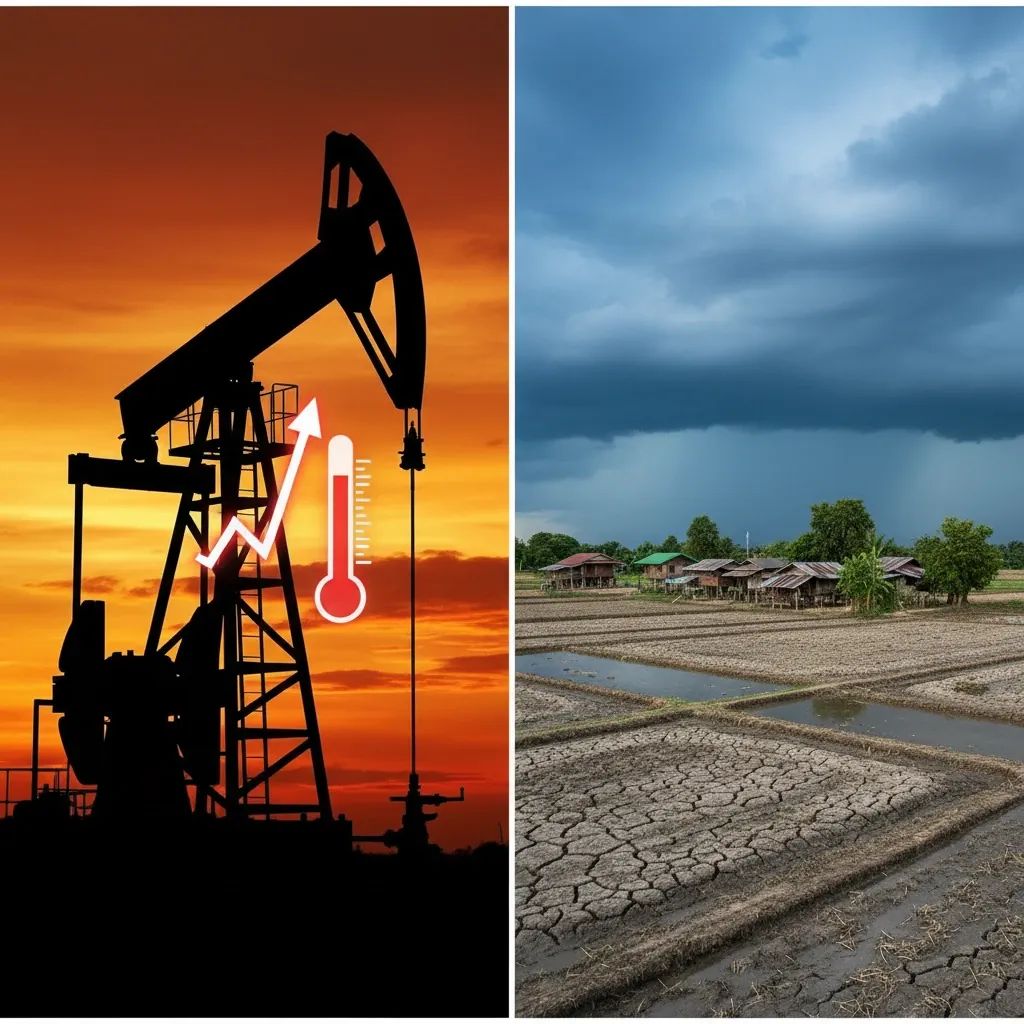
Thailand is mobilizing resources and deploying emergency water infrastructure in anticipation of severe drought conditions linked to a strengthening El Niño pattern expected to persist through late 2026. On July 9, 2026, authorities across the nation announced comprehensive drought-mitigation strategies, with Chiang Rai Province positioning itself as a national model for climate adaptation as meteorologists warn of one of the most severe dry periods in recent history.
Why This Matters
• Agricultural losses nationwide could exceed ฿62,000 million, with rice production alone dropping by 5.4 million tons if water reserves continue falling.
• Provincial water authorities nationwide have contingency plans for up to 80 consecutive days without rainfall, a scenario previously considered extreme.
• Reservoir levels across central Thailand have already fallen below the 30% crisis threshold as of early June 2026, signaling nationwide water stress.
• Temperature forecasts predict sustained highs above 45°C in some regions, threatening both crop yields and public health.
Coordinated National Response
Provincial governors and the National Disaster Prevention and Mitigation Command (NDPMC) have convened representatives from irrigation offices, military units, and agricultural extension services to establish operational protocols nationwide. The coordination formalizes Thailand's most aggressive pre-emptive drought response to date, integrating civilian agencies with military logistics capacity.
Military districts have positioned water tanker fleets and personnel under the "Citizens, State, United Against Drought" initiative, ready to deploy emergency drinking water to rural villages within hours of distress calls. Engineers are simultaneously inspecting village-level water storage containers and repairing community pipeline networks to maximize distribution efficiency when rationing begins.
Infrastructure Projects Fast-Tracked
The Ministry of Agriculture and Cooperatives has accelerated funding approval for critical water infrastructure projects that had languished in planning stages. In Chiang Rai, the Rong Pao Sluice Gate project will begin immediate construction, featuring 34 kilometers of distribution canals designed to irrigate 18,700 rai (approximately 3,000 hectares) of rice paddies and vegetable plots in areas currently dependent on unpredictable rainfall.
Companion projects include irrigation capacity expansion at Mae Nad for an additional 800 rai, while upgrades to the Mae Tak Reservoir will extend coverage to another 9,700 rai through spillway reinforcement and sediment dredging to restore water storage volume. These improvements also include solar-powered pumping systems to reduce operational costs for farmers.
In Phan District, engineers will reconstruct irrigation lateral 3La-RMC in San Klang subdistrict, serving 1,650 rai, and install a new overflow weir in Tan Tawan to address chronic flooding during the brief monsoon season while capturing runoff for dry-season use.
Nationally, the government approved 858 groundwater development projects to supplement surface supplies, focusing on communities with no access to canal networks. Additionally, the Wang Tonod Reservoir project in Chanthaburi Province received cabinet approval to bolster eastern region water security.
Smart Agriculture Transition
Provincial agricultural officers are pushing farmers toward Smart Farmer technology platforms that use soil moisture sensors and weather data to optimize irrigation schedules. The initiative aims to cut water consumption per harvest cycle by at least 20% without reducing yields, particularly for rice cultivation outside formal irrigation zones.
Authorities are offering subsidies for farmers willing to switch from water-intensive rice varieties to drought-resistant crops such as millet, sorghum, and cassava. Though industry analysts warn that cassava yields could fall 15-20% if drought conditions match worst-case projections.
Traditional rice cultivation consumes roughly 75% of Thailand's total water supply, yet more than 80% of agricultural land lies outside government-managed irrigation districts. This structural vulnerability leaves hundreds of thousands of households exposed to rainfall variability that El Niño will intensify.
What This Means for Residents
For residents throughout Thailand, the drought preparations signal potential disruptions to daily water access and agricultural supply chains. Water authorities have not announced universal residential rationing schedules yet, but contingency planning suggests authorities expect prolonged stress on municipal systems.
Residents in vulnerable areas—particularly provinces in central, northeastern, and northern Thailand—should prepare for:
Price volatility in fresh produce markets as farmers reduce planting or lose crops to heat stress. Rice prices could climb 10-15% by late 2026 if national production falls by the projected 5.4 million tons. Vegetables requiring frequent watering—lettuce, tomatoes, cucumbers—will likely see sharper price increases.
Intermittent water restrictions in areas served by surface reservoirs rather than groundwater wells. Urban centers like Bangkok and Chiang Rai city have diversified water sources, but suburban developments and rural areas may face evening cutoffs or rotating supply schedules starting July through September 2026.
Air quality deterioration from agricultural burning and forest fires, which historically intensify during El Niño-driven dry spells. The Association of Southeast Asian Nations has already flagged transboundary haze as a regional concern.
Practical steps residents should take now:
• Store 10-14 liters of drinking water per person (a two-week emergency supply)
• Check your local Provincial Waterworks Authority website for reservoir levels and water status updates
• Install water storage tanks if possible; government rebate programs are available in some provinces
• Prepare for heat (stock electrolyte drinks, plan air-conditioned refuge locations)
• Reduce non-essential water use immediately to ease pressure on municipal systems
National Context and Economic Impact
Krungthai COMPASS, the research arm of one of Thailand's largest banks, estimates that El Niño will shave 0.31% off national GDP through agricultural losses alone. Rice accounts for the largest share at ฿43,000 million, followed by sugarcane and cassava. Farmer incomes are projected to contract 8% year-over-year, compounding rural economic stress in provinces already struggling with commodity price swings and fertilizer cost inflation.
The National Water Resources Office is coordinating reservoir management across river basins to balance competing demands from agriculture, industry, and municipal users. Officials have prioritized drinking water security but acknowledge that sustaining industrial operations—particularly in the Eastern Economic Corridor—will require difficult trade-offs if monsoon rains fail to materialize by September 2026.
Regional Patterns and Precedents
Southeast Asia last endured a Super El Niño in 2015-2016, which caused widespread forest fires in Indonesia, severe droughts across the Mekong basin, and crop failures that triggered food inflation spikes. Meteorologists estimate an 80% probability that current conditions will persist through November 2026, with potential intensification into a "super" classification by August or September.
Bangkok and Samut Prakan rank among Asia's most heat-vulnerable cities due to dense urban development, limited green space, and the urban heat island effect that amplifies ambient temperatures by 2-4°C. Public health officials are preparing heat stroke treatment protocols and cooling center networks, though rural areas with limited medical infrastructure face greater risks.
The Meteorological Department forecasts "dual water crisis" scenarios in which prolonged drought is punctuated by sudden intense rainfall that overwhelms drainage systems, causing flash floods. This volatility complicates agricultural planning and urban infrastructure maintenance.
Lessons from Previous Droughts
Thailand's 2015-2016 drought experience revealed critical weaknesses in water storage and distribution networks. Reservoirs that appeared adequate under normal conditions depleted rapidly when rainfall dropped 30% below historical averages. Farmers who delayed crop transitions or lacked access to alternative water sources suffered total losses, while those who invested early in drip irrigation and drought-resistant seeds maintained partial yields.
The Department of Agriculture is now recommending "wet-dry alternation" rice cultivation techniques that reduce water use by 25-30% while cutting methane emissions. The method involves allowing paddies to dry between flooding cycles, which stresses plants slightly but dramatically lowers water demand. Adoption remains slow due to unfamiliarity, though pilot programs show promise.
Mulching to retain soil moisture and spraying white kaolin clay on leaves to reflect solar radiation are also being promoted as low-cost defensive measures. These techniques gained traction during the 2015 crisis and are now considered standard practice among progressive farmers.
Monitoring and Adaptation
Provincial authorities will track weather patterns, reservoir levels, and soil moisture indexes weekly, adjusting response protocols as conditions evolve. The Real-Time Water Monitoring System developed by the National Water Resources Office provides basin-by-basin data accessible to officials and the public at www.nwro.go.th, improving transparency and enabling faster resource allocation decisions.
For residents, the practical takeaway is clear: water conservation should begin immediately, not when restrictions are formally announced. Simple measures—shorter showers, drought-tolerant landscaping, rainwater capture during brief storms—will ease pressure on municipal systems and reduce the severity of inevitable rationing.
Agricultural households outside irrigation districts should evaluate crop calendars now, considering whether to plant at all or shift entirely to dry-season crops that align with available water. Government extension services offer free consultations, though demand is overwhelming offices in vulnerable areas.
The coming months will test Thailand's climate resilience infrastructure and its capacity to balance economic growth with environmental sustainability. The coordinated national response offers a template for adaptation, but success will ultimately depend on action across provinces, sectors, and communities facing a climatic challenge without recent precedent.


