
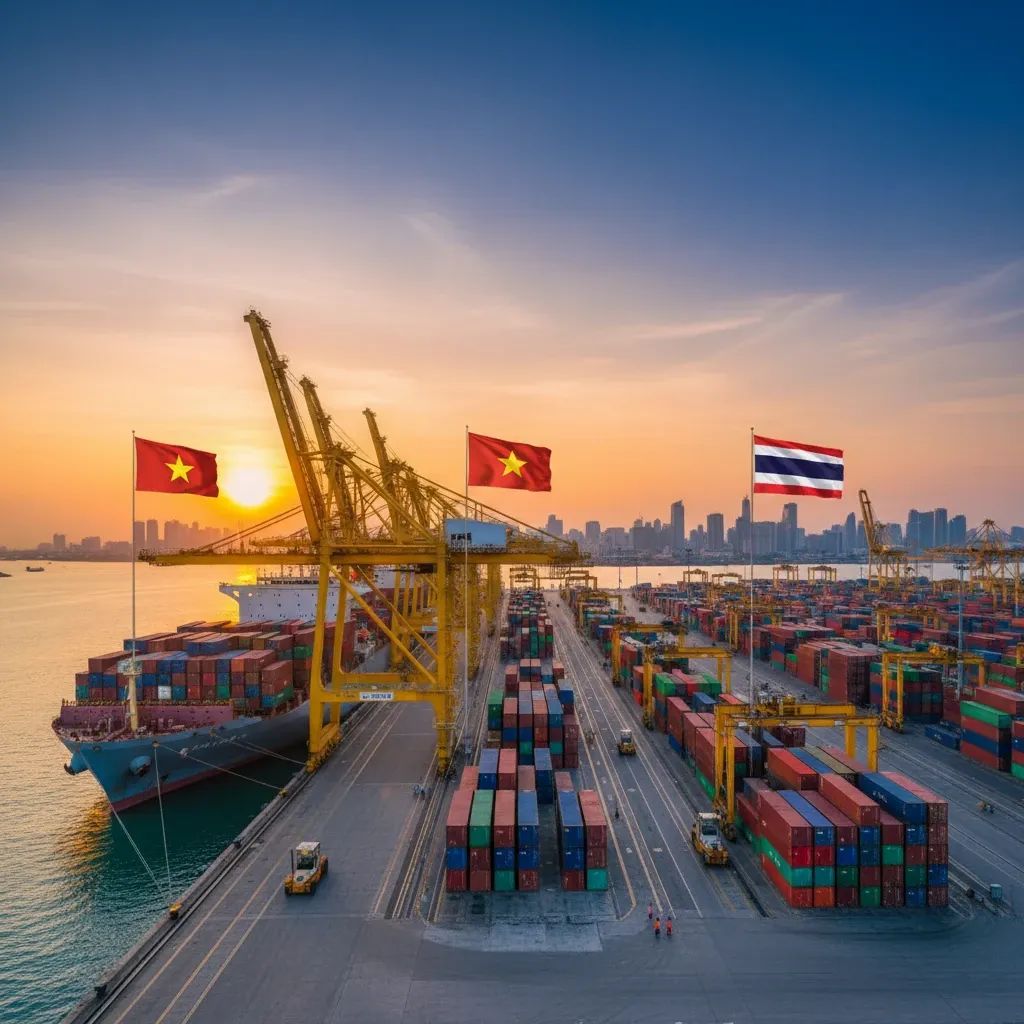
The Thailand Ministry of Foreign Affairs has confirmed that Vietnamese President To Lam will arrive in Bangkok on May 27 for a three-day state visit, a diplomatic milestone that underscores the deepening strategic ties between Southeast Asia's two largest economies. The trip, President To Lam's first official visit to Thailand since taking office in April 2026, coincides with the 50th anniversary of bilateral relations and sets the stage for what officials describe as a "new chapter" in regional integration.
Why This Matters
• Economic urgency: Thailand and Vietnam are racing to finalize a $25 billion trade target as Vietnam's economy threatens to surpass Thailand's GDP within the coming years.
• Security cooperation: Both governments will discuss joint operations against cross-border crime syndicates, including drug trafficking and online scam networks operating in the Golden Triangle region.
• Strategic positioning: The visit cements the Comprehensive Strategic Partnership recently upgraded, making this the most advanced bilateral framework between any two ASEAN members.
From Cold War Rivals to Strategic Partners
Thailand and Vietnam share a fraught history. During the Vietnam War, Bangkok hosted U.S. military bases and deployed thousands of Thai troops to support South Vietnam. The relationship hit its lowest point in the 1980s when Vietnamese forces occupied Cambodia, prompting Thailand to back resistance movements along the border. Cross-border artillery exchanges and refugee crises defined that decade.
The turning point came in 1989 with Vietnam's withdrawal from Cambodia, followed by Hanoi's Đổi mới economic reforms and ASEAN membership in 1995. What was once a relationship of mutual suspicion transformed into one of economic pragmatism. By 2013, the two nations established a Strategic Partnership—the first of its kind within ASEAN. The recent upgrade to Comprehensive Strategic Partnership reflects how far both countries have traveled from their Cold War antagonism.
What This Means for Residents
For expatriates, investors, and Thai nationals, this visit carries tangible implications across multiple sectors:
Trade and business: Thailand remains Vietnam's largest ASEAN trading partner, with bilateral commerce reaching $22.1 billion in 2024, up significantly year-on-year. President To Lam will preside over the Thailand-Vietnam Business Forum, where executives from both countries are expected to announce new joint ventures in semiconductors, renewable energy, and digital payments. Thai businesses with supply chains dependent on Vietnamese manufacturing should watch for announcements on streamlined customs procedures and cross-border logistics improvements.
Tourism and mobility: Annual visitor flows between the two countries exceed 1 million trips. Discussions during the visit may include expanded visa-free travel, improved consular services, and a proposed cruise route linking Singapore, Thailand, and Vietnam. The nearly 100,000-strong Vietnamese community in Thailand represents a significant demographic bridge, and cultural exchange programs are likely to receive renewed government support.
Security implications: Residents in border provinces and major cities may see enhanced law enforcement coordination. Both governments are prioritizing operations against transnational crime syndicates, particularly those running call center scams and human trafficking operations. This has direct implications for consumer protection and public safety in urban centers like Bangkok and Chiang Mai.
The "Three Connects" Framework
At the heart of the diplomatic agenda lies the "Three Connects" strategy, an ambitious framework designed to integrate supply chains, local economies, and sustainable development policies. For Thailand, this represents both opportunity and challenge.
Supply chain integration: Vietnam's rapid industrialization has positioned it as a manufacturing powerhouse, particularly in electronics and textiles. Thai manufacturers are increasingly dependent on Vietnamese intermediate goods, while Vietnam relies on Thailand's more advanced financial services and regional logistics hubs. The strategy aims to formalize these interdependencies, potentially creating unified production corridors that span both countries.
Green economy alignment: Thailand's Bio-Circular-Green (BCG) Economy model will be mapped against Vietnam's Green Growth Strategy. Practical outcomes may include joint investments in solar farms, electric vehicle production, and sustainable agriculture. For Thai companies in the renewable energy sector, this could open access to Vietnam's growing clean energy market.
Digital economy cooperation: Expect announcements on QR code payment integration between Thai and Vietnamese banking systems, facilitating seamless transactions for tourists and businesses. Collaboration on artificial intelligence, semiconductors, and STEM education is also on the table, reflecting both nations' ambitions to compete in the regional tech sector.
Political Choreography and Royal Protocol
President To Lam's itinerary reflects the careful diplomatic choreography that defines Thai statecraft. Beyond bilateral talks with Prime Minister Anutin Charnvirakul at Government House, the Vietnamese leader will be granted an audience with Their Majesties the King and Queen of Thailand—a significant honor that underscores the visit's importance.
Meetings with the President of the National Assembly and Speaker of the House of Representatives will provide opportunities to discuss parliamentary cooperation and legislative harmonization, particularly on trade regulations and environmental standards. These sessions often produce less public attention than ministerial talks but can yield substantive policy alignment over time.
The Competitive Undercurrent
While official statements emphasize partnership, economic data reveals a more complex reality. Vietnam's GDP growth has consistently outpaced Thailand's in recent years, with analysts projecting that Vietnam's nominal GDP could surpass Thailand's by 2027. This creates an unspoken competitive tension, particularly as both countries vie for foreign direct investment and regional manufacturing dominance.
Thailand currently ranks as the 8th largest foreign investor in Vietnam, with nearly 800 projects valued at over $15 billion. However, Vietnamese investment in Thailand remains comparatively modest, highlighting an imbalance that Thai policymakers are eager to address. The Business Forum will likely see Thai officials making a concerted pitch to attract Vietnamese capital into sectors like hospitality, real estate, and advanced manufacturing.
Regional Security and ASEAN Coordination
Beyond bilateral matters, both leaders will discuss coordination on regional flashpoints, including the ongoing crisis in Myanmar and maritime disputes in the South China Sea. Neither country has territorial claims in those waters, but both have significant economic interests in maintaining freedom of navigation and regional stability.
The visit also provides an opportunity to strengthen cooperation within ASEAN, APEC, and Mekong subregional mechanisms. As two of the bloc's largest economies, Thailand and Vietnam often serve as power brokers on regional policy, and their alignment can significantly influence ASEAN's collective stance on trade negotiations and security matters.
Looking Ahead
The three-day visit represents more than diplomatic pageantry. For residents and businesses in Thailand, the outcomes will ripple through daily economic life—from banking integration to supply chain reliability to security cooperation. Whether the Comprehensive Strategic Partnership translates into measurable improvements in trade balances, investment flows, and regional stability will become clear in the months following President To Lam's departure on May 29.
For now, the message from both capitals is unambiguous: Thailand and Vietnam, once battlefield adversaries, are betting their economic futures on deeper integration.


