
Thailand Royal Police have arrested a 58-year-old Philippine national in Bangkok's Phaya Thai district, marking the latest arrest in a sprawling cryptocurrency fraud investigation that has cost victims in the country's Northeast at least ฿5M and highlights the kingdom's escalating battle with transnational digital scams.
Why This Matters
• Resident impact: Social media platforms remain the primary entry point for fraudsters targeting Thai investors with fake crypto schemes.
• Growing threat: This case joins several other major crypto fraud investigations in Thailand in early 2026, with combined losses exceeding ฿1.4B.
• Arrest warrants issued: Police are seeking 16 members of the alleged scam gang, most still at large.
• Visa exploitation: Authorities allege Romano used her visit to Thailand to facilitate money laundering operations.
The Arrest and Allegations
Gina Romano was detained Sunday morning at a rental property in Phaya Thai, one of Bangkok's central districts popular with short-term visitors. According to the Thailand Royal Police, Romano is suspected of serving as a money launderer for an organized gang that deceived residents of Roi Et province through a counterfeit investment website.
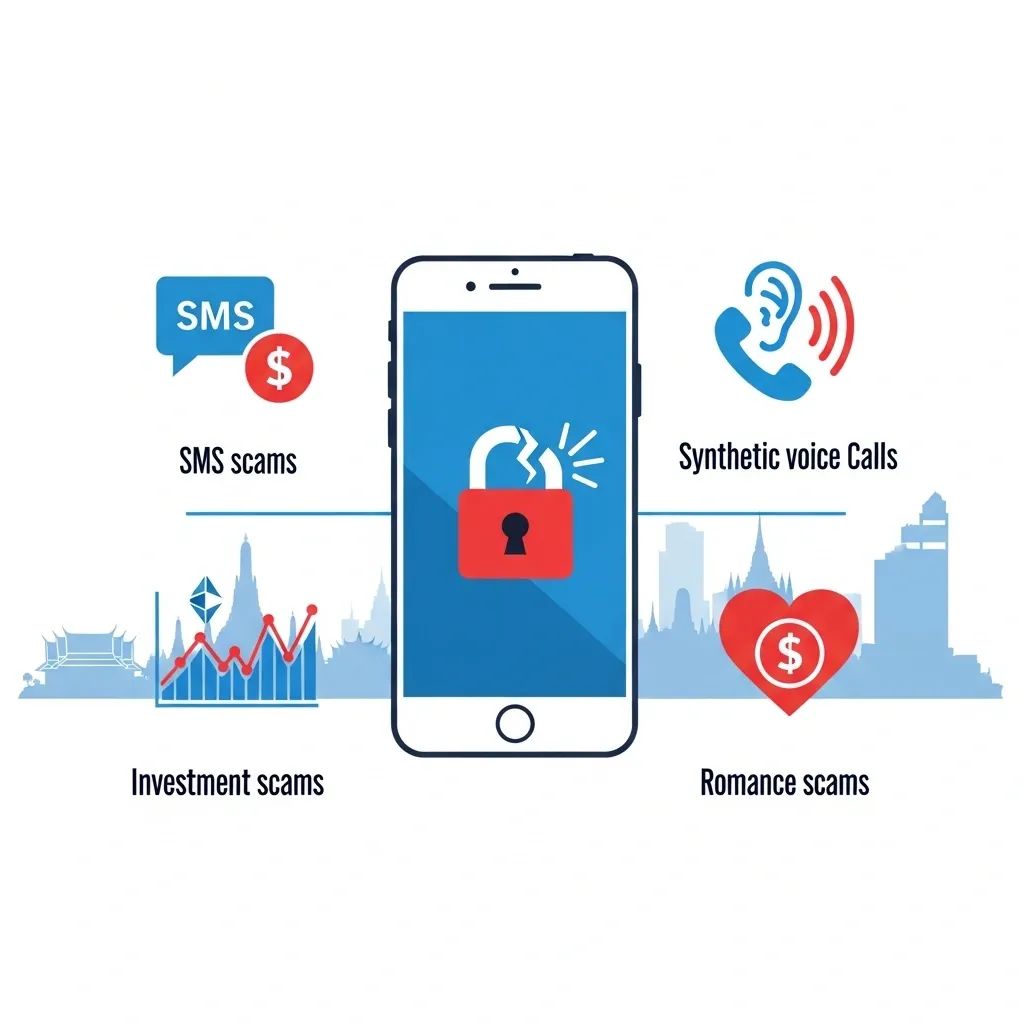
Investigators say the operation followed a now-familiar playbook: fraudsters used Facebook to distribute links to the bogus platform, which mimicked legitimate cryptocurrency exchanges with polished interfaces and fabricated profit displays. Victims were persuaded to deposit funds, only to find withdrawal requests blocked and their money vanished.
Police traced Romano's involvement through investigation and travel records. The arrest underscores how scam operatives exploit Thailand's open environment to facilitate cross-border criminal networks.
The Broader Scam Landscape in Thailand
Romano's arrest is part of a troubling pattern. April 2026 alone has seen multiple high-profile crypto fraud cases surface across the kingdom. Just days before Romano's detention, authorities arrested a self-proclaimed "crypto coach" and an associate for a separate scheme that bilked investors out of ฿30M by promising high returns while systematically blocking withdrawals.
The most significant case this year involves Worawat Narknawdee, founder of the 1000X crypto platform, who remains at large despite an active manhunt. Users of his platform reported losses of approximately ฿1.39B (roughly $42M), and investigators believe he fled to the UAE, where he reportedly owns property. The Thailand Securities and Exchange Commission (SEC) had filed a complaint against Narknawdee back in March 2023 for operating without a license, but enforcement has been elusive.
In March 2026, a joint FBI and Thailand Royal Police operation froze an astonishing $580M in cryptocurrency assets and seized over 8,000 mobile phones and 1,300 hard drives linked to "pig butchering" scam networks—sophisticated operations that blend romance fraud with fake investment platforms to systematically drain victims' savings.
What This Means for Residents
The methods used in these cases are distressingly effective and replicable. Here's what anyone living in Thailand should understand:
Social media platforms, particularly Facebook, remain the most common gateway for these scams. Links distributed via messenger apps or posts appear legitimate but lead to fraudulent websites designed to harvest deposits. Similar fraudulent sites emerge weekly, constantly adapting to evade detection.
Fake trading apps often display rigged profit figures to convince victims their investments are growing, creating a false sense of security that encourages larger deposits. When victims attempt to withdraw funds, they encounter fabricated technical issues, additional "tax" requirements, or simply find the platform inaccessible.
The Northeast region, including provinces like Roi Et, appears particularly vulnerable. Victims there collectively lost ฿5M in this single operation, suggesting scammers may be targeting communities with less exposure to financial fraud education or fewer resources to verify investment opportunities.
Enforcement is improving but struggling to keep pace. While the Thailand SEC filed a precedent-setting criminal complaint in January 2026 against five individuals for unauthorized crypto dealing—notably targeting individuals rather than just platform entities—the sheer volume of scams continues to overwhelm investigators.
The Southeast Asian Scam Ecosystem
Thailand sits at the heart of a regional crisis. More than 300,000 people are estimated to have been trafficked into scam compounds across Southeast Asia, often lured by fake job offers and then forced to perpetrate fraud under threat of violence. These operations, many concentrated in the Mekong sub-region, generate billions annually and are increasingly linked to Chinese transnational organized crime.
In December 2025, Thai investigators busted a Bitcoin mining operation worth $8.6M that was directly funding scam networks operating from Myanmar. The cryptocurrency generated by these mining rigs was used to launder illicit proceeds and finance ongoing fraud operations.
The U.S. Justice Department launched the Scam Center Strike Force in November 2025 specifically to dismantle these Southeast Asian compounds, recognizing that victims span continents. Americans and Europeans are frequently targeted through LinkedIn and Instagram with professional-looking investment opportunities, while Thai nationals face localized schemes through Facebook and Line.
How the Money Moves
Romano's alleged role as a money launderer highlights a critical component of these operations. Once victims deposit funds, the money must be rapidly moved through multiple accounts to obscure its origin. Scammers have adapted their tactics in response to enforcement pressure, now moving stablecoin funds within 48 hours and increasing the complexity of blockchain transactions.
Crypto exchanges serve dual roles as both the entry point where victims send funds and the exit where scammers convert digital assets to cash. Despite growing regulatory scrutiny, these platforms remain the primary infrastructure enabling large-scale fraud.
What to Watch For
With 16 arrest warrants outstanding in this case alone, authorities expect additional arrests in coming weeks. The Thailand Royal Police and SEC have pledged full cooperation with international partners, but the cross-border nature of these networks makes prosecution challenging.
For residents, the message is unambiguous: any unsolicited investment opportunity shared via social media should be treated as fraudulent until proven otherwise. Legitimate crypto exchanges operating in Thailand require licensing from the SEC, and that list is publicly available on the regulator's website.
Romano remains in custody as investigators work to trace the full network behind the scheme. Her case serves as a stark reminder that Thailand's relatively open environment and advanced digital infrastructure make it an attractive operational base for international fraud networks—and that both expats and Thai nationals remain prime targets.


