
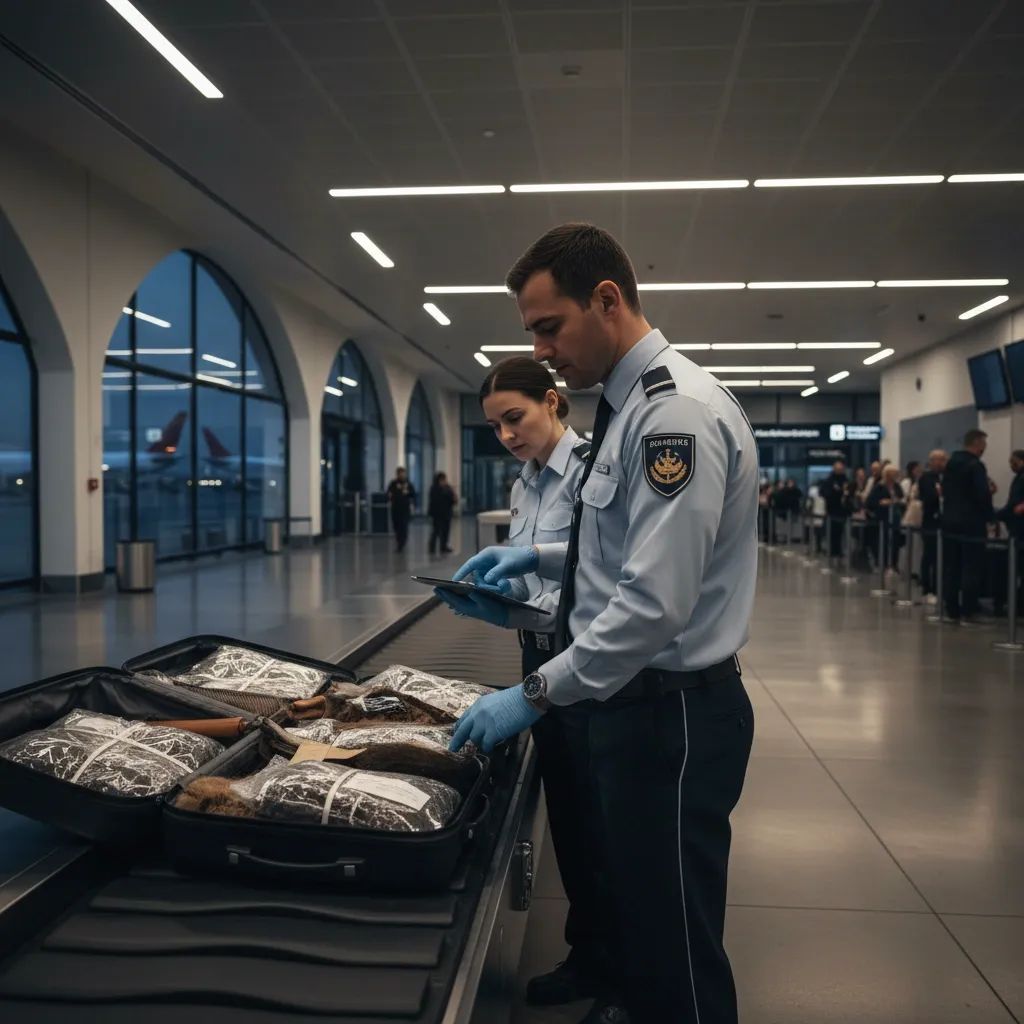
Thailand's Suvarnabhumi Airport authorities intercepted a 19-year-old Taiwanese woman on Tuesday, March 18, 2026, who strapped 30 endangered tortoises to her body in a failed smuggling bid bound for Taipei, underscoring the kingdom's persistent role as a transit hub for illegal wildlife trafficking despite intensified enforcement.
Why This Matters
• CITES Appendix I protection: Indian star tortoises have carried the highest tier of international protection since 2019, banning all commercial trade—yet demand from collectors persists.
• Body-concealment tactic: The woman wrapped 29 live tortoises and one carcass in cloth sacks and taped them directly to her torso, a brutal method that often kills animals en route from stress and suffocation.
• Network investigation underway: Thai wildlife, customs, and aviation security teams are now tracking upstream suppliers and downstream buyers to dismantle the broader syndicate.
• Legal exposure: Violations span three statutes—the Wildlife Conservation Act, Customs Act, and Animal Epidemic Control Act—carrying prison terms and fines.
The Arrest at Dawn
Officers flagged the suspect at the outbound passenger screening area around 5:25 a.m., noticing suspicious bulges around her midsection. A detailed body search revealed the tortoises—each immobilized with adhesive tape and stuffed into fabric pouches—secured against her skin to evade X-ray scanners. One animal had already perished by the time officials unwrapped the cache. The surviving 29 tortoises were immediately transferred to the Thailand Department of National Parks, Wildlife and Plant Conservation for veterinary triage; many arrivals from similar seizures exhibit dehydration, shell fractures, and acute distress.
Indian star tortoises (Geochelone elegans) fetch premium prices on black markets across East Asia, prized by collectors for their radiating shell patterns and relatively straightforward husbandry. Native to India, Pakistan, and Sri Lanka, the species was uplisted to CITES Appendix I in 2019 after decades of over-collection pushed populations toward collapse. Under Thailand's Wildlife Conservation Act B.E. 2562 (2019), possession, import, or export without explicit permits triggers criminal penalties; the woman now faces charges under that statute, plus customs and animal-health regulations.
Suvarnabhumi's Smuggling Corridor
Suvarnabhumi remains a documented chokepoint for transnational wildlife crime. Throughout 2025 and early 2026, authorities have recorded multiple significant busts:
• A South Korean national caught with more than 400 live tarantulas, scorpions, centipedes, and dwarf geckos arriving from Kenya.
• An Indian passenger intercepted with 15 live animals—including lorises, gibbons, and multiple turtle species—en route to Kolkata.
• A Thai man arrested for importing monitor lizards and giant rats from the Philippines.
• Another seizure involving a Taiwanese courier carrying leopard cubs across the Thai–Myanmar border in Tak Province.
Each case shares a common thread: Thailand's geographic position between source countries in South Asia and Southeast Asia and consumer markets in China, Taiwan, Hong Kong, and beyond. Smugglers exploit the kingdom's high passenger throughput, betting that volume will overwhelm inspection capacity. They employ "ant trafficking" tactics—small parcels moved by individual couriers—to minimize per-trip losses if caught.
The Taiwanese and Chinese Appetite
Taiwan and mainland China anchor the highest-demand markets for Indian star tortoises. Cultural associations with longevity and luck, combined with a booming exotic-pet subculture, drive prices upward. Online marketplaces and encrypted messaging apps facilitate anonymous transactions, allowing buyers to browse species catalogs and arrange shipments with minimal traceability. Although Taiwan's own wildlife laws mirror CITES commitments, enforcement gaps and light penalties create arbitrage opportunities for syndicates willing to absorb occasional seizures as a cost of doing business.
What This Means for Residents
For travelers: Customs and wildlife officers at Suvarnabhumi have expanded random baggage checks and body scans, particularly on routes to Northeast and East Asia. Expect longer queues at departure gates during peak hours. Passengers carrying legitimate animal products—leather goods, traditional medicines—should keep purchase receipts and CITES permits accessible to avoid detention.
For expats and conservation advocates: The Thailand Royal Police Natural Resources and Environmental Crime Division (NRECD) is pursuing leads from the suspect's mobile phone to map financial flows and identify upstream suppliers and downstream buyers. If you observe suspicious shipments—especially parcels marked as "handicrafts" or "dried goods" leaving wildlife-adjacent provinces such as Kanchanaburi or Chiang Mai—the NRECD hotline (1362) accepts anonymous tips in English and Thai.
For policy watchers: The government is intensifying enforcement efforts against wildlife trafficking, with discussions ongoing about tightening penalties for false-origin declarations. Watch for implementing regulations from the Thailand Customs Department in the coming months.
Enforcement Gaps and Syndicate Adaptation
Despite the headline seizures, conservationists caution that arrests represent a fraction of actual traffic. Syndicates adapt rapidly: when body-strapping becomes risky, couriers shift to commercial freight containers mislabeled as agricultural produce or hide animals inside hollowed-out furniture. The flexibility of these networks—often intertwined with narcotics and human-trafficking operations—means a single bust rarely dismantles an entire supply chain.
Wildlife Justice Commission investigators working with Thai authorities estimate that for every seized tortoise, three to five reach their destination. The March arrest may deter amateur couriers but is unlikely to meaningfully disrupt professional operators who compensate mules generously and maintain redundant routes through Laos, Cambodia, and Myanmar.
Next Steps in the Investigation
Thai wildlife officials confirmed they are cross-referencing the suspect's travel history with flight manifests and hotel records to identify co-conspirators. Investigators will also examine financial transfers on her phone to trace payments upstream to poachers in South Asia and downstream to distributors in Taipei. Cooperation with U.S. Fish and Wildlife Service attachés stationed in Bangkok and liaison officers from Taiwan's Coast Guard Administration may yield intelligence on recipient networks.
The surviving tortoises face months of rehabilitation before possible repatriation to their country of origin, contingent on diplomatic agreements and veterinary clearances. Thailand's bilateral wildlife-repatriation pact with India, signed in 2024, establishes a framework for returning seized fauna, but bureaucratic delays often extend timelines beyond a year.
The Broader Southeast Asian Picture
Thailand is far from alone. Vietnam's Nghe An Province has emerged as a trafficking nexus for big-cat parts, while Malaysia's ports handle shipments of pangolin scales and rhino horn. Regional cooperation under the ASEAN Wildlife Enforcement Network (ASEAN-WEN) has produced joint operations, yet inconsistent sentencing—ranging from token fines to multi-year prison terms—undermines deterrence. Advocacy groups continue to press for harmonized penalties and real-time intelligence sharing across borders.
Cambodia's Siem Reap airport and Myanmar's Yangon hub have recorded parallel Indian star tortoise seizures in recent months, suggesting that syndicates test multiple exit points simultaneously. When one route tightens, traffickers pivot to another, maintaining a cat-and-mouse dynamic that stretches limited enforcement budgets.
Conservation Status and Market Dynamics
Indian star tortoises command retail prices between 15,000–30,000 baht (roughly US$430–860) in illicit Taiwanese pet shops, a markup that can exceed 1,000% over poacher payments in rural India. The IUCN Red List classifies the species as Vulnerable, with wild populations declining sharply in Maharashtra, Karnataka, and Tamil Nadu due to habitat loss and collection pressure.
Captive-breeding programs in Europe and North America produce limited numbers of legally sourced individuals, but supply lags far behind demand. This price differential incentivizes poaching and smuggling despite the legal risks. Without parallel demand-reduction campaigns in consumer markets—public-awareness messaging, celebrity endorsements of legal alternatives, and e-commerce platform audits—enforcement alone will struggle to reverse the trend.
Practical Takeaways
If you witness suspicious activity involving live animals at Suvarnabhumi or other Thai airports, note flight details, physical descriptions, and baggage tags, then report to the Suvarnabhumi Wildlife Checkpoint (located post-security in the international departure hall) or call the NRECD hotline. Officers prioritize tips that include specific gate numbers and departure times.
For educators and NGOs: The Department of National Parks periodically hosts "Stop Illegal Wildlife Trade" campaigns at the airport, distributing multilingual brochures. Volunteer translators and graphic designers are periodically recruited; inquiries can be sent to the department's Bangkok headquarters.
For investors in conservation tech: Thai Customs has earmarked budget for AI-assisted baggage-screening pilots that flag anomalies indicative of live cargo—thermal signatures, movement patterns—complementing manual inspections. Startups with proven track records in biodiversity informatics may find procurement opportunities through the Thailand Digital Government Development Agency.
The Taiwanese woman's arrest on March 18, 2026, offers a snapshot of a sprawling, resilient criminal ecosystem. Until consumer demand ebbs and penalties rise across the region, Suvarnabhumi and its peers will remain battlegrounds in the fight to keep the world's most coveted species out of suitcases and off black-market shelves.


