
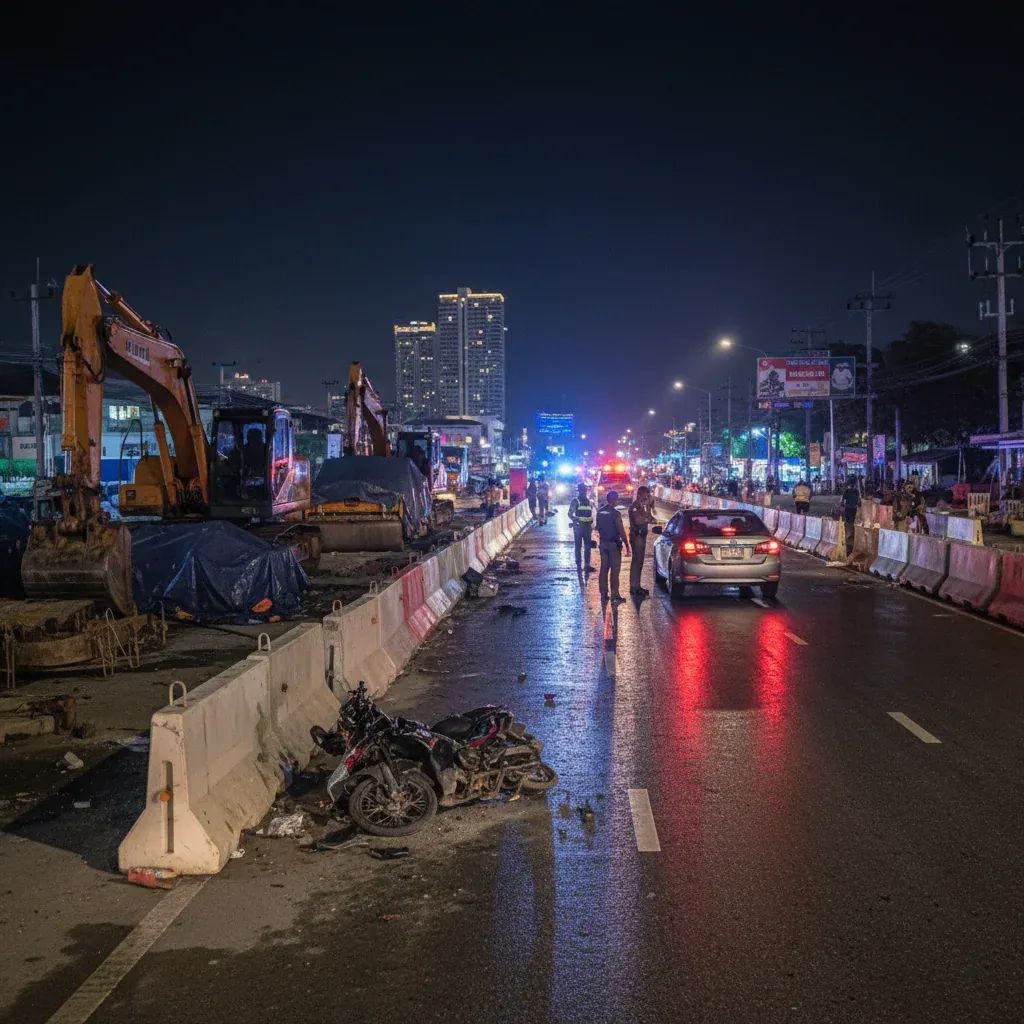
Why This Matters
• The improvement is measurable but the danger persists: A 20% drop in accidents and 6.5% in deaths represents genuine progress—yet 216 Thais still died on the roads during six days in April. For residents planning April travel, the odds shifted in your favor, but the underlying risk profile remains severe.
• Your age and vehicle type determine your fate: If you're between 20-29 and riding a motorcycle—the country's dominant form of personal transport—you face concentrated vulnerability. Motorcycles accounted for 68% of Songkran accidents, and this age group absorbed nearly one-quarter of all casualties.
• Speed and alcohol remain the unchecked killers: Nearly 5,232 driving violations involved intoxication (94.5% of all infractions), with Chiang Mai recording 680 drunk-driving cases alone. Speeding caused 44% of all crashes. Current penalties and enforcement clearly haven't deterred these behaviors at scale.
• Community-level checkpoints outperformed formal police stations: Village volunteers proved more effective at stopping dangerous drivers than traditional law enforcement, suggesting a structural lesson about social accountability versus impersonal policing.
If You're Driving During Songkran: Essential Safety Guide for Residents
Avoid peak danger times: The 6:01 p.m. to 9:00 p.m. window accounts for 18% of all accidents. If possible, travel earlier in the day or after 10:00 p.m.
Helmet requirements are non-negotiable: Water-splashing reduces visibility and road grip. Helmets that fit properly and meet safety standards can be the difference between walking away from a collision and becoming part of the fatality statistics.
Watch your route carefully: Straight highways account for 90% of accidents—the opposite of expected. This means speed becomes the primary culprit. Maintain speeds well below legal limits on long stretches.
Zero alcohol if driving: 94.5% of all drunk-driving violations occurred during Songkran. One impaired decision affects not just you but every person in your vehicle and on the road.
Contact 1784 for emergencies: This hotline connects you to rapid response teams positioned along major accident corridors. Knowing help arrives within minutes changes your treatment outcomes.
High-risk provinces to navigate carefully: Chiang Mai (680 drunk-driving violations), Samut Prakan (433 cases), and Nonthaburi (335 cases) showed the highest enforcement activity, indicating concentrated risk areas.
The Improvement, Explained
Thailand recorded 1,108 accidents, 216 deaths, and 1,073 injuries during the first six days of the official Songkran "Seven Dangerous Days" campaign (April 10-15, 2025). That same period in 2024 had logged 1,391 accidents, 231 fatalities, and 1,350 injuries. The comparison reveals what authorities celebrated as a breakthrough: a 20% reduction in collisions and a 6.5% decline in fatalities year-over-year.
Deputy Interior Minister Jeseth Thaiseth announced these figures on Thursday, April 17, as the annual holiday migration wound toward conclusion. While the numbers show genuine tactical progress, they also expose a paradox—each 1% reduction in fatalities still translates to real funerals, bereaved families, and disabled survivors. The improvement is real. The crisis persists.
On April 15 alone, the sixth and deadliest day tracked so far, authorities documented 156 accidents claiming 23 lives and leaving 161 injured. That single day's toll would dominate news cycles in most developed nations; in Thailand during Songkran, it barely registers as remarkable. Chiang Rai province led that day's incidents with 10 crashes, three deaths, and 11 injuries.
Where Death Concentrated
Phrae province in the North recorded the highest accident volume during the six-day window with 47 crashes and 49 injured persons. Yet the geographic distribution reveals a counterintuitive pattern: Bangkok, despite having traffic management infrastructure and urban planning that regional provinces lack, accumulated the nation's highest death toll at 19 fatalities. The capital's lethal toll stems from its dual role as both launching point and destination for millions of holiday travelers, combined with Bangkok residents' reliance on motorcycles for rapid urban navigation before exiting the city on highways.
The roads themselves told a consistent story. Straight stretches hosted 90% of all accidents—the opposite of what conventional safety wisdom suggests. Curves and challenging intersections are theoretically dangerous; reality showed otherwise. Highways specifically accounted for 47% of crashes. This pattern points relentlessly toward a single conclusion: the problem wasn't environmental complexity or driver skill but rather velocity. Drivers were moving too fast down straightaways where they mistakenly believed higher speeds were safe.
The Twin Demons: Speed and Alcohol
Speeding triggered 44% of all Songkran accidents—nearly half of all crashes traced directly to drivers exceeding safe limits or legal speed restrictions. Drunk driving followed as a distant but still catastrophic second cause at 26%. When these factors combined, as they often did during late-night returns from celebrations, the probability of a driver walking away intact plummeted sharply.
The danger window proved remarkably consistent: 6:01 p.m. to 9:00 p.m. accounted for 18% of all accidents—a concentration that corresponded precisely with the moment when provincial water-play festivities wound down, celebrants transitioned into vehicles, and exhausted revelers merged onto highways returning to Bangkok and urban centers. Add darkness, roads still slick from water-play residue, and the cumulative fatigue of a day spent celebrating, and the accident probability became less about statistics and more about physics.
The Department of Probation documented 5,232 driving violations during the campaign period, with an overwhelming 94.5% involving alcohol. This percentage should trigger urgent policy reevaluation. Current enforcement measures, sobriety checkpoints, and penalty structures have demonstrably failed to deter systematic intoxicated driving. The persistence suggests that consequences lack severity, social stigma remains weak, and alternative transportation—particularly in provincial regions where public transit barely functions—remains inadequate.
Chiang Mai emerged as the drunk-driving capital, registering 680 impaired-driving violations during the period. Samut Prakan followed with 433 cases and Nonthaburi with 335. Chiang Mai's distinction reflects its status as both a cultural epicenter of Songkran celebrations and a magnet for domestic tourism, creating conditions where extended festivities, unfamiliar roads, mixed crowds, and readily available alcohol normalize impairment rather than stigmatize it.
Why Young Adults Die—And What Stops Them
The 20-29 age group absorbed 24.5% of all Songkran casualties. This demographic concentrates multiple risk factors simultaneously: they represent Thailand's largest cohort of motorcycle riders, exhibit the highest alcohol consumption rates during festival periods, possess less highway experience than older drivers, and demonstrate a cultural comfort with risk-taking that Songkran reinforces. Socially, this age group treats the festival as a moment for celebration rather than caution, and they often feel personally invincible in ways older drivers do not.
Motorcycles themselves deserve specific analysis. The two-wheeler represents both a practical transportation solution for millions of Thais and a safety liability that becomes exponentially deadlier when combined with speed and alcohol. The failure to wear helmets—particularly among young riders making short urban trips before longer highway journeys—transforms every collision into a potential fatality. Water-splashing, Songkran's defining tradition, compounds the danger by reducing visibility and tire grip on wet pavement, turning what should be festive into what becomes lethal.
Yet enforcement data revealed a surprising finding: community-based checkpoints staffed by local volunteers consistently outperformed formal police stations at preventing dangerous drivers. These village-level stations operated not as rigid enforcement mechanisms but as social accountability structures where individuals recognized their neighbors and faced community judgment. Local shame—the knowledge that news of an arrest would circulate through one's village—functioned as a deterrent that impersonal police checkpoints could not replicate. The psychological mechanism differed fundamentally from legal penalty; it operated through social recognition rather than state authority.
How Thailand Actually Changed Tactics
The Thailand Road Safety Directing Centre, working through the Department of Disaster Prevention and Mitigation, implemented a substantially restructured intervention architecture for 2025 that departed meaningfully from previous years. The strategy combined traditional enforcement with experimental community prevention in ways that generated measurable results:
Alcohol Control Beyond Drivers: Rather than focusing exclusively on detecting impaired motorists, authorities targeted the supply chain—vendors, family members, and facilitators of underage drinking. Investigations into fatal crashes involving young drivers expanded to include accountability for those who enabled consumption. When a vendor faced legal consequences for selling alcohol to an underage driver who subsequently caused a fatal crash, behavior changed. This supply-side approach distributed responsibility beyond the individual driver and created deterrence at the source.
Physical Road Infrastructure: On major routes, authorities opened dedicated lanes, adjusted traffic signal timing to reduce congestion-related aggressive driving, and established mandatory rest stops explicitly designed to combat fatigue. This infrastructure approach acknowledged that behavioral enforcement alone cannot overcome the neurological effects of fatigue during extended highway drives.
Public Transport Mandates: Provincial transport offices issued mandatory requirements: all drivers of buses and shared taxis must test at zero blood alcohol content, abstain from psychoactive substances, and maintain scheduled rest breaks on journeys exceeding four hours. Vehicle inspections became non-negotiable. The logic was sound—a bus driver's intoxication endangers 40 passengers simultaneously, making individual risk-taking a collective danger.
Volunteer Checkpoints: Rather than relying solely on formal police stations, the campaign mobilized local volunteers at village-level checkpoints. These caught drivers before they reached highways, created immediate accountability through social recognition, and referred persistent offenders to police for formal action. The hybrid system generated deterrence through multiple mechanisms: legal penalty, social shame, and immediate intervention combined to create behavioral change.
Emergency Response Acceleration: Public awareness of the 1784 emergency hotline was amplified systemwide. Response teams were positioned along major accident corridors. The messaging emphasized that victims received medical attention within minutes of reporting, transforming road safety from a behavioral issue into one where speed-of-care could reduce fatality severity.
What International Campaigns Reveal—And How They Apply to You
Other nations managing holiday road safety offer lessons relevant for residents and expats living in Thailand.
Australia's emotional messaging uses television advertisements depicting the devastating personal consequences of impaired driving and speeding—grieving families, disabled survivors, financial devastation—moving beyond abstract warnings. The insight: abstract statistics don't change behavior; specific human tragedy does.
The Czech Republic's "National Delay Day" campaign strategically postponed Easter celebrations. The result: the lowest road fatality count of the 21st century. The principle applies to Songkran: if you know celebrations won't peak on a specific day, rushing becomes irrational. Consider staggering your travel rather than competing with millions of others converging on highways simultaneously.
Greece's motorcycle-focused campaigns directly address Thailand's vulnerability. Greek authorities treat helmet enforcement not as bureaucratic requirement but as cultural priority—normalizing protective gear as an identity marker of responsible adults rather than a legal obligation. Residents and expats accustomed to different safety standards at home should recognize that Thailand's approach differs significantly. Adjusting your expectations and practices accordingly protects your life.
The U.S. high-visibility enforcement model combines temporary intensive police presence with media saturation about enforcement. Thailand's community checkpoint model actually aligns better with localized social accountability but proves more effective when residents understand that village-level oversight creates real consequences through social recognition.
What Remains Unchanged, What Remains Dangerous
For residents and regular travelers in Thailand, the 2025 Songkran improvement should not inspire complacency. A 20% reduction in accidents still means 1,108 collisions in six days. A 6.5% decline in fatalities still registers 216 deaths during a period celebrated as a safety success. Young motorcycle riders remain catastrophically vulnerable. Late-evening travel remains statistically dangerous. Intoxicated driving remains epidemic despite thousands of arrests.
The improvement reflects genuine tactical effectiveness in coordinating multiple intervention points simultaneously—evidence that when enforcement, infrastructure, community engagement, and public messaging align, outcomes improve. Yet the underlying patterns—speeding behavior, systematic intoxication, inadequate helmet use, fatigue on long journeys, motorcycle dominance as the primary transportation mode—remain structurally unchanged. Thailand has improved the short-term crisis response without addressing the foundational factors that make Songkran lethal.
For future years, the challenge is embedding these interventions into permanent infrastructure rather than treating them as temporary campaign efforts. Community checkpoints should become year-round fixtures at transportation intersections rather than seasonal mobilizations. Public transport safety mandates should apply continuously. Helmet use should shift from a technical regulation to a cultural norm that young adults internalize before they become riders. The messaging about road safety should graduate from generic warnings to narratives about responsibility to family, community, and personal future.
The 20% improvement is real. It is also insufficient. The fact that 216 people died during what authorities deemed a successful road safety campaign reveals how normalized tragedy has become in Thailand's relationship with annual holiday travel. Until that normalization shifts, each percentage-point reduction in fatalities will remain a modest achievement rather than a genuine solution.


