
Songkran's Safety Reckoning: What Thailand's Crackdown Means for Your Week
The Thailand Department of Disaster Prevention and Mitigation has activated its most punitive road enforcement operation in recent memory. Starting April 11 and running through April 17, the seven-day "Dangerous Days" campaign transforms the nation's highways into a high-scrutiny zone where traffic violations that might draw a warning any other time of year now trigger immediate fines, point deductions, and potential license suspension. For anyone planning to travel, commute, or navigate the country during Songkran's peak migration, the stakes are concrete and personal.
Why This Matters
• Every violation triggers automatic penalties: The Thailand Department of Land Transport has eliminated discretionary warnings, with enforcement intensity escalating significantly during the Songkran campaign period. Speeding, running lights, improper helmet use, and phone use now incur immediate fines—no leniency during the campaign window.
• Motorcycles dominate Songkran fatality statistics: Eight of every ten crashes nationwide involve two-wheelers, with peak danger concentrated between 3 PM and 6 PM when heat fatigue and afternoon congestion converge.
• Your traffic point balance erodes fast: Under current traffic regulations, drivers face point deductions for violations including drunk driving and speeding. Accumulate too many violations and you face license suspension—a disruption that stops commuters, traders, and delivery operators mid-livelihood.
• Airport congestion peaks April 12-15: Chiang Mai Airport alone expects 22,104 daily passengers during the festival window, with water celebrations around the old city moat creating gridlock on main access routes.
Historical Songkran enforcement periods have consistently recorded significant accident rates during the seven-day campaign window. Motorcycles feature heavily in crash statistics, with highways representing high-risk environments. The deadliest hours typically run from 3 PM to 6 PM, when driver fatigue peaks alongside traffic density. Drunk driving and excessive speed emerge repeatedly as contributing factors in casualty reports, compounded by the epidemic of improper or absent helmet use.
The response this year reflects the severity of these recurring patterns. The government has set a baseline target: reduce fatalities, injuries, and accidents compared to previous Songkran periods. That translates to fewer deaths and crashes across the seven days. The enforcement infrastructure deployed to achieve that goal is significantly more aggressive than previous years.
The Enforcement Apparatus on the Ground
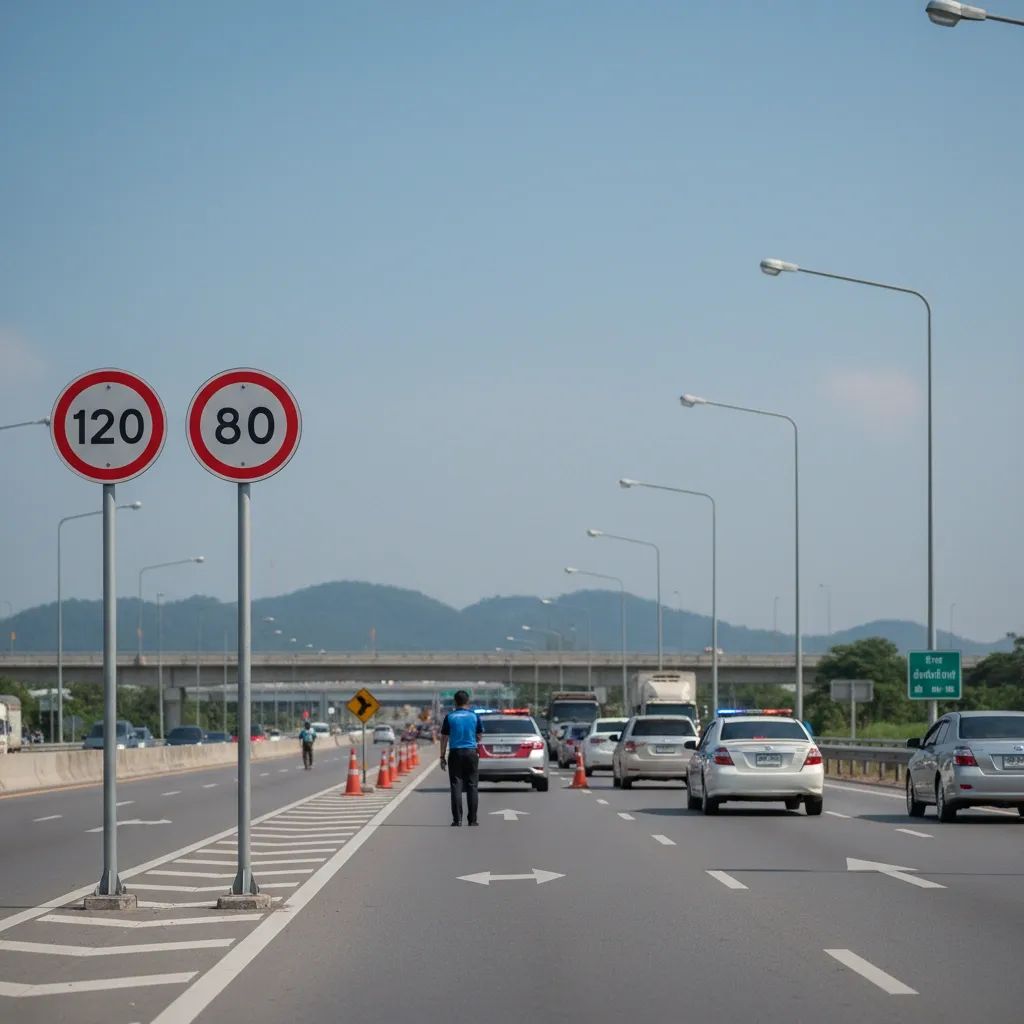
Speed cameras now operate 24 hours daily on major corridors, including the newly toll-free M6 and M81 motorways. Roving breathalyzer units and mobile radar sets rotate through districts to prevent drivers from identifying fixed checkpoint patterns and timing their routes accordingly. Police have announced daily progress reports from April 11 through 16, with a comprehensive summary released on April 17—a visible accountability mechanism designed to demonstrate results under high-scrutiny conditions.
Drunk driving carries the heaviest consequences. First-time offenders face up to one year in jail, fines ranging from ฿5,000 to ฿20,000, and point deductions from your traffic point balance. Repeat offenders within two years face up to two years in prison and fines reaching ฿100,000. The blood alcohol threshold for drivers aged 20 and above remains 50 mg%; drivers under 20 face a stricter 20 mg% limit. In practical terms, a single beer can push a young driver over the legal limit.
Speeding violations incur fines up to ฿4,000 and demerit points per offense. Running a red light, unsafe lane changes, wrong-way driving, failure to wear a seatbelt or helmet, and phone use while driving each trigger fines and point deductions. The Thailand Department of Land Transport emphasizes these major traffic violations during the campaign period, with enforcement intensity escalating noticeably.
Enforcement operations concentrate in provinces historically associated with higher crash counts. Enforcement is particularly visible in major tourist and travel hub areas, with heightened police deployment during peak travel windows. Foreign residents holding converted international driving permits face equal enforcement scrutiny; expired documents or language barriers will not receive leniency.
Traffic Enforcement and Point Systems
Thailand's traffic enforcement framework includes point-based deductions for violations. The cumulative effect of multiple violations during a short period can result in significant consequences, including license suspension. For anyone traveling during the campaign period, even seemingly minor violations compound quickly. That is not a symbolic penalty; it represents a genuine hardship for anyone reliant on a vehicle for daily work, commerce, or essential movement.
A motorcyclist or taxi driver who receives multiple speeding violations across a week—plausible if traffic conditions or road navigation mistakes occur—accumulates point deductions. The framework applies uniformly regardless of driver category, income level, or occupational dependence on driving.
For traders, delivery operators, ride-hailing drivers, and others whose livelihoods depend on vehicle operation, the stakes during the campaign period shift sharply. Compliance is no longer discretionary advice but operational necessity.
Northern Thailand's Congestion Cascade
Chiang Mai Airport, the gateway to northern Thailand's cultural tourism, expects 177 flights per day and approximately 22,104 passengers daily from April 10-19. Airlines have deployed additional flights to accommodate Songkran travel surges.
The critical congestion window runs April 12-15, when Songkran water festivals transform Chiang Mai's old city moat into a water-fight epicenter. Heavy pedestrian traffic and spontaneous celebrations effectively block major arterial routes leading to and from the airport. Passengers transferring between downtown accommodations and the terminal should budget 30 to 45 additional minutes during this window. Ride-hailing services face surge pricing during peak demand hours, typically between 10 AM and 6 PM.
Security at the airport has been reinforced, with additional agencies deployed across the terminal and surrounding roadways to manage pedestrian flow during one of the year's busiest travel periods. The airport has installed double-door air chambers and air purification systems to mitigate PM2.5 dust infiltration, a recurring concern as northern Thailand's hot season typically coincides with agricultural burning across neighboring regions and stagnant air conditions that trap particulate matter close to ground level.
Travelers should also comply strictly with liquid-carry restrictions during the campaign. Airport security will enforce these rules more rigidly to prevent processing delays. Booking ground transfers well in advance and, if schedules permit, departing outside the April 12-15 window can reduce both travel friction and transportation costs.
What Changes for You During These Seven Days
The enforcement environment during April 11-17 differs fundamentally from the rest of the year. Assume every traffic violation—speeding, running a red light, improper helmet fastening, phone use at a stop—will result in an immediate fine and point deduction. You will not receive a warning. Officers operate under specific performance metrics and political pressure to demonstrate visible enforcement results.
Carrying a valid driver's license, vehicle registration, and proof of insurance is essential. Expired documents will not be overlooked. If you hold an international driving permit that you have converted to a Thai license, understand that enforcement scrutiny applies equally. Language barriers will not shield you from enforcement.
For motorcyclists, the statistical reality demands serious attention. Eight of every ten Songkran crashes involve two-wheelers. Highways represent high-risk environments, particularly during afternoon hours when fatigue peaks and traffic volume crests. Helmet use—both wearing one and securing it properly—is non-negotiable. Speeding on highways during holiday periods is how Songkran-related deaths happen. The data is clear and consistent across multiple enforcement periods.
If you are traveling to or from Chiang Mai during the April 12-15 peak celebration window, plan accordingly. The moat area becomes impassable for vehicles during prime hours. Consider shifting your airport travel to April 10-11 or April 16-19 if your schedule allows. If not, arrange airport transfers 24 hours in advance to secure vehicle availability and lock in standard pricing rather than surge rates.
For those with respiratory sensitivities, the convergence of Songkran with northern Thailand's air quality nadir poses compounding health risks. PM2.5 concentrations typically spike between March and May, with peak pollution hours generally between 6 AM and 10 AM. Motorcyclists and pedestrians participating in outdoor water festivals should monitor local air quality indexes and carry masks. Timing activities outside peak pollution hours can meaningfully reduce exposure.
International Precedent and Thailand's Selective Adoption
The Thailand Ministry of Transport reviewed road safety campaigns and enforcement models from South Korea, Japan, the European Union, and Singapore. The EU's Intelligent Speed Assistance (ISA) system, which automatically governs vehicle speed based on GPS data and posted limits, is projected to reduce fatalities by 20%. Singapore employs optical illusion road markings—lines painted closer together than reality—that psychologically compel drivers to slow down. Japan imposes strict liability on alcohol-serving establishments; if a bartender serves someone who subsequently drives drunk and crashes, the establishment shares legal responsibility.
Thailand has not yet mandated ISA technology, though the 24-hour speed camera deployment on major routes represents an incremental step toward continuous, automated compliance monitoring. The government has not extended strict liability to establishments serving alcohol, though escalating penalties for repeat drunk drivers suggest the government may eventually explore that deterrent pathway.
What Thailand has adopted is the enforcement intensity and point-based licensing model—a framework designed to shift driver behavior through both deterrence and cumulative consequences. The premise is straightforward: make violations costly enough, frequent enough, and visible enough that compliance becomes the rational default.
The Deeper Pattern
Songkran marks the Thai New Year and triggers the nation's largest internal migration. Millions of urban workers return to provincial hometowns. Long-distance highway driving combined with family gatherings, elevated alcohol consumption, and the physical toll of extreme heat creates a predictable crash spike. The seven-day campaign is, in essence, the government's most visible effort to interrupt that cycle.
The slogan deployed across billboards, radio, and social media is deliberately blunt: "Drive safely, slow down, reduce accidents." This is not aspirational messaging. Treat it as instruction. The enforcement infrastructure—automated cameras, point-based licensing, escalating fines—reflects a longer-term institutional shift in how Thailand intends to manage traffic safety during high-risk periods.
The results from April 17 will reveal whether stricter enforcement translated into measurably safer roads. What is certain now is that the next week demands a different calculation from anyone behind the wheel. The cost of even minor violations has risen sharply. Plan your travel accordingly.


