
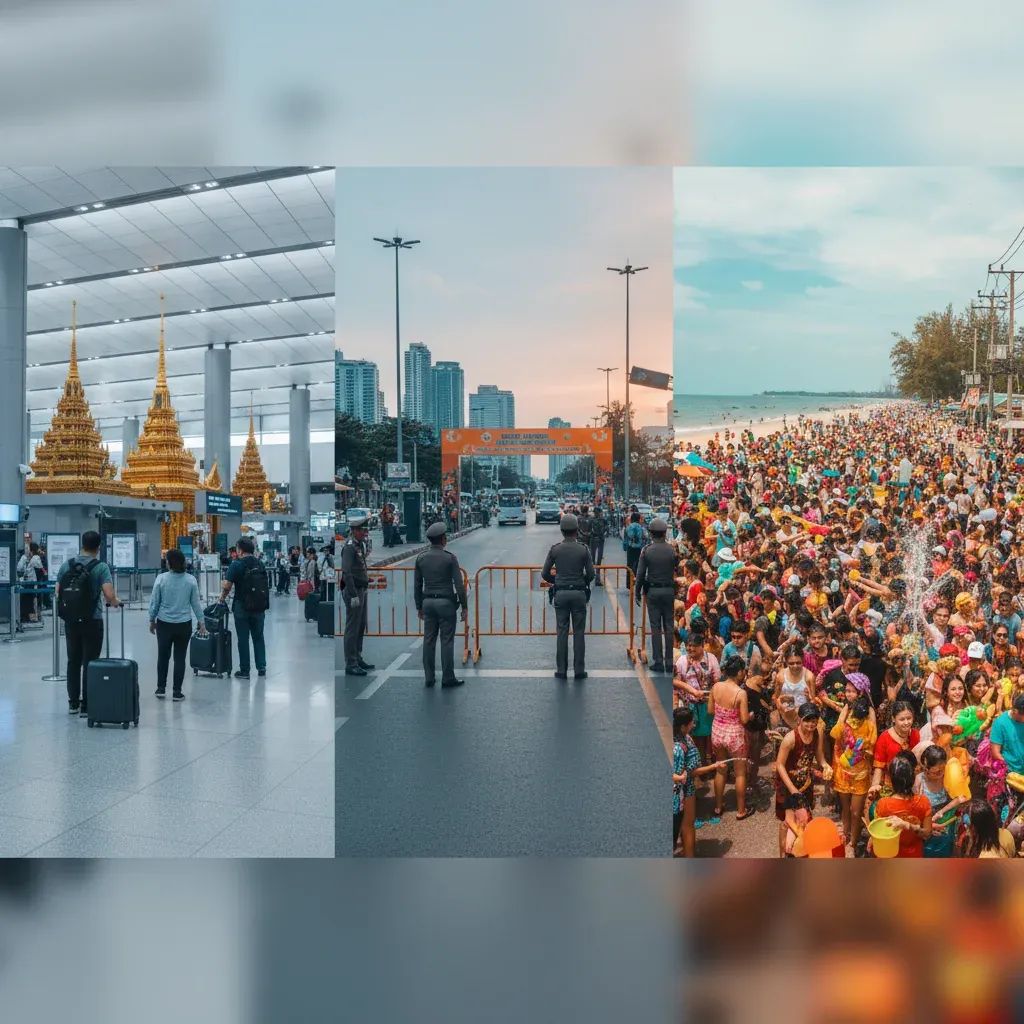
Thailand's 2026 Songkran Splits into Three Distinct Experiences—Here's What You Need to Know
Important calendar note: Thailand's Buddhist calendar year 2569 corresponds to April 2025 in the Gregorian calendar. When references mention "Songkran 2026," this festival occurs in April 2025 for residents planning their schedules.
The Thailand Airport Authority has transformed Suvarnabhumi International Airport into a ceremonial cultural gateway, while the Bangkok Metropolitan Police Bureau is enforcing its strictest Songkran restrictions yet, and the coastal city of Pattaya remains committed to an entirely different celebration model. For anyone navigating Thailand during April, understanding these divergent approaches isn't optional—it's essential logistics.
Why This Matters
• Arriving April 3-20? Interactive cultural workshops and photo installations greet you at the airport; plan extra time for baggage claim.
• Living in Bangkok? Road closures now require official permits; unauthorized neighborhood water celebrations face police enforcement and fines.
• Heading to Pattaya? Expect Beach Road to function as a water festival zone, not a thoroughfare; vehicle movement will be severely restricted through April 19.
• Rising fuel costs are keeping more domestic travelers in the capital, intensifying pressure on Bangkok's controlled celebration zones.
The Airport's Cultural Welcome
Suvarnabhumi Airport is operating as a cultural showcase from April 3-20, with the Thailand Airport Authority installing temple-inspired photo backdrops, live performances, and water-pouring rituals throughout passenger zones.
The most trafficked installation sits between baggage carousels 11 and 12 in the international arrivals hall. Arriving passengers encounter photo recreations of Thailand's most recognizable landmarks: the Giant Swing (Sao Ching Cha), the Prang of Wat Arun, and characteristic three-wheeled tuk-tuk taxis. These photo points have become nearly unavoidable—most arriving travelers photograph themselves here, generating informal documentation that spreads through social media.
The departure hall on Level 4, between gates 4 and 5, features a Buddha water-pouring ritual station where arriving and departing passengers can participate in rod nam, a purification practice marking the new year spiritually. This brings religious practice into the airport terminal in a direct way that residents and visitors will encounter upon arrival.
Calendar of Programming
The airport structures passenger engagement across specific dates. On April 10, arrival and departure halls host traditional Thai puppet theater performances combined with long-drum parade sequences, with souvenir giveaways.
The core festival window runs April 13-15, with interactive workshops in Concourse D (Level 4) for departing passengers. Sessions cover traditional Thai massage, herbal inhaler production, dried flower sachet assembly, and garland-weaving. On April 13, a live classical Thai music performance runs continuously near international baggage claim during peak flight times.
A practical detail: free parking at the long-term facility (Zone C) from April 12-16 eases congestion at terminal drop-off zones and reduces traffic delays for domestic travelers whose journey to the airport is complicated by festival congestion in surrounding provinces.
Bangkok's Strict Enforcement
Police Lieutenant General Siam Boonsom, Commissioner of the Metropolitan Police Bureau, has issued directives representing a fundamental policy shift: unauthorized road closures for water celebrations are now prohibited entirely. This marks a departure from years of informal tolerance.
Last year's Songkran saw unauthorized street takeovers in Thawee Watthana, Don Mueang, and Chokchai 4 districts, where residents blocked roads without permits and emergency vehicle access became compromised. The Metropolitan Police Bureau eliminated the permission space for unsanctioned celebrations entirely.
The practical distinction is now legally explicit: small-scale water play in front of private residences remains acceptable within tradition; large-scale street closures are prohibited. Neighbors will discover that even modest street-corner water celebrations risk police intervention if they obstruct through-traffic.
Designated Zone 1 areas where controlled celebrations are permitted include Silom Road, Khao San Road, major shopping districts including Siam Square, Benjakitti Park, and major temples throughout the capital.
How to obtain permits and find zones: Zone 1 maps are available on the Metropolitan Police Bureau website or residents can inquire at their local police stations. Permit applications must meet safety requirements and operate within specified hours.
Enforcement infrastructure has expanded accordingly. The Metropolitan Police Bureau deployed screening checkpoints at all Zone 1 entry points equipped with CCTV monitoring and facial recognition systems. These checkpoints function simultaneously as crowd density control mechanisms—if a particular area reaches critical population mass, police can restrict entry without closing the celebration entirely.
Emergency medical routes are now fixed across 17 key locations throughout the capital, marked on police dispatch maps. Large vehicles are restricted from entering inner Bangkok zones during peak celebration hours.
Pattaya's Extended Celebration Model
Pattaya operates under fundamentally different economic and regulatory constraints. The city's Songkran celebrations are structurally designed around extended, citywide street participation rather than designated zones. Road closures, water trucks at key intersections, and multi-block water-play areas constitute the economic model itself.
Festival intensity typically builds from April 11-13 and extends through April 18-19, culminating in Wan Lai (the water festival finale) centered around Naklua and the Central Festival Pattaya Beach waterfront. This nine-day sustained celebration allows hotels to market extended-stay packages and vendors to operate continuous revenue streams.
Beach Road—Pattaya's primary commercial thoroughfare—becomes functionally closed to vehicular traffic during daytime hours. Walking Street and connecting alleys (Soi 6, 7, 8) transform into water-play zones. The city effectively yields its normal traffic patterns to festival occupation.
The Tourism Authority of Thailand identifies Pattaya as the primary domestic Songkran destination. Historical data shows hotel occupancy exceeds 90% in central Pattaya during peak festival days. However, advance bookings have declined compared to previous years—attributable to flight cancellations, rising fuel costs, and some long-term foreign residents actively avoiding the city during Songkran.
Impact on Daily Movement and Business Operations
Bangkok residents should understand that Zone 1 designations are now legal boundaries, not suggestions. Attempting to organize unsanctioned water celebrations in your neighborhood risks police intervention, potential fines, or formal warnings. If you reside near Silom, Khao San, or Siam Square, expect significant congestion, heightened security presence, and elevated pedestrian density during April 13-15. Schedule essential journeys—medical appointments, work commutes, errands—for early morning or late evening.
Delivery-dependent businesses should anticipate 24-48 hour disruptions around core festival dates. The Metropolitan Police Bureau has restricted large commercial vehicles from inner Bangkok areas. Suppliers and retail operators should pre-position inventory or negotiate adjusted delivery schedules.
In Pattaya, Beach Road will be closed to normal vehicular traffic during daytime hours from approximately April 12-19. Budget significantly longer travel times or use alternative routes (Sukhumvit Road north/south, inland parallel streets) for work or essential services. The city's water infrastructure will be under strain; some water shortages or reduced pressure have been reported in peripheral neighborhoods during previous years.
Heat Safety—Critical Precautions
Both Bangkok and Pattaya will experience extreme heat during festival days. The heat index is projected to reach 60°C, representing dangerous "feels-like" temperatures that can cause serious health problems.
Critical health guidance: The 60°C heat index represents conditions where heat exhaustion and heat stroke become serious risks. Residents and visitors should:
• Seek air-conditioned shelter during peak heat hours (11am-3pm)
• Stay hydrated with electrolyte drinks, not just water
• Watch for signs of heat exhaustion: dizziness, nausea, rapid heartbeat, weakness
• Avoid prolonged sun exposure
• Check elderly neighbors and vulnerable individuals regularly
Children, the elderly, and anyone with heart or respiratory conditions face elevated risk during these conditions.
Safety Protocols and the "5 P" Campaign
Both Bangkok and Pattaya are enforcing the "5 P" campaign: no high-pressure water guns (which have caused serious eye injuries), no public alcohol consumption in designated zones, no inappropriate exposure, no powder (which clogs drainage systems), and water conservation.
In Bangkok, these are enforceable directives within Zone 1 areas. The Metropolitan Police Bureau confiscates high-pressure water guns and issues citations for public intoxication or disorderly conduct. Checkpoints include breathalyzers and weapon detection equipment.
In Pattaya, enforcement is more selective. High-pressure water guns remain prevalent despite warnings, and alcohol consumption is visibly widespread throughout Beach Road during peak hours. Many long-term foreign residents view Pattaya's Songkran as riskier than Bangkok's controlled celebration, citing higher rates of alcohol-related incidents and traffic accidents, particularly late at night.
Economic Projections
The Tourism Authority of Thailand projects Songkran 2026 revenue at approximately 30.35 billion baht, representing a 6% increase from 2025. This projection contains embedded uncertainty. Rising fuel prices and Middle East geopolitical tensions may suppress long-haul international travel.
Domestic travel faces its own friction. Elevated fuel costs typically discourage Thais from undertaking long upcountry journeys to ancestral villages—the traditional Songkran behavioral pattern. Instead, more residents may remain in Bangkok, vacation in nearby destinations, or visit beach resorts like Pattaya. This reallocation intensifies pressure on metropolitan celebration zones.
Pattaya's concerns are more acute. Declining advance bookings suggest lower international tourist volume and reduced foreign long-term resident participation. Domestic tourists may substitute for this loss, but at different spending profiles.
Planning Your Movement Through April
Songkran 2026 (April 2025) will be three distinct experiences depending on geography. At Suvarnabhumi, you'll encounter cultural programming and curated experiences. In Bangkok, you'll navigate controlled zones and police-managed celebration boundaries. In Pattaya, you'll experience extended, commercialized immersion with less systematic enforcement.
If you're arriving during the festival window, allocate extra ground transportation time. The Airport Rail Link bypasses traffic congestion entirely. If you're resident in Bangkok, clarify whether your neighborhood falls within a Zone 1 designation by consulting maps at your local police station or the Metropolitan Police Bureau website. If so, assume disruption to normal movement patterns and plan accordingly.
If you're in Pattaya, accept that the city will be operationally different from April 12-19. Schedule business and essential services outside this window or very early in the morning.
The regulatory divide between Bangkok and Pattaya will persist through the festival period. They represent two different approaches to managing Thailand's most visible cultural celebration. Your experience of Songkran 2026 depends entirely on accepting this reality and planning around it.


