
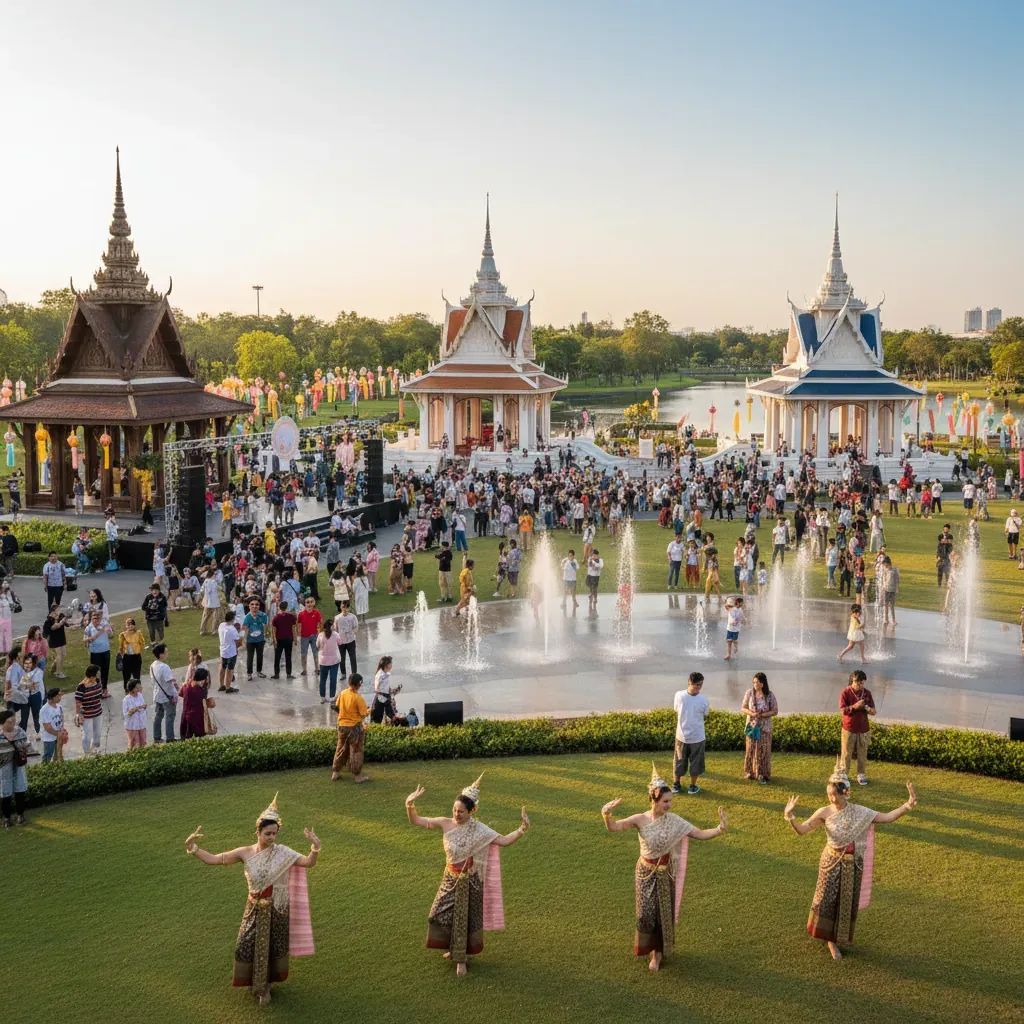
The Tourism Authority of Thailand has launched its most ambitious Songkran celebration yet, converting Bangkok's sprawling Benjakitti Park into a five-day cultural exhibition that promises to generate over 30.35B baht in nationwide tourism revenue—though fuel prices and regional air quality are dampening the usual Thai New Year travel surge.
Why This Matters
• Extended festival dates: April 11-15 at Benjakitti Park, before the official April 13-15 public holidays, offering residents a full week of programming.
• Revenue target: The Tourism Authority of Thailand projects 500,000 international visitors contributing 8.1B baht, plus nearly 6M domestic trips worth 22.25B baht.
• Access shift: Organizers have moved the event from congested street parties to open parkland—80% fewer logistical headaches for families and older participants.
• Economic headwinds: Soaring fuel costs have already cut consumer spending forecasts by 3.7% compared to 2025, with 58% of surveyed Thais skipping water-play events entirely.
Five Regions, One Park
The Maha Songkran World Water Festival 2026 occupies the former Tobacco Factory grounds, where the Tourism Authority of Thailand has subdivided the venue into regional pavilions. Each zone recreates the aesthetic and traditions of Thailand's geographic zones, layering food stalls, craft workshops, and performance stages into a single afternoon itinerary.
Eastern Thailand brings beach-club décor and tropical photo installations—think palm trees, bright murals, and coastal food vendors hawking grilled seafood. The Northern pavilion channels Lanna heritage with floating lanterns, replica temple gates, and a "slow life" lounge area designed for quiet contemplation. Visitors to the Northeastern sector encounter vibrant Isan textiles, towering Naga sculptures, and live Mor Lam ensembles performing throughout the day.
The Southern zone spotlights rare art forms, including traditional shadow puppetry (Nang Talung) workshops and performances that few Bangkok residents have seen live. Meanwhile, the Central Thailand exhibit showcases classical literature vignettes, intricately painted Yaksha (giant) figures, and demonstrations of royal court etiquette—a nod to the region's historical role as the kingdom's administrative heart.
All zones operate from 11 AM to 10 PM daily, with more than 100 food and product vendors rotating through the grounds. The Tourism Authority of Thailand allocated a budget comparable to the 183M baht spent on the 2025 edition, though private sponsors—including the SIAM Songkran Music Festival organizers, who increased their own budget to 250M baht—are supplementing infrastructure and entertainment costs.
Opening Ceremony and Nightly Entertainment
The festival launches on April 11 at 6:30 PM with a parade led by Nang Raksasadevi, the 2026 Songkran goddess portrayed by Miss World 2025 Opal Suchata Chuangsri. The procession crosses the park's main promenade, accompanied by traditional dance troupes, regional costume ensembles, and contemporary art installations on wheeled floats.
From 5 PM to 10 PM each evening, the central stage hosts concerts by acts including Bodyslam, Palmy, Joey Boy, and Ink Waruntorn. A nightly drone show featuring more than 1,200 illuminated units closes the program, choreographed to sync with a commissioned soundtrack that blends Thai folk melodies with electronic beats. The Tourism Authority of Thailand frames the drone spectacle as a counterpoint to the chaotic street splashing that has historically dominated Songkran coverage in international media.
Water Zones and Traditional Merit-Making
Planners have segmented water-play areas by age and intensity. Families with young children gravitate toward shallow splash pads equipped with foam machines and low-pressure fountains. A senior-friendly zone offers misted courtyards and shaded seating, where older participants can dab water on shoulders in the traditional gesture of respect without navigating crowds or slippery pavement.
The EDM water zone occupies a corner of the park, enclosing speakers, raised DJ platforms, and high-pressure water cannons within temporary fencing. Attendees older than 18 are encouraged to bring waterproof phone pouches; security staff enforce a no-glass policy and check bags at entry points.
For those prioritizing ritual over revelry, the Tourism Authority of Thailand has installed sand-pagoda stations and Buddha-bathing pavilions near the park's quieter northern edge. Volunteers distribute lotus flowers, incense, and small packets of sand for participants building merit as part of the Thai New Year observance. These areas remain alcohol-free and are staffed by monks from nearby temples who offer blessings and answer questions about the ceremonies' significance.
What This Means for Residents
Thailand-based expatriates and long-term visa holders gain a structured alternative to the infamous Khao San Road or Silom splashing zones, where pickpocketing and overserved tourists have historically created friction. Benjakitti Park's layout—open lawns, visible security, and multiple entry-exit points—reduces the claustrophobia that has driven many residents to skip Songkran altogether or flee Bangkok during the holiday.
Parents with school-age children benefit from the 11 AM start time, which allows families to tour the cultural zones, eat lunch, and depart before the evening concert crowds arrive. The park sits adjacent to the Queen Sirikit National Convention Centre MRT station, eliminating the need to drive and search for parking in a city where holiday-weekend traffic routinely doubles commute times.
Domestic tourists from upcountry provinces face a tougher calculation this year. Diesel prices have climbed to levels that make the eight-hour bus ride from Khon Kaen or Udon Thani prohibitively expensive for middle-income families. The University of the Thai Chamber of Commerce reported that 33% of surveyed respondents will skip inter-provincial travel entirely, a figure that correlates with the Tourism Authority of Thailand's acknowledgment that revenue could have been 5-7% higher without the energy-price shock.
International visitors arriving during the April 10-19 travel window will encounter an estimated 3.7M passengers moving through Airports of Thailand facilities—1.44M domestic, 2.26M international. Europeans booking flights have seen ticket prices double on certain routes due to Middle East airspace restrictions, which force carriers onto longer, fuel-intensive paths. The Tourism Authority of Thailand anticipates this will shave 4% off projected international arrivals, though Southeast Asian and East Asian markets remain strong.
Regional Challenges and Adjustments
Chiang Mai's air-quality crisis continues to suppress northern tourism. PM2.5 readings during early April have historically spiked above 150 micrograms per cubic meter, prompting hotel cancellations from health-conscious European travelers. The Thai Hotels Association estimates occupancy in Chiang Mai will hover between 50-60%, well below the 85% rates recorded in 2023 before the pollution became a sustained international news story.
Phuket and Koh Samui are faring better, with beach-resort operators reporting near-capacity bookings for beachfront Songkran parties. Pattaya's extended "Wan Lai" celebrations stretch to April 19, spreading crowds across multiple weekends and reducing the single-day bottlenecks that have previously overwhelmed waste-collection services.
Central Pattana, the Thailand-based mall operator, has programmed more than 1,000 Songkran events across 44 branches nationwide, expecting to draw 10M participants. These indoor celebrations—featuring air-conditioned food courts, retail promotions, and family-friendly water zones—appeal to consumers who want cultural programming without the expense or risk of overnight travel.
Broader Context
The Tourism Authority of Thailand has positioned the Benjakitti Park festival as the flagship of its campaign to secure UNESCO recognition for Songkran as intangible cultural heritage. By centralizing performances, traditional crafts, and educational exhibits in a controlled venue, organizers hope to counteract the international perception of Songkran as a week-long street brawl fueled by buckets and water pistols.
Running in parallel, the "Saneh Art by Songkran Festival 2026" occupies Lumpini Park from April 10-30, featuring large-scale sculptures by prominent Thai artists. The two events bracket the official April 13-15 holidays, extending the capital's programming to nearly three weeks and giving tourism operators multiple windows to fill hotel rooms and restaurant seats.
Whether the strategy succeeds depends partly on variables outside the Tourism Authority of Thailand's control. If global fuel markets stabilize and Chiang Mai's annual burn season delivers cleaner air, the 30.35B baht revenue forecast may prove conservative. If not, the Benjakitti Park model—accessible, family-oriented, and anchored to public transit—could become the blueprint for future Songkran celebrations, gradually displacing the chaotic street parties that have defined the holiday for decades.
Admission to the Maha Songkran World Water Festival 2026 is free. Attendees should bring sunscreen, a change of clothes, and waterproof bags for valuables. The park enforces a ban on glass containers, drones (except the official display), and water guns exceeding 50 centimeters in length.


