
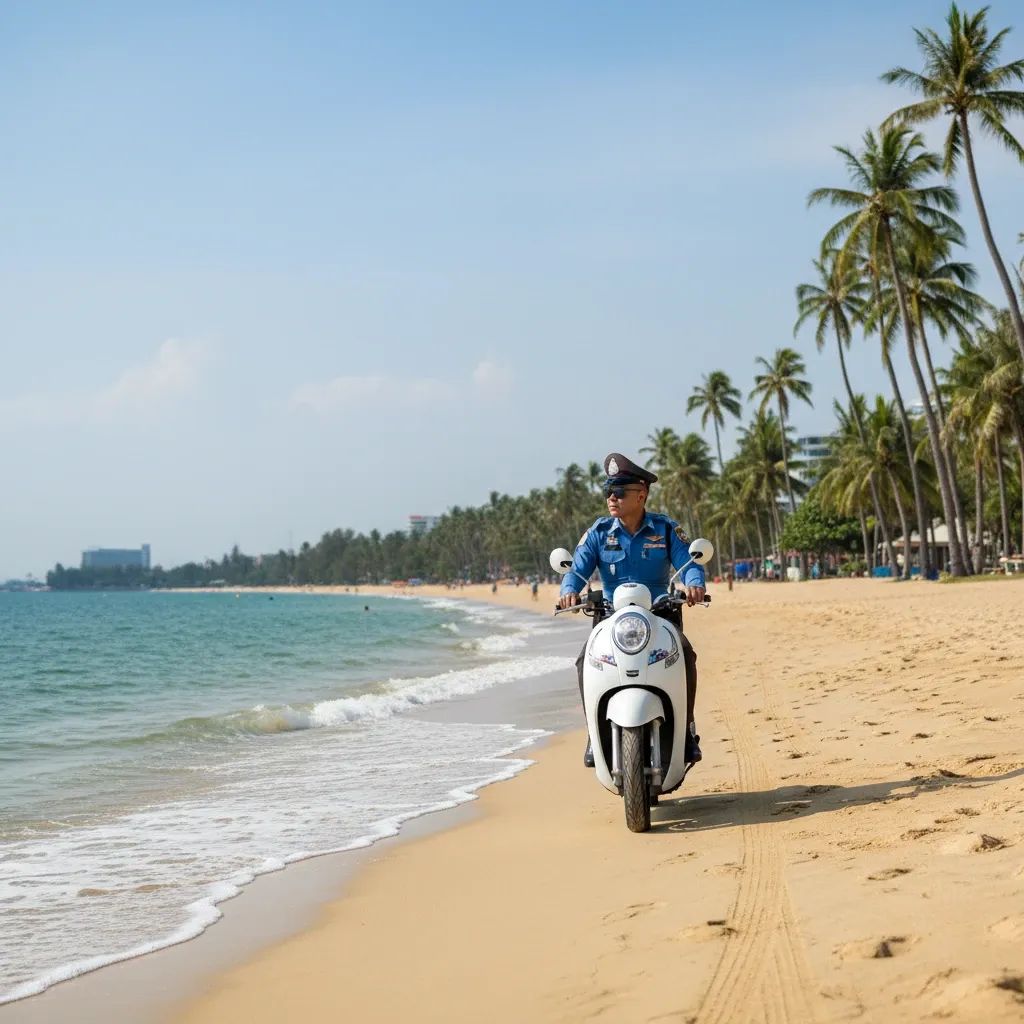
Thailand's coastal resort cities confronted a troubling sequence of public safety incidents in early June, exposing vulnerabilities in mental health services, informal dispute resolution, and tourist conduct enforcement. Rather than a spike suggesting systemic collapse, what emerged from authorities' swift response was a clearer picture of where the system works—and where gaps still demand urgent attention.
Why This Matters
• Mental health crises now recognized as public safety drivers: Unprovoked assaults in tourist zones are forcing police and municipal authorities to coordinate with healthcare providers on real-time psychiatric intervention and involuntary evaluation protocols.
• Foreign nationals face automatic enforcement: Visa revocation and permanent blacklisting now follow criminal conviction, with no diplomatic exceptions regardless of nationality.
• Compensation settlements accelerating: Police are brokering victim restitution agreements outside formal court channels, reducing processing time and ensuring faster victim recovery for material damages.
• Infrastructure investment yielding faster response: CCTV integration and 24-hour dispatch systems have cut police arrival times from 15–20 minutes to 8–12 minutes in central Pattaya.
Between June 8 and 10, Pattaya and Phuket recorded at least five separate violent incidents. Most were unprovoked. Several involved foreign nationals; others involved domestic service-sector workers. The incidents arrived precisely when Thailand's tourism authority was attempting to rebuild international confidence following the U.S. State Department's downgrade of Thailand to Level 1 travel advisory (lowest risk category) in June 2025. Viral social media footage threatened to undermine that messaging, creating a perception gap between official safety rankings and street-level reality.
Yet the official response—rapid arrest, forensic documentation, psychiatric screening, and victim compensation—also revealed institutional capacity that had improved markedly compared to responses recorded just two years earlier.
The Homeless Crisis Intersecting Violence
On the evening of June 8, a 48-year-old tourist from Bangladesh named Hassan was walking along Pattaya Beach near the Bayoke resort complex when an unknown man struck him without provocation. Hassan collapsed with a nosebleed and facial trauma. Rescuers from the Sawang Boriboon Foundation arrived quickly; Hassan refused hospitalization but confirmed the assault was entirely unprovoked.
Witnesses described the suspected assailant as a familiar presence in the beach corridor—someone frequently observed engaging in disruptive behavior. Business owners and residents told investigators they believed he was experiencing untreated mental illness and should have been receiving professional support years ago.
The incident reopened a debate that has simmered in Pattaya City for years. The municipality manages homelessness through a voluntary four-pillar framework launched in fiscal 2025, known locally as the "BIG 4" initiative. The program includes drop-in service centers offering meals and hygiene facilities, halfway house placements, subsidized rental units, and targeted street outreach. Yet participation remains voluntary, funding is limited, and the system remains reactive rather than preventive.
The Chonburi Provincial Center for Homeless Persons, which coordinates with Pattaya City authorities, documented that roughly 40% of registered rough sleepers refuse services or disappear from registries within weeks. Mental health screening occurs inconsistently. Thai law permits involuntary psychiatric commitment only when individuals pose documented imminent danger—a legal threshold that encourages reporting but delays intervention until after harm occurs.
Residents and business operators have pressed the Thailand Ministry of Social Development and Human Security to expand involuntary commitment pathways. The ministry's April 2026 response outlined a pilot program deploying mobile psychiatric assessment teams to high-risk tourist areas during peak seasons, but implementation timelines and funding remained undefined.
Territorial Disputes in the Service Economy
Separate incidents on June 8 in the Ban Nong Manao community within Banglamung district and June 10 on Pattaya Third Road revealed a chronic problem: informal service workers—particularly motorcycle taxi operators—lack formal dispute resolution mechanisms. When conflicts arise, informal power networks and street violence become the default option.
A 25-year-old Thai man named Rojanavisit told Banglamung Police he had test-revved his recently repaired Honda Wave 125 motorcycle outside his home after midnight on June 8. The noise prompted complaints from a group of young men in the neighborhood. Later that night, the group returned with motorcycles, tools, and knives, revving their engines aggressively near Rojanavisit's residence.
Rojanavisit attempted to de-escalate by speaking directly with the group. They initially told him the matter was resolved. As he rode home, however, one member allegedly pursued him with a knife. Rojanavisit abandoned his motorcycle and fled indoors, calling relatives for backup. A mass brawl erupted between the two groups. One member from the opposing side sustained injuries severe enough to require hospitalization. Police seized multiple knives from the scene and documented damage to a parked car and the motorcycle.
Hours later on Pattaya Third Road, a 20-year-old man was hospitalized with severe facial swelling and a laceration near his left eyelid after allegedly being assaulted by a group of motorcycle taxi drivers. According to a female witness, the victim's social group was leaving an entertainment venue in the Excite project complex when an exchange of stares with individuals standing at a nearby taxi stand created immediate tension.
The taxi drivers allegedly made rapid phone calls summoning reinforcements. Within minutes, seven to eight motorcycles arrived carrying additional men. They allegedly surrounded the 20-year-old in front of tourists and bystanders, striking him repeatedly until he lost consciousness. The attackers fled on motorcycles before Pattaya City Police arrived. Rescuers transported the victim to hospital disoriented. CCTV footage and eyewitness statements are under investigation.
Both incidents illustrate how informal service workers operate without consistent regulation, occupational arbitration, or formal conflict resolution. Motorcycle taxis in Pattaya compete aggressively for fares. When disputes arise—whether over territory, vehicle noise, or perceived disrespect—informal enforcement networks and street violence persist as the settling mechanism.
Foreign Nationals and Enforcement Consistency
American Tourist Settles Property Damage Claim
On June 8, an American tourist identified as Alexander, 28 years old, was escorted to Na Jomtien Police Station following an altercation at a hotel in the station's jurisdiction. Security footage and social media clips showed Alexander behaving erratically in the hotel lobby before allegedly grabbing a female receptionist's mobile phone and smashing it repeatedly against a table, destroying both glass panels.
The hotel staff contacted police and the employee's family. Investigators transported Alexander to the station for questioning. Both parties negotiated a settlement agreement in which Alexander paid ฿8,000 to cover phone replacement. He signed the agreement on June 10.
However, Na Jomtien Police also revealed that the same individual had been reported by another hotel in Pattaya for allegedly damaging an automatic entrance door in a separate incident. That case remains under investigation, with compensation discussions ongoing through formal legal channels. Police have not disclosed whether alcohol or other substances contributed to either incident.
The handling reflects a deliberate policy shift. Rather than pursuing immediate arrest, stations are encouraging negotiated settlements and victim compensation when damage is material and relatively modest. This approach reduces court caseload while ensuring accountability and victim recovery. However, the strategy carries risks: repeat offenders may perceive lenient initial responses as tolerance, and the approach works only when defendants are solvent and cooperative.
Public Disturbance in Phuket Raises Mental Health Questions
On June 9 in Phuket's Cherng Talay district, a foreign woman was detained after stripping naked on Srisoonthorn Road near Surin Beach and engaging in a violent public disturbance. Witnesses reported she walked along the roadway shouting incoherently, entered a massage establishment where she allegedly assaulted a female staff member, tore away a towel staff had wrapped around her, struck parked vehicles, and chased pedestrians through the area.
Cherng Talay Police approached cautiously and brought her into custody without escalation. She was transported to the police station for toxicology screening and psychiatric evaluation. Authorities have not disclosed her nationality, immigration status, or the underlying cause of her behavior. Investigation into potential charges—including public indecency, assault, and causing a public nuisance under Thailand's Criminal Code—remains active.
Uniform Enforcement Standards for All Nationalities
All three cases involving foreign nationals resulted in formal police intervention and legal processing. This consistency signals that Thai authorities apply criminal law equally regardless of visitor status. Under Section 4 of the Thai Criminal Code, any individual—Thai citizen or foreign national—who commits an offense within the kingdom's territory is subject to prosecution and potential imprisonment.
Conviction for crimes involving violence or property damage triggers additional penalties specific to foreign nationals. The Immigration Act of 2522 (1979) empowers Thailand's Immigration Bureau to revoke entry permits, deny future visa applications, and place individuals on permanent entry blacklists. Deportation typically follows conviction.
What This Means for Residents
For Thailand-based professionals and expats, the June incidents carry three practical implications.
First, violent crime remains statistically rare but geographically concentrated in Pattaya and Phuket's tourist corridors. Pattaya City Police Station recorded 5 assault cases, 10 theft incidents, and 11 technology-related fraud cases in April 2026—a typical monthly baseline. Arrest rates exceeded 90% across all categories, indicating strong investigative capacity. However, assault cases involving territorial disputes or untreated psychiatric conditions have resisted statistical decline despite enforcement efforts.
Second, compensation and legal recovery have become more accessible. Victims of property damage can pursue both criminal prosecution and civil claims. The civil pathway, governed by Thailand's Civil and Commercial Code, allows victims to file suits in Thai courts for compensation covering medical expenses, property replacement, and lost income. Foreign nationals can participate but must retain Thai legal counsel and ensure all documentation is professionally translated and certified before filing.
Third, tourist misconduct triggers zero-tolerance enforcement from immigration authorities. The message embedded in recent operations is unambiguous: criminal behavior results in immediate visa revocation, permanent blacklisting, and deportation. There are no diplomatic exceptions. The U.S. State Department maintains Thailand at Level 1 advisory status precisely because the kingdom's legal system applies rules consistently and predictably.
Coordination on Homelessness and Mental Health
The HON Pattaya network—a coalition of government agencies, nonprofit organizations, and healthcare providers—conducts targeted outreach to homeless populations. Mobile assistance teams help individuals access identification documents, healthcare eligibility transfers, and shelter placements. Funding constraints remain severe; the program reached approximately 340 individuals in Pattaya during the first five months of 2026, a fraction of the estimated homeless population.
The Thai Ministry of Public Health operates a 24-hour psychiatric hotline (1300) where callers can report individuals experiencing apparent mental health emergencies. Trained responders assess whether individuals meet criteria for involuntary evaluation. Current law permits involuntary psychiatric holds only when an individual poses documented danger to themselves or others—a standard that encourages reporting but relies on clinical judgment in high-stress situations.
Mental health professionals in Pattaya have privately expressed frustration with the system's reactive posture. "We see the same faces in crisis every three to six months," one psychiatrist noted in May 2026. "The legal framework requires us to wait for acute danger before we can intervene. By then, the person has often committed a crime or been victimized."
Immigration Enforcement in Public Spaces
On June 10, officers from Pattaya City's municipal enforcement department discovered a foreign national begging inside Wat Chaimongkol, a prominent Buddhist temple in central Pattaya. After questioning, the man was transferred to Thailand Immigration Bureau personnel for status verification and legal processing. Officials declined to release his nationality, immigration status, or duration in Thailand.
The operation reflects a coordinated enforcement strategy now active across Pattaya's high-profile spaces. Municipal officers regularly conduct unannounced inspections of temples, beaches, and commercial districts with high tourist foot traffic. When foreign nationals are identified without valid documentation or engaging in prohibited activities, they are referred to immigration authorities for processing.
Thailand's Immigration Bureau processes approximately 150 to 200 cases monthly involving foreign nationals engaged in unauthorized activities or residing without valid permits. The majority result in voluntary departure agreements within 30 days; roughly 20% require forced deportation.
Infrastructure and Response Capacity
Pattaya City has invested heavily in surveillance and rapid-response infrastructure over the past 18 months. The municipality installed more than 2,500 closed-circuit television cameras across tourist zones, beaches, and commercial streets. Integration with the "1337 Pattaya Contact Center," a 24-hour emergency dispatch system launched in 2025, allows residents and tourists to report incidents in real time.
Response times to violent crime reports average 8 to 12 minutes for police arrival in central Pattaya, a marked improvement from the 15 to 20-minute baseline of prior years. Rescue teams from the Sawang Boriboon Foundation are stationed at multiple beach access points to provide immediate first aid.
Yet infrastructure alone does not address root causes. The June incidents underscore persistent gaps in mental health outreach, homelessness services, and worker dispute-resolution mechanisms. The Thailand Ministry of Social Development and Human Security acknowledged these challenges in June 2026, committing to pilot involuntary psychiatric evaluation programs in Pattaya and Phuket by October 2026. The timeline is aggressive; implementation depends on recruiting and training psychiatric teams, negotiating space-sharing agreements with hospitals, and establishing legal protocols that comply with Thai mental health law. Early estimates suggest the initiative will reach fewer than 20% of at-risk individuals in the first 12 months.
Legal Pathways for Victims and Witnesses
Tourists who witness or experience crime can contact the Tourist Police hotline at 1155, available 24 hours with English-language support. The 1337 Pattaya Contact Center also accepts incident reports and coordinates dispatch. All reports are logged in a centralized database reviewed by investigators and supervisors.
Evidence collection has improved markedly. Video footage—whether from business surveillance systems, personal devices, or public-area cameras—is now the primary basis for prosecutions involving assault or property damage. In cases where video evidence is clear and uncontested, conviction rates exceed 85%.
Defendants in Thai courts enjoy procedural rights including legal representation, the right to cross-examine witnesses, and appellate review. However, Thai law does not provide jury trials; cases are decided by professional judges trained in Thai legal codes. For foreign defendants, the absence of jury trial sometimes creates perceived bias, though judicial review mechanisms offer several layers of appellate oversight. Complex criminal cases often require a Thai-licensed attorney specializing in international clients; legal fees range from ฿30,000 to ฿150,000 depending on case complexity and trial duration.
Context and Forward Direction
The timing of the June incidents is notable. Thailand's official high tourism season peaks during November through February. June marks the monsoon transition and a temporary decline in visitor volume. Yet the June incidents occurred during shoulder season, suggesting that underlying tensions—territorial disputes, untreated psychiatric conditions, informal-sector friction—operate independently of seasonal tourism fluctuations.
Pattaya and Phuket authorities have committed to quarterly enforcement summits involving police, immigration, municipal enforcement, social services, and healthcare providers. The stated goal is transitioning from reactive incident response to predictive risk management.
Skeptics note that similar initiatives have been launched multiple times over the past decade with limited sustained impact. Budget cycles, staff turnover, and the sheer scale of tourist traffic create operational friction. Optimists point to recent technological investments and the evident political will demonstrated through CCTV expansion and contact center launch.
For residents and regular visitors, the practical implication is clear: Pattaya and Phuket remain statistically safer than comparable beach destinations in Southeast Asia, and enforcement capacity has demonstrably improved. However, vulnerabilities remain—particularly in mental health crisis response, homeless population management, and informal-sector dispute resolution. Situational awareness and caution remain reasonable precautions, particularly during evening hours in high-traffic tourist zones where informal power dynamics and service-sector tensions periodically ignite into visible violence.


