
When foreign retirees started arriving in Pattaya three decades ago, the arithmetic was straightforward: a European pension of €1,200 monthly translated into comfortable housing, daily meals at quality restaurants, and a casual social life. Today, that same pension buys roughly 25% less than it did in 2023. The Thai baht has strengthened significantly, cost-of-living has accelerated, and the equation that made Pattaya viable for ordinary pensioners has fundamentally broken. For tens of thousands living here on fixed incomes, the reality has shifted from "pleasant retirement destination" to "financial management exercise."
Why This Matters
• Currency headwinds: A British pensioner receiving £1,200 now receives approximately ฿45,000 monthly, down from ฿52,000 in 2023—a 12% effective income loss in under three years regardless of pension increases at home.
• Survival budget: Basic monthly expenses for frugal retirees now stand at approximately ฿15,000–฿25,000, leaving tight margins for emergencies, healthcare, or social activity beyond local markets and street food.
• Visa requirements: Thailand's retirement visa program requires holders to maintain either ฿800,000 in deposits or ฿65,000 monthly income—increasingly difficult as exchange rates move unfavorably and living costs climb.
• Housing pressures: Local sources report growing inquiries for inland neighborhoods as residents seek to reduce rental costs, with many fleeing beachfront accommodation they can no longer afford.
The Population and Demographics
Approximately 50,000–60,000 foreign residents call Pattaya home, though precise numbers remain unclear. They hail primarily from Europe—Britain, Germany, and Scandinavia—alongside substantial Russian and South Korean communities. Crucially, these are not the wealthy retirees pursuing Thailand's Long-Term Resident (LTR) visa programs, which target higher-income categories. Instead, they live on ordinary state and occupational pensions: approximately £11,500 annually from UK state pensions, roughly €18,000 from German public systems, or approximately $1,900 monthly from U.S. Social Security.
For this demographic, rising costs represent a genuine financial threat to their ability to remain.
Transportation: Adapting to Tighter Budgets
Vehicle ownership once symbolized integration into Pattaya's expat life. Today, however, many long-term residents report selling cars and switching to cheaper alternatives—a visible shift reflecting financial pressures rather than lifestyle preference.
The mathematics explain the change clearly. Operating a mid-range sedan costs approximately ฿15,000–฿25,000 monthly when fuel, insurance, parking, and depreciation are included. By contrast, songthaews—shared pickup trucks—charge ฿20–฿50 per ride, meaning regular users spend only ฿1,500–฿3,000 monthly. Bicycles cost nothing to operate.
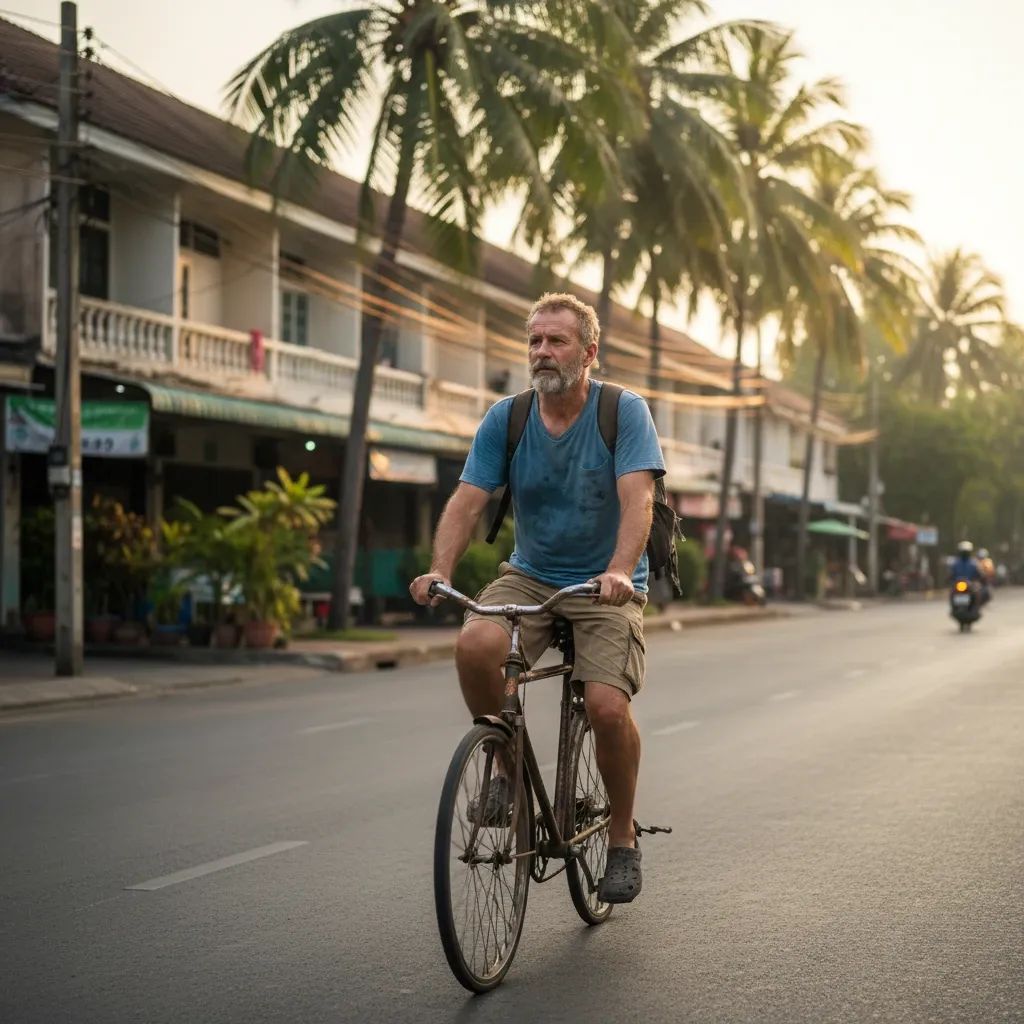
Pattaya's compact geography—roughly 8 kilometers end to end—makes cycling practical for most errands. Anecdotal reports from local residents increasingly describe German and British retirees pedaling through central streets, their bicycles a visible symbol of financial adaptation. One Australian resident described the shift: "I sold my car six months ago. Now I walk or take the bus. I saved around ฿18,000 a month."
This shift reflects not lifestyle preference but economic necessity. Every transportation decision now involves explicit cost-benefit analysis—a stark contrast to how expat residency functioned a decade ago.
Housing: The Search for Affordable Alternatives
Long-term foreign residents report growing pressure to relocate inland as rental prices rise. Neighborhoods once considered less desirable by Western standards—such as Naklua and Jomtien—now attract increasing interest from cost-conscious retirees, while demand for central beachfront apartments appears to be softening.
The rental market has become increasingly stratified. Studio apartments in more central areas command ฿12,000–฿20,000 monthly, while premium units reach ฿35,000–฿80,000. By contrast, older apartment blocks further inland reportedly offer units starting at ฿8,000—a significant gap that can determine solvency for pensioners living on ฿40,000 total monthly income.
A 67-year-old German resident shared his experience: "I lived on Soi 6 for five years. Now I'm 3 kilometers inland. The rent dropped by ฿7,000, and I bought a bicycle."
The trade-off—slower internet, longer songthaew rides to attractions, distance from expat social hubs—represents the price many residents now pay for continued financial viability.
Dining: The Restaurant Culture Contracts
Pattaya's hospitality reputation rested partly on its social dining culture, where foreign retirees regularly gathered in mid-range restaurants. That pattern has noticeably changed among cost-conscious long-term residents.
Local sources report the economic gap explains the shift. A Western-oriented restaurant meal costs approximately ฿500–฿800, while Thai roadside eateries charge ฿50–฿100 per plate. Eating three daily street meals costs roughly ฿4,500 monthly. The same person dining twice weekly at mid-range restaurants while cooking at home spends approximately ฿12,000—a ฿7,500 monthly difference representing survival versus chronic deficit for someone living on ฿40,000.
Local market vendors report that imported Western staples—cheese, cold cuts, breakfast cereals—have become more expensive, further incentivizing shifts toward local produce. Local markets have increasingly become social gathering points for budget-conscious expats seeking fresh vegetables and prepared Thai dishes rather than supermarket aisles stocked with imported goods.
Hospitality workers in entertainment areas report reduced regular customer visits over the past year among long-term foreign residents, despite surging tourist foot traffic. The change reflects a deeper reality: foreign retirees increasingly view Pattaya as a place of residence requiring disciplined financial management rather than a recreational destination.
Healthcare: The Continuing Advantage
One area where Pattaya genuinely outperforms Western countries is medical care. Private facilities provide internationally recognized services at a fraction of home-country costs. A specialist consultation costs approximately ฿500–฿1,500, routine blood work ฿1,000–฿2,000, and complex procedures like hip replacement cost approximately ฿400,000–฿600,000—roughly one-fifth typical U.S. pricing.
Many retirees cite accessible, affordable healthcare as the primary reason they remain despite tightening budgets. Private health insurance costs approximately ฿30,000–฿80,000 annually depending on age and coverage—far below comparable Western policies. For retirees managing chronic conditions—hypertension, diabetes, joint deterioration—Pattaya's infrastructure offers quality and affordability difficult to replicate at home.
This advantage remains significant today but may narrow as the population ages and medical complexity increases.
Thailand's Policy Direction: Higher Income Targets
Thailand has shifted its expat visa strategy toward higher-income categories. The Long-Term Resident (LTR) visa program targets wealthy retirees, highly-skilled professionals, remote workers, and global citizens with substantial annual incomes. Additionally, recent policy changes have made it possible for foreigners purchasing or leasing high-value properties to qualify for extended residence permits.
These policies represent intentional demographic recalibration away from mid-tier pensioners toward higher-net-worth individuals. Yet analysts note that long-term foreign residents have historically contributed meaningful spending to local economies through rent, food, healthcare, and services. If financial pressures drive mid-tier retirees toward cheaper alternatives like Vietnam or the Philippines, the impact on local communities could be significant.
The Financial Squeeze Widens
The pressure to cut costs distributes unevenly. Those pursuing high-income visa categories remain largely insulated, maintaining central apartments, dining out regularly, and enjoying the lifestyle that defined expatriate Pattaya a generation ago.
The majority occupy a different tier. Their adaptations have become increasingly systematic. Budgeting strategies proliferate within the expat community. Informal online communities have grown, with residents sharing practical tips on affordable accommodation, food shopping, and healthcare options. The culture of casual spending has yielded to careful arithmetic and deliberate financial planning.
Local online forums suggest many foreign retirees are actively considering relocation options, either returning home or moving to less expensive Asian destinations. That represents not only individual departures but potential damage to Pattaya's long-standing reputation as a viable retirement destination.
The Underlying Question
A 71-year-old British pensioner, speaking anonymously, summarized the concern many residents quietly share: "I've been here 12 years. I love the weather, the people, the healthcare. But my pension buys 25% less than it did three years ago. At some point, you have to ask: how long can this work?"
That question—increasingly common in expat conversations yet rarely addressed officially—now weighs on many foreign residents. Pattaya remains warmer, friendlier, and cheaper than major Western cities. Healthcare quality exceeds what many pensioners could access at home. The social infrastructure supporting long-stay residents remains strong.
Yet it is no longer the financial refuge it once was for ordinary pensioners. The strengthening baht shows no signs of reversing. Local inflation continues as tourism recovers and wages increase. For pensioners whose incomes remain fixed, the monthly arithmetic grows tighter.
The Broader Challenge
Thailand's policymakers face an implicit tension. Official strategy targets wealthy newcomers, yet quietly ordinary pensioners—the demographic that built Pattaya's foreign community—quietly depart. Tourism boards celebrate new arrivals, but departures leave no trace in official statistics.
Some residents have adapted successfully through disciplined lifestyle redesign—bicycles, inland housing, street food, and reduced entertainment spending. Others have begun considering relocation to cheaper alternatives or back to home countries they once left.
The question facing Thailand's tourism and immigration authorities is whether the current upmarket strategy serves long-term community interests. Pattaya's historical value to the broader tourism ecosystem has rested on its role as an accessible destination for ordinary people worldwide. As that accessibility erodes through policy direction and currency movements, the city faces the prospect of losing not just individuals but an entire demographic category that once sustained the city's long-term foreign community.
The financial equation of retirement in Thailand has changed. Whether Thailand recognizes the full implications of that change remains an open question.


