
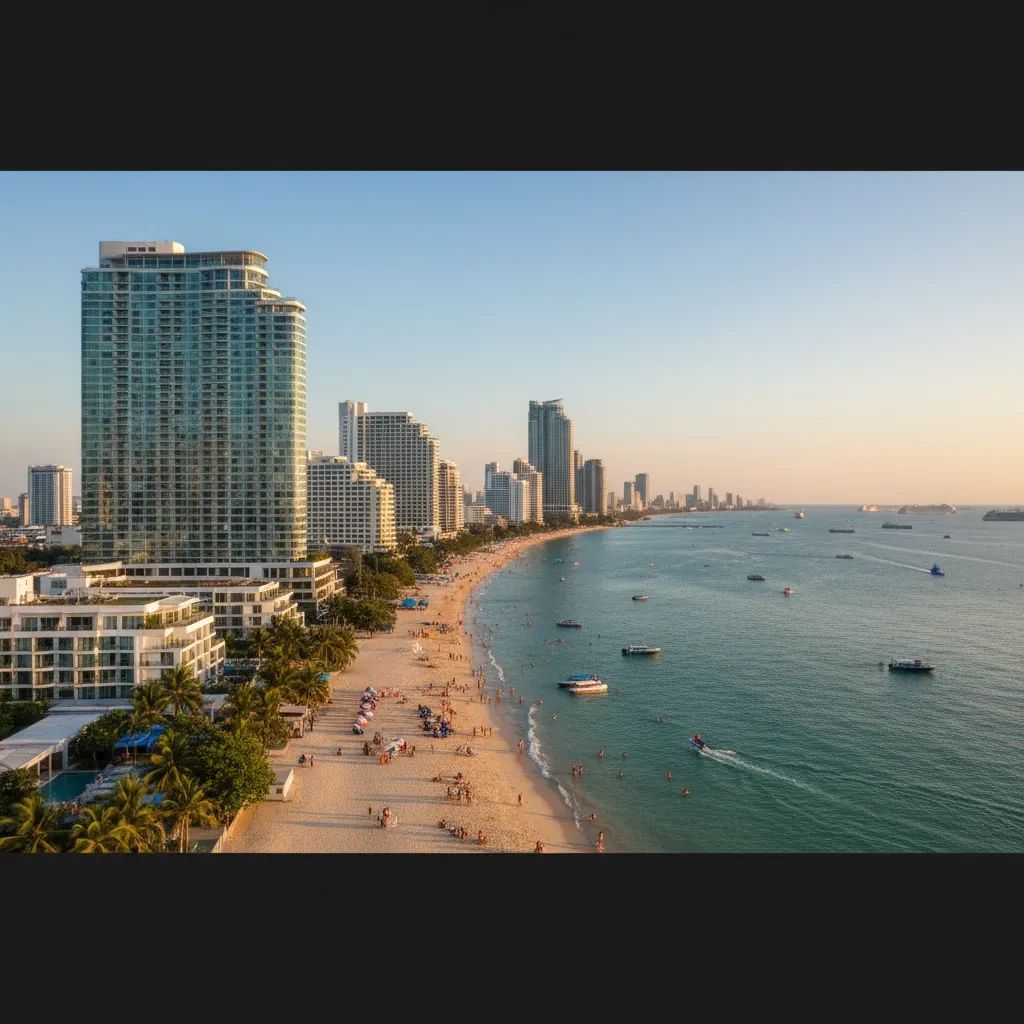
The Tourism Authority of Thailand (TAT) and Pattaya's hospitality sector are projecting a significant uptick in international arrivals for 2026—optimism that could translate into higher business costs, increased congestion, and shifting neighborhood dynamics for the city's resident community. But seasoned expatriates warn that structural questions about pricing, geopolitical volatility, and visitor mix threaten both the projections and the city's livability.
Why This Matters
• Chinese visitor volumes remain 35% below pre-pandemic levels despite being labeled the primary recovery driver.
• Hotel room rates have climbed 5-10% year-on-year, with average nightly costs now exceeding pre-COVID benchmarks.
• Middle East tensions could suppress traveler confidence and push fuel costs higher, directly impacting ticket affordability.
• Pattaya is diversifying away from nightlife dependency, targeting families, digital nomads, and wellness tourists—a shift that may redefine the city's economic model.
The Numbers Tell a Mixed Story
On paper, Chonburi Province—home to Pattaya—welcomed approximately 13.7M visitors in the first half of 2025, reflecting continued year-on-year growth. Nationwide, however, foreign arrivals for calendar year 2025 declined 7.23% from 2024, landing at 32.9M. January 2026 alone saw an 18% drop in foreign entries compared to the same month a year prior.
This regional divergence—Chonburi's growth against national decline—likely reflects Pattaya's infrastructure advantages and its appeal to long-stay European visitors, who have proven more resilient than short-term Asian tourists affected by economic headwinds.
This gap between provincial optimism and national data has prompted skepticism among long-term residents and business operators who measure recovery by year-over-year consistency, not weekend spikes. One expatriate hotelier, who requested anonymity, put it bluntly: "Short spikes don't equal genuine recovery. Until we see consecutive quarters of sustained growth—not just festival weekends—we're still in a rebuilding phase, not a boom."
For 2026, the TAT is targeting 36.7M foreign arrivals nationally, a 10.35% increase over 2025's figures. Pattaya is expected to capture a sizeable share, fueled by infrastructure investments in the Eastern Economic Corridor, the U-Tapao Airport expansion, and the forthcoming high-speed rail link to Bangkok. The Tomorrowland Thailand electronic music festival, scheduled for December 2026, is anticipated to draw a large international crowd and further cement Pattaya's repositioning as a family-friendly and lifestyle destination.
China and India: The Twin Engines That Sputter
China remains the official centerpiece of Pattaya's recovery strategy. In early 2026 (January 1 to February 22), Chinese nationals represented the single largest tourist nationality entering Thailand, with close to 1M arrivals. Yet in 2025, Chinese visitor numbers to Chonburi fell 35% year-on-year, and nationwide figures showed Chinese arrivals nearly halved in Q2 2025 compared to Q2 2024.
The causes are varied: a slowing domestic economy, intensified trade tensions, social media-driven safety concerns (including the high-profile kidnapping of a Chinese actor), and fierce competition from Vietnam and Japan. Before the pandemic, Chinese tourists accounted for 70% of Pattaya's visitor base. Today, while FIT (free independent traveler) bookings remain steady, the large-scale group tours that once packed hotels and restaurants have largely evaporated.
India presents a brighter—but still modest—picture. Indian arrivals to Thailand rose 30% in 2024, reaching 2.1M. The extended visa-on-arrival scheme (permitting stays of up to 60 days) and improved flight connectivity have been key. In Chonburi specifically, Indian visitors ranked fifth among foreign nationalities in the January–November 2024 period, with just over 26,600 arrivals. That's growth, but it's not yet scale. Indian tourists tend to travel as families or couples, favoring Bangkok, Phuket, and Pattaya, and their spending patterns lean toward budget and mid-tier accommodations.
Together, these two markets are meant to drive Pattaya's 2026 surge. But both are sensitive to currency volatility, economic headwinds at home, and external shocks—which brings geopolitics back into focus.
Geopolitical Friction and Fuel Costs
Escalating tensions in the Middle East—particularly the confrontations involving the United States, Israel, and Iran that intensified in February 2026—are having ripple effects far beyond the region. While Thailand is geographically distant and politically neutral, the conflict has triggered flight cancellations, airspace restrictions, and higher aviation insurance premiums.
Most critically, prolonged instability threatens to push fuel prices higher, which airlines will inevitably pass on to consumers. For price-sensitive markets like China and India, even a 5-10% fare increase can shift booking behavior. European travelers, who currently represent the most stable segment for Pattaya, may also reconsider long-haul trips if global headlines remain dominated by conflict.
The Ministry of Tourism and Sports has already issued directives to monitor the situation and prepare contingency measures for stranded travelers, including 24-hour support centers. Thailand's neutral diplomatic stance—maintaining relationships with Iran, Israel, and the United States—means the kingdom is unlikely to face direct travel advisories. However, the ministry has activated monitoring protocols for stranded travelers and is coordinating with airlines to manage potential disruptions. For residents hosting visiting friends or family from affected regions, it's worth noting that travel insurance claims related to geopolitical events have surged 40% industry-wide in Q1 2026, potentially affecting coverage availability and premiums.
But the real worry among expatriates is not the immediate logistical response—it's the longer-term erosion of traveler confidence. As one restaurant owner in central Pattaya noted, "When people feel uncertain, they stay closer to home. And that hits us harder than any fuel surcharge ever could."
Middle Eastern tourists themselves—historically a high-spending segment favoring medical tourism and luxury stays—are projected to decline by up to 80% from Iran and surrounding countries, and 30% from Israel. That's a material loss for upscale properties and specialty wellness centers.
The Price Question
Another recurring theme in expatriate circles is the steady upward drift in accommodation costs. Average nightly rates in Pattaya now hover around 3,100–3,700 THB, depending on the season. That's 5-10% higher than 2024 and, in many cases, exceeds pre-pandemic pricing. Budget properties start at 300–1,000 THB, mid-range options run 1,000–3,000 THB, and upscale resorts begin at 3,000 THB and climb sharply.
Hotels justify the increases by citing rising operational costs, full-service resumptions, and stronger-than-expected demand from European long-stay guests. Centara Grand Mirage Beach Resort, for example, reopened after a major renovation and immediately saw revenue gains. But some long-term residents argue that Pattaya is pricing itself out of the "value destination" category that once defined its appeal.
One expatriate who has lived in Pattaya for over a decade observed, "Drink prices are up. 'Lady drinks' have crept higher. Even street food feels more expensive. If you're a first-time visitor from Europe or Australia, maybe you don't notice. But repeat guests—the ones who came here for affordability—are starting to compare us unfavorably to Bali or Da Nang."
This perception gap matters. Repeat visitors and retirees are a stabilizing force in Pattaya's economy, smoothing out the seasonal volatility. If they begin to feel gouged, the city risks losing a loyal customer base that can't easily be replaced by short-term arrivals.
What This Means for Residents
For expatriates, retirees, and foreign business owners, the current moment is one of cautious recalibration. On the positive side, hotel occupancy rates averaged 71% in 2024 and are expected to climb further in 2026. Beaches are full, restaurants are busy, and visible economic activity is strong. The high-speed rail project and U-Tapao expansion promise to improve connectivity and reduce travel time to Bangkok to under 90 minutes, opening Pattaya to weekend commuters and business travelers.
However, full recovery in the mid-market hotel segment is not expected until after 2026, and new supply is flooding the market, intensifying competition. For small business owners—especially those reliant on discretionary spending—the challenge is managing shorter stays and tightening budgets among visitors. Tourists are arriving, but many are staying fewer nights and spending less per day.
For long-term residents, the high-speed rail construction means potential disruption through 2027, though improved connectivity afterward. The pricing spiral in tourist accommodations is already spilling into the long-term rental market, particularly in central zones, where landlords increasingly favor short-term bookings via Airbnb-style platforms. And the geographic shift from nightlife zones to family beaches is gradually reshaping property values and neighborhood character—a trend worth monitoring for anyone considering property investment or relocation within the city.
The shift toward family-oriented, wellness, and sports tourism also means the city's traditional nightlife economy is shrinking as a proportion of total revenue. That's a structural change, not a temporary dip. For those who built businesses around the entertainment district model, adaptation is no longer optional—it's survival.
A Steady Climb, Not a Boom
Pattaya is not in crisis. It's also not in the midst of a boom. What's unfolding is a gradual, uneven recovery supported by infrastructure investment, visa liberalization, and a diversifying visitor profile. The city's resilience—its ability to reinvent itself across decades—remains its greatest asset. But that resilience has always been built on pragmatism, not hype.
Expatriates who weathered the pandemic, the tsunami, and earlier economic downturns tend to share a common refrain: wait for consistency. A few strong weekends don't constitute a trend. A surge in European charters doesn't offset a 50% collapse in Chinese group tours. And a rosy headline about 2026 projections doesn't account for the geopolitical, currency, and competitive headwinds that could shift the picture overnight.
As one long-time resident summarized: "Pattaya will survive. It always does. But anyone expecting a return to the old days—cheap drinks, packed clubs, and endless Chinese tour buses—needs to accept that the city has moved on. The question isn't whether we'll recover. It's what 'recovered' looks like in 2026."
For now, the answer appears to be modest growth, managed expectations, and a continued pivot toward quality over volume. In uncertain times, that may be the most sustainable path forward.


