
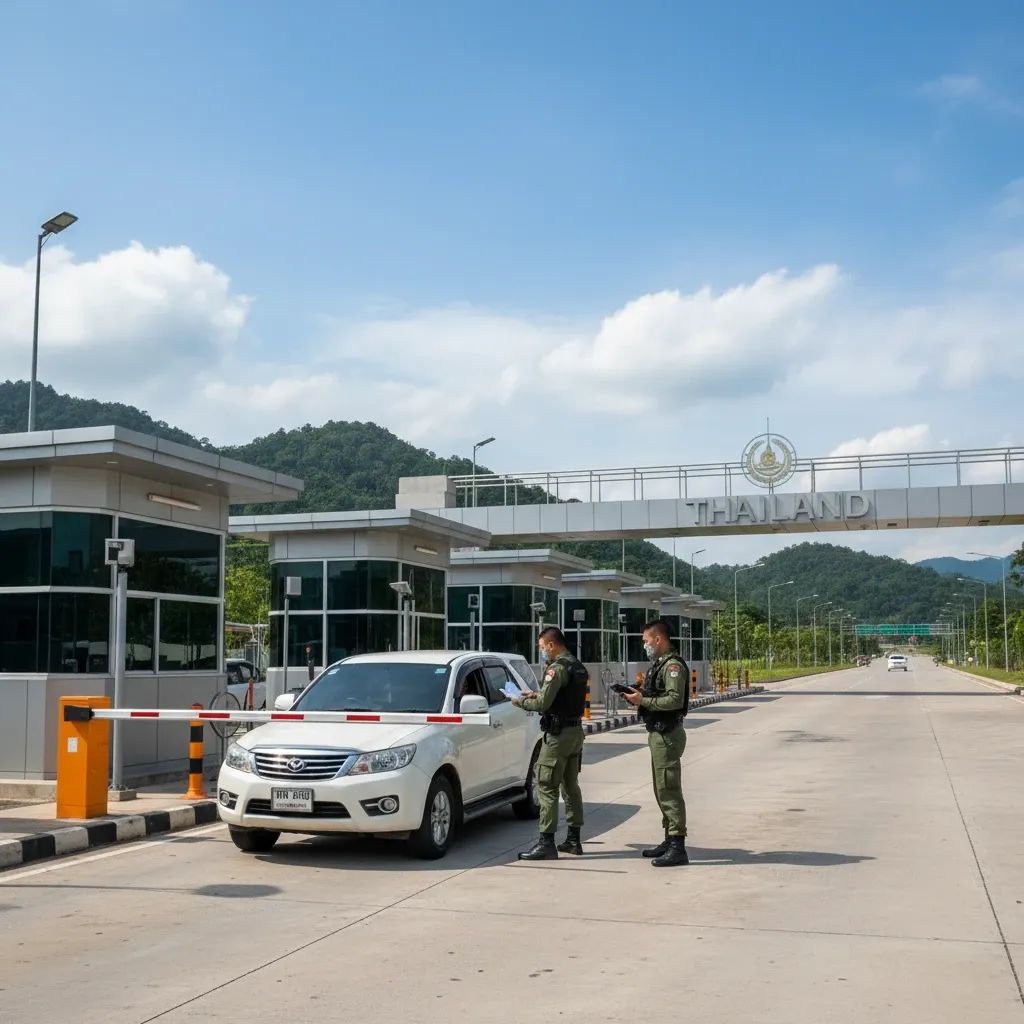
Coastal Haven Becomes Transit Point: The Anatomy of a Border Smuggling Bust
A seaside resort in Songkhla Province has emerged as the focal point of a major cross-border investigation, revealing how infrastructure and administrative access become exploited in migrant trafficking networks. On April 9, authorities apprehended a retired civil servant who allegedly allowed his beachfront property to serve as a staging area for 22 individuals from Bangladesh and Myanmar destined for Malaysia—a discovery that exposes the vulnerability of border enforcement despite heightened military surveillance.
Why This Matters
• Enforcement is escalating, but enforcement is selective: The Thailand 4th Army Region tightened controls on April 8, targeting smuggling networks and fuel trafficking. For residents in border zones, this means increased checkpoints and unannounced inspections that will disrupt daily routines and business operations.
• Official involvement signals systemic risk: When a retired Department of Provincial Administration employee becomes a suspect, it underscores how governance weaknesses at the provincial level remain a critical vulnerability that global compliance cannot simply legislate away.
• Your property carries existing legal liability: Property owners and rental operators face criminal exposure under the 2017 Alien Employment Act if they knowingly or negligently harbor undocumented individuals—Thai law presumes knowledge in border regions.
How Migrants Reach Thailand and Move Beyond
The migrant flow into Thailand operates through established geography and economic logic. Myanmar and Bangladesh sit among the poorest nations in the region, with limited employment prospects. Malaysia, by contrast, maintains perpetual demand for unskilled labor in construction, agriculture, and domestic service—sectors Malaysians themselves avoid.
Thailand becomes the natural corridor. The country's 4,000-kilometer border with Myanmar, Laos, and Cambodia offers dense forest cover and river crossings that render walls meaningless. Unlike formal checkpoints, these natural routes deposit migrants in remote areas where they must rely on local networks to reach urban transit hubs.
The economics of smuggling are brutally straightforward. Middlemen charge ฿15,000 to ฿50,000 per person (roughly equivalent to 2 to 3 months of agricultural wages in Myanmar) to coordinate safe houses, transportation, and intelligence on enforcement schedules. A seaside resort near Jana District offers plausible cover: tourists arrive and depart constantly, generating foot traffic that conceals irregular guests.
The April 9 Arrest: What Officials Say
The suspect operates his property in a district 45 kilometers south of Songkhla City, positioning it within reasonable distance of both the Malaysian border crossing at Sadao and clandestine maritime routes. Investigators allege he knowingly provided accommodation to the group in exchange for payment. The suspect has denied knowledge, claiming he runs a legitimate business and cannot monitor every guest.
Thai law offers him scant protection. Under the 2017 Alien Employment Act and related trafficking statutes, property owners face criminal liability for facilitating entry, regardless of intent. Proving he "didn't know" becomes irrelevant once authorities demonstrate the scale of undocumented individuals present on his premises.
The broader network remains partially obscure. Police are investigating whether the suspect worked independently or as a node within a larger syndicate. Early intelligence suggests the operation aimed to facilitate onward travel within 48 hours, indicating tight coordination with Malaysian-side accomplices.
Malaysia's Role: The Enforcement Squeeze
Malaysia tightened border enforcement in December 2024, particularly in Kelantan State, which shares the most porous frontier with Thailand's Narathiwat, Yala, and Songkhla provinces. The shift followed political pressure from anti-immigration constituencies in Malaysia who argue that illegal workers depress wages and strain public services.
The new Malaysian regime imposes severe jail terms and substantial fines for unauthorized entry. In response, smuggling networks have shifted tactics—moving away from volume-based ground crossings toward smaller maritime movements and reliance on paid facilitation by locals with documentation or official access.
For Thai nationals who participate in smuggling operations, bilateral judicial cooperation between Thailand and Malaysia is now operational: assistance in one country may trigger prosecution based on transnational agreements.
Why Border Communities Are Caught Between
For residents in Songkhla, Narathiwat, Yala, and Satun, the April 8 military directive presents a paradox. Stricter enforcement enhances security by reducing visible smuggling activity and associated criminal elements. But it simultaneously disrupts informal cross-border trade networks that many communities depend on—small merchants who transport goods across checkpoints, fishermen who sell into Malaysian markets, and agricultural traders who exploit tariff arbitrage.
The 4th Army directive mandates random inspections of hotels, guesthouses, and resorts. Non-compliance risks business suspension or criminal charges. For owners who rent to foreign nationals, the burden shifts inward: verify identity documents, confirm work permits, and file TM.30 notifications with immigration within 24 hours of guest arrival. Violation carries fines and potential prosecution.
Expat property owners face heightened scrutiny. Under existing law, landlords retain responsibility for tenant legality. Leasing to foreign nationals without verified employment status carries criminal risk—particularly in border provinces where courts interpret the law more strictly.
Migrant Trafficking: The Broader Context
Illegal movement of migrants into Thailand remains endemic despite enforcement efforts. Thai anti-trafficking authorities actively prosecute smuggling cases, with a particular focus on networks that target vulnerable populations. What distinguishes trafficking from simple illegal immigration is the commercial facilitation element—someone profits from the transaction.
Victim profiles include vulnerable groups, with particular concern for minors who may be targeted for labor exploitation or sexual servicing. A concerning trend involves online recruitment networks—where initial contact through social media or messaging apps often misrepresents employment terms or wages.
Authorities note that trafficking victims include substantial numbers of Thai nationals, a reality that complicates the "foreign migrant problem" narrative often deployed in public discourse.
Government Strategy and Its Limitations
Thailand's response evolved from episodic amnesties and deportations toward a more systematic enforcement model. The Cabinet approved temporary work permits for migrants from Laos, Myanmar, Cambodia, and Vietnam, allowing undocumented residents to register and obtain legal status for limited periods. Yet implementation falters: registration fees, medical testing requirements, and employer verification create bureaucratic friction that pushes many migrants into informal channels.
The corruption obstacle remains stubborn. Both Thailand's Anti-Trafficking Division and its Malaysian counterparts acknowledge that bribery and official collusion enable networks to operate with relative impunity. The arrest of a retired civil servant is rare precisely because most cases involve lower-level personnel or civilians with minimal enforcement visibility.
Government data shows increasing prosecution rates, but this reflects detection capacity, not network disruption. Larger syndicates simply absorb arrests as operational costs, replacing compromised safe houses and mid-level operatives within weeks.
Practical Guidance for Those Living in Southern Thailand
If you operate a hotel, guesthouse, or resort: Implement a verification protocol that documents guest identification, work permits, and purpose of stay. File TM.30 notifications electronically within 24 hours. Request copies of employment contracts or business licenses. If a booking appears inconsistent with legitimate tourism (e.g., rapid turnover, all-male groups, no luggage), report to immigration rather than assume innocence.
If you own or rent residential property: Verify tenant documentation before lease execution. Confirm employment status through the relevant sector authority. Request proof of work permit registration. If you discover undocumented occupancy, notify immigration immediately—documented reporting provides legal protection and shifts liability to the tenant.
If you employ foreign workers: Ensure all employees hold valid work permits and health certificates. Maintain payroll records that prove legitimate employment. Non-compliance risks fines reaching ฿800,000 ($22,700) and imprisonment up to 10 years under the 2017 Alien Employment Act.
If you cross borders regularly: Use only official checkpoints: Sadao, Padang Besar, Sungai Kolok, and the coastal ports. Informal crossings now carry severe penalties in both countries. Small-scale smuggling—carrying goods or facilitating unlicensed passage—courts now prosecute as trafficking facilitation.
The Rohingya Factor and Regional Context
Myanmar's civil conflict creates a secondary pressure valve. Rohingya refugees, a persecuted ethnic minority, periodically arrive on Thailand's Andaman coast aboard unseaworthy vessels bound for Malaysia, which hosts the world's largest Rohingya diaspora. These maritime movements occasionally intersect with conventional migrant smuggling operations, creating enforcement complexity—refugee rescue and smuggler interdiction operate on different legal and humanitarian frameworks.
Malaysia's paradox mirrors Thailand's: the country hosts an estimated 3 million to 5 million foreign workers, many undocumented, while simultaneously criminalizing illegal entry. Labor demand in construction and domestic service cannot be met by the domestic workforce, yet political pressure demands border tightness. This contradiction ensures smuggling networks remain profitable indefinitely.
What Comes Next
The Jana District arrest will not disrupt smuggling networks for extended periods. Seaside properties will be replaced; payment structures will shift; coordinators will rotate. What may shift is enforcement focus: rather than targeting migrants themselves (the traditional approach), authorities now target infrastructure and enablers—property owners, transporters, and facilitators.
Whether this strategic pivot succeeds depends on sustained political will, judicial follow-through, and corruption control among enforcement personnel. More fundamentally, it depends on addressing the economic differentials that drive people to risk illegal crossings in the first place. Until Myanmar stabilizes, Bangladesh develops, and Malaysia's labor demand moderates, the financial incentive for smuggling remains rational.
For residents in border communities, the immediate reality is tighter restrictions, more checkpoints, and expanded legal accountability. Security improves at the cost of convenience and informal economic activity. The calculation differs for each person—but the stakes, for those caught between, have unambiguously risen.


