
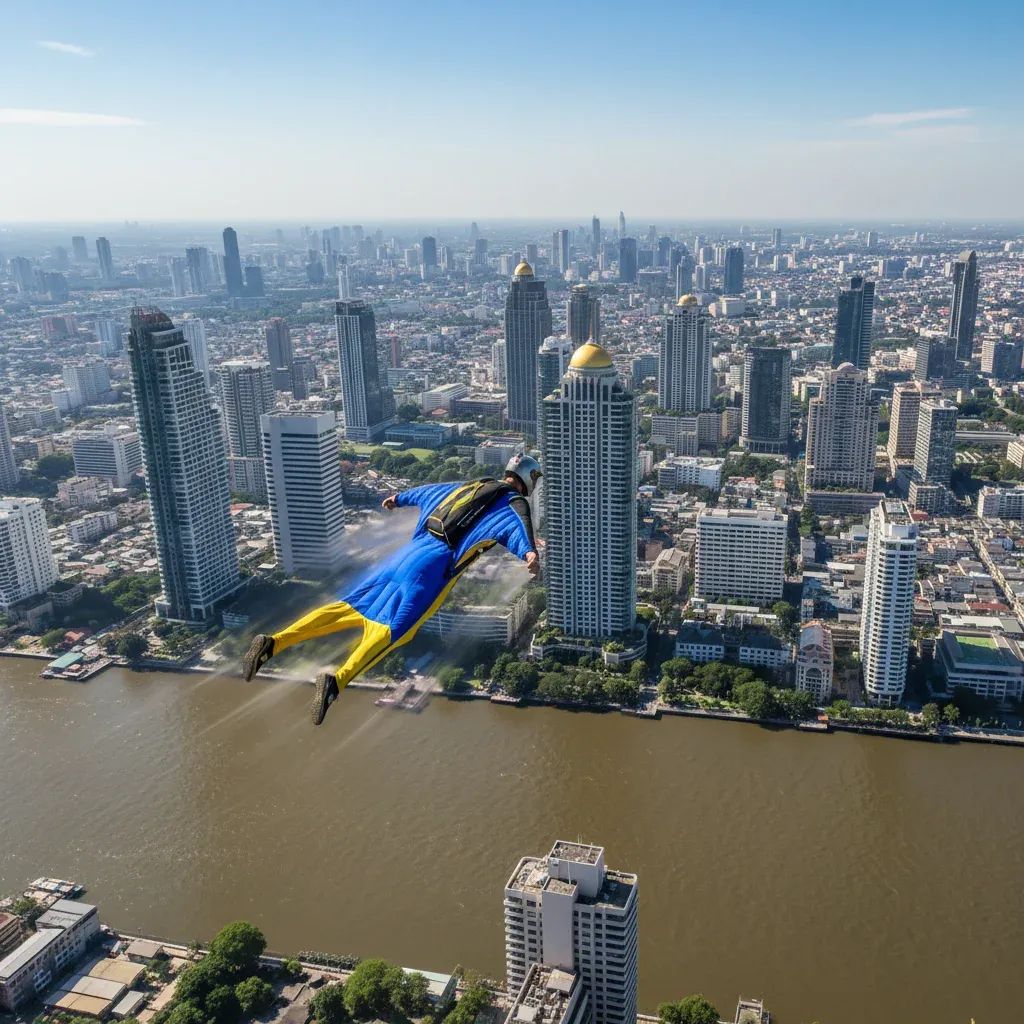
The Thailand Tourism Authority (TAT) has successfully leveraged a high-profile wingsuit stunt over Bangkok to signal its ambition of transforming the country into a global extreme sports hub — a strategy that could reshape the kingdom's tourism economy and attract a new generation of high-spending adventure travelers.
Why This Matters
• First urban wingsuit flight in Thailand took place over Bangkok on April 2, 2026, reaching speeds of 260 km/h
• TAT's "Amazing Thailand Grand Tourism & Sports Year 2025" campaign, which extends into 2026, targeted 40M international visitors and ฿3 trillion in tourism revenue through sports tourism
• Future extreme sports events planned for Railay Beach and Ton Sai Beach in Krabi
• Event required unprecedented coordination between aviation authorities, civil agencies, and private partners
Hollywood Stuntman Executes Precision Flight Over Chao Phraya River
Miles Daisher, a veteran Hollywood stuntman and Red Bull Air Force athlete with more than 12,000 jumps under his belt, launched from an aircraft high above the capital and streaked past the Lebua at State Tower — the gleaming hotel made famous by The Hangover: Part II — before executing a controlled landing on a boat positioned in the Chao Phraya River. The maneuver, conducted at speeds approaching 260 km/h, marked the first time a wingsuit pilot has navigated Bangkok's dense urban airspace in a sanctioned event.
The April 2 showcase was not merely a spectacle. It represented a calculated soft-power play by the Tourism Authority of Thailand, which has been aggressively repositioning the kingdom as a destination for experience-based and adventure tourism rather than relying solely on beach resorts and cultural heritage sites. TAT Governor Thapanee Kiatphaibool described the collaboration with Red Bull as a strategic component of the agency's broader campaign to attract "quality tourists" — industry shorthand for visitors who stay longer and spend more.
What This Means for Residents and the Tourism Sector
For those living in Thailand, the wingsuit flight is a visible indicator of how the government intends to diversify the tourism economy. The "Amazing Thailand Grand Tourism & Sports Year 2025" campaign, which extends into 2026, prioritizes high-value tourism over sheer volume, with a focus on visitors from Europe, the Americas, and emerging markets who seek unique, Instagram-worthy experiences.
This shift has tangible implications. In Buriram province, a deliberate pivot to sports tourism — anchored by stadiums and racetracks — increased the Gross Provincial Product (GPP) and tourism revenue by 16.7% to 21.5% between 2011 and 2018. The model is now being replicated nationwide, with extreme sports serving as the next frontier.
For expats and long-term residents, the rise of extreme sports tourism could mean increased infrastructure investment in secondary cities, improved connectivity, and a growing international events calendar. However, it also raises questions about regulatory oversight. The Civil Aviation Authority of Thailand (CAAT), the primary body governing aviation permissions, does not have a readily available framework for individuals seeking to conduct urban wingsuit flights. The Red Bull event required event-specific permits and coordination across multiple agencies, suggesting that such activities will remain tightly controlled rather than open to freelance thrill-seekers.
Technical Precision and Cross-Sector Coordination
Urban wingsuit flying presents hazards that do not exist in natural environments. Daisher noted that wind currents between high-rise buildings create turbulence and require split-second adjustments, particularly during the final descent to a moving river target. The operation involved precise flight path mapping, airspace clearance, emergency medical teams on standby, and cooperation from the Royal Thai Police, Bangkok Metropolitan Administration, and private hospitality partners.
Narawadee Bualert, President and CEO of Lebua Bangkok, emphasized that hosting the event demonstrated the city's capability to serve as a stage for world-class spectacles. The hotel's Sky Bar and Sirocco restaurant, perched atop the 64-story tower, have long been iconic photo ops; now, they serve as a literal launchpad for extreme sports branding.
Expansion Plans: From Bangkok to Krabi's Coastline
TAT Deputy Governor for Marketing Communications Nithee Seeprae confirmed that the agency is exploring additional extreme sports venues beyond the capital. Railay Beach and Ton Sai Beach in Krabi, already renowned for rock climbing with over 700 bolted routes on limestone cliffs, are under consideration for advanced aerial sports and large-scale film productions.
The timing aligns with Thailand's hosting of the 33rd Southeast Asian (SEA) Games in late 2025, which featured extreme sports categories including sport climbing, skateboarding, and wakeboarding in Bangkok and Chonburi. The Thailand Extreme Fest 2026, scheduled for April 24–26 in Pattaya, will bring downhill and freestyle competitions in disciplines ranging from BMX to cable wakeboarding, with the explicit goal of identifying talent for the 2028 Los Angeles Olympics.
Red Bull's involvement is not accidental. The energy drink giant has built a global empire by embedding itself in extreme sports culture, from Formula 1 to cliff diving. Its partnership with TAT mirrors campaigns in Austria, Switzerland, and Dubai, where government-backed spectacles generate media coverage worth millions in advertising equivalents.
The Regulatory Reality: Not Open to the Public
While the Bangkok wingsuit flight has sparked international headlines, it is crucial to understand that this was a one-off, government-sanctioned event rather than the opening of a new commercial activity. Thailand has established skydiving drop zones in Pattaya and Phuket, which adhere to Fédération Aéronautique Internationale (FAI) safety standards and require participants to hold licenses such as a USPA C-license for wingsuit flying.
However, conducting a wingsuit flight over Bangkok's urban core is an entirely different matter. The Civil Aviation Authority of Thailand (CAAT) maintains an online flight permission system primarily for airlines and aircraft operators, not individual extreme sports enthusiasts. Any future urban wingsuit attempts would almost certainly require extraordinary, event-specific permissions involving multiple governmental bodies, extensive insurance, and potentially prohibitive costs.
For adventure tourists hoping to replicate Daisher's feat, the reality is more grounded: tandem skydiving over Pattaya's coastline, rock climbing in Krabi, or ziplining through Chiang Mai's jungle canopy remain the accessible extreme sports options. Urban wingsuit flying, at least for now, is reserved for elite athletes working with global brands and government agencies.
Economic Multiplier Effects and Long-Term Vision
Sports tourism produces multiplier effects across hospitality, transport, retail, and local services. The Bangsaen21 Half Marathon, for example, generated measurable increases in provincial tourism revenue through participant spending on accommodation, dining, and retail. Large-scale events like the Red Bull wingsuit flight amplify this impact by attracting international media attention and positioning Thailand as a destination for cutting-edge, photogenic experiences.
The strategy is not without risk. High-profile stunts require significant upfront investment, intricate logistics, and carry reputational stakes if something goes wrong. Yet TAT's calculus appears to be that the global visibility and branding value justify the expense. Daisher's flight was broadcast across Red Bull's social media channels, reaching millions of viewers worldwide and reinforcing Bangkok's image as a city where tradition and innovation coexist.
Where to Experience Extreme Sports in Thailand Today
For residents and visitors looking to engage with Thailand's extreme sports scene, the following destinations are operational and accessible:
• Skydiving: Pattaya and Phuket offer tandem jumps with ocean and island views
• Rock Climbing: Railay and Ton Sai in Krabi provide routes for all skill levels; indoor walls in Bangkok and Chiang Mai
• Ziplining: Chiang Mai's Kingkong Smile Zipline ranks among Asia's longest and highest
• White Water Rafting: Mae Taeng River in Chiang Mai caters to various experience levels
• Kitesurfing: Southern beaches including Phuket, Hua Hin, and Koh Phangan offer consistent winds
• Muay Thai Training: Camps in Phuket (Tiger Muay Thai), Pattaya (Fairtex), and Kanchanaburi (Sitmonchai Gym)
• Scuba Diving: Similan Islands, Surin Islands, and Koh Tao are world-class dive sites
The Bangkok wingsuit flight may have been a singular spectacle, but it signals a broader transformation in how Thailand markets itself. Whether the strategy succeeds in attracting the coveted "quality tourist" remains to be seen, but for now, the kingdom is betting that adrenaline sells — and that the world is watching.


