
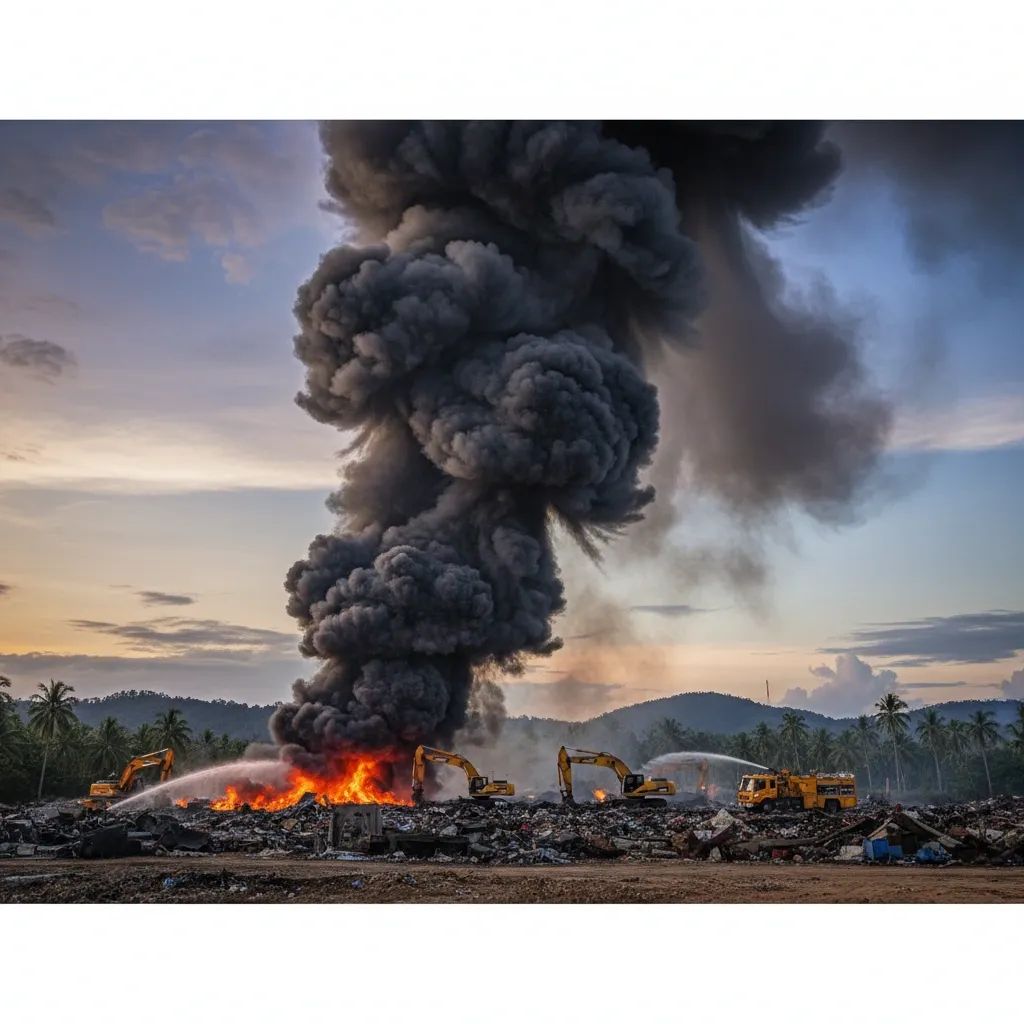
A 30-hour inferno at Phuket's landfill exposed the island's fragile waste-management foundation, finally stamped out in the early hours of Monday but leaving a trail of contaminated air, suspended services, and hard questions about the system's ability to handle the island's mounting garbage crisis.
Why This Matters
• Waste operations suspended indefinitely: The Phuket City municipal landfill remains closed with no reopening date, forcing the island's municipalities to scramble for interim disposal solutions as refuse accumulates daily.
• Air quality remains compromised: Residents near the Saphan Hin area face continued respiratory risks from lingering smoke and acrid smells; authorities distributed face masks but stopped short of mandatory evacuation orders.
• The math does not add up: Phuket's incinerators handle 500 tonnes daily while the island generates 1,200 tonnes (rising to 1,500 during peak tourism)—a daily shortfall that keeps landfills dangerously full and fire-prone.
How the Blaze Trapped Firefighters for More Than a Day
The fire ignited around 3 PM on Saturday, April 11, in cells 4 and 5 of the integrated waste disposal center, in Muang district's Saphan Hin zone. The initial burst appeared manageable—crews had visible flames under control within an hour—but the underlying problem never went away. Deep reserves of wood, tree branches, and compacted refuse smoldered beneath the surface, reigniting on Sunday morning despite intensive water applications.
Conditions on the ground made suppression a test of endurance. Hot weather and strong coastal winds fanned the buried combustion zones while excavators carved through mountains of waste to give firefighting crews access. Water trucks from across Phuket province converged on the site. Long-distance pumping systems were deployed to feed a continuous supply from nearby sources. Even with this arsenal, the fire persisted, burning deeper into the landfill's structure.
By 12:26 AM on Monday, April 13, authorities declared the flames fully extinguished with no visible smoke. Yet firefighters remained stationed nearby as a precaution against sudden reignition—a threat taken seriously given the combustible material still embedded in the refuse pile.
The Immediate Human Cost
Neighborhoods downwind of the landfill bore the brunt. Thick black smoke rolled across parts of Muang district while foul odors from burning refuse and sewage drifted into residential areas despite prevailing winds initially pushing much of the plume toward the sea. The Thailand Public Health Ministry distributed respiratory masks, and local authorities issued advisories for residents to remain indoors, keep windows sealed, and monitor official channels.
Phuket Governor Nirat Phongsitthaworn declared an emergency assistance zone, a move that accelerated resource deployment and activated contingency evacuation plans for communities in the smoke's path. A provincial multipurpose hall was designated as temporary shelter, though mass relocations proved unnecessary. Still, the incident prompted health officials to revisit a December 2025 report documenting elevated rates of cancer and respiratory-related deaths among residents near the landfill and incinerator—concerns that remain unresolved despite calls for provincial health screenings.
The human cost extended to municipal services. The Phuket City Municipality suspended its popular free water distribution for Songkran celebrations, redirecting those trucks to the firefighting operation. For a city already managing thin resources, that diversion crystallized the tradeoff between crisis response and quality of life.
Why This Fire Was Almost Inevitable
The blaze did not emerge from nowhere; it emerged from a system pushed to its breaking point. Phuket generates approximately 1,200 tonnes of waste daily—a figure that spikes to 1,500 tonnes during the high tourist season when the island's population temporarily balloons. Against this, the island's incineration capacity stands at merely 500 tonnes per day, leaving a daily surplus of 700 tonnes with nowhere to go except into landfills already holding an estimated 1.2 million tonnes of accumulated refuse.
That backlog creates ideal conditions for fire. Unlike household garbage, which can be compressed and buried, wood waste and tree branches create air pockets that allow smoldering combustion to persist for weeks or months before flaring into visible flame. Hot, dry weather acts as an accelerant. Strong winds feed oxygen into the burning layers.
Chalermpong Saengdee, a Phuket member of parliament, characterized the pattern bluntly: recurring landfill fires are symptoms of a "broken waste management system" defined by the absence of source sorting, reliance on open dumping, and inadequate pollution controls. Officials have not released investigation findings on the precise ignition trigger—spontaneous combustion, arson, or careless disposal—but the volume of combustible material makes fires not a rare event but an inevitable outcome of poor planning.
Infrastructure Bottleneck and Bureaucratic Inertia
Phuket's authorities have outlined a multi-pronged strategy, yet implementation remains glacial. A second incinerator, with funding already approved by the Thailand Ministry of Interior, remains trapped in bureaucratic delays. A third facility sits on the drawing board, years away from construction. Meanwhile, the daily waste-capacity deficit widens.
Smaller interventions are underway but operate at insufficient scale. A December 2024 initiative targets a 15-tonne daily reduction in food waste—a material that comprises a significant portion of Phuket's daily refuse and sabotages incinerator efficiency due to its moisture content. The program operates in three pilot districts—Mueang, Kathu, and Thalang—combining data collection, surplus food redistribution platforms, and composting infrastructure. Early results suggest promise, but expanding the model citywide would require investment and coordination that bureaucratic systems have yet to mobilize.
Governor Nirat has called on private businesses and municipal administrations to enforce strict waste-sorting protocols, particularly for organic and recyclable materials. Incentive packages, including reduced garbage collection fees, have been proposed to encourage participation. Additional measures include bans on foam containers and promotion of eco-friendly packaging, alongside efforts to strengthen Local Environmental Volunteer (LEV) networks for grassroots waste reduction.
Some private operators demonstrate what scaled innovation could look like. The Racha Hotel and Katathani Phuket Beach Resort have constructed on-site waste separation and biogas systems that minimize external disposal. Provincial officials are studying whether such models can be adapted for municipal infrastructure, but the conversation remains theoretical.
What Residents Should Know Now
The landfill closure creates immediate logistical pressure. With the main disposal facility offline and incinerators already saturated, municipalities across Phuket are searching for interim storage solutions. Unofficial reports suggest waste diversion to private transfer stations, but the Thailand local authorities have not released public contingency plans or transparency on where garbage is being routed.
For residents, the priority is air quality vigilance. Authorities declared the visible fire extinguished, but smoldering hotspots can reignite for days. Keep respiratory masks accessible. Monitor official announcements for air quality updates. Those living within a few kilometers of the landfill should remain alert; prevailing winds shift with daily weather patterns.
The temporary halt to waste collection will likely extend beyond what authorities initially announce. Residents should prepare for possible service delays by reducing garbage volume where feasible and avoiding disposal of large bulky items.
The Structural Problem Remains
The April 2026 landfill fire will fade from headlines. The municipal services will gradually resume. But the underlying crisis persists unchanged. Phuket's waste generation continues climbing as tourism rebounds and the island's permanent population expands. The incinerator capacity does not expand. The landfill continues accumulating refuse at an unsustainable rate. The cycle of reactive crisis management—firefighting after each blaze, distributing masks after each smoke event—substitutes for the structural investment required to actually solve the problem.
Unless Phuket's provincial government can accelerate infrastructure construction, implement genuine waste reduction at the source, and align tourism growth with disposal capacity, fires at the Saphan Hin landfill will recur with seasonal regularity. The next blaze may come in weeks or months. It will be extinguished. Services will resume. The system will return to its precarious state. For residents and workers exposed to the resulting smoke, the cycle represents not occasional crisis but chronic risk built into the island's development model.


