The Thailand Ministry of Tourism and Sports is betting on "quality over quantity" in 2026, and nowhere is this strategic pivot more visible than in Pattaya—the kingdom's beachside workhorse that has weathered decades of boom-and-bust cycles. While geopolitical turbulence rattles travelers worldwide, and visitor arrivals to the resort city dipped 18% in January compared to the same month in 2025, Pattaya's hoteliers are reporting an unexpected silver lining: revenue is climbing despite the drop in foot traffic, and rooms remain readily available for those willing to pay slightly more for a less crowded experience.
Why This Matters
• Hotel occupancy in Pattaya is projected to reach 75% for 2026, outpacing the national average of 72-73%, yet rooms remain accessible across all price tiers.
• Revenue per visitor is rising as Pattaya attracts higher-spending European and Russian tourists who stay 14-21 days instead of the traditional weekend crowd.
• Average room rates range from ฿600-฿1,200 for budget guesthouses to ฿2,500+ for beachfront properties, with mid-tier hotels averaging $78 per night for four-star properties—still competitive by regional standards despite a stronger baht that has raised costs 8-10% for foreign visitors.
• Infrastructure investment exceeding ฿203M is underway, including a 5.3-kilometer flood mitigation system expected to be complete in early 2027.
The Tourism Paradox: Fewer Visitors, Bigger Wallets
Tourism Authority of Thailand (TAT) forecasts 36.7 million foreign arrivals nationally in 2026, targeting ฿2.8 trillion in revenue—a figure that prioritizes spending power over headcount. Pattaya is the testing ground for this model. During the 2026 New Year holiday period, the city recorded fewer arrivals than the previous year but generated substantially higher revenue, according to municipal tourism data.
The reason? A compositional shift. Chinese arrivals to Pattaya in 2024 totaled approximately 6.7 million, down from 11.13 million in 2019. Yet markets like Russia, India, and the Gulf Cooperation Council (GCC) states are filling the gap with travelers who book longer stays and frequent higher-end establishments. European tourists, in particular, are extending trips to 2-3 weeks, treating Pattaya as a temporary winter residence rather than a quick beach stopover.
Average daily room rates (ADR) climbed above ฿3,498 in 2024, marking 6% year-over-year growth, according to Horwath HTL. That momentum is holding into 2026, even as some four- and five-star properties discount strategically to compete with three-star competitors. Booking platforms like KAYAK list couples' rooms averaging $133 per night, while Booking.com shows five-star properties at $190—figures that remain attractive compared to Western beach destinations but reflect the baht's newfound strength.
What This Means for Residents
For expatriates and long-term residents in Thailand, Pattaya's evolving tourism landscape translates to mixed economic signals. On one hand, the shift toward wealthier visitors is driving up restaurant prices and evening entertainment costs along Beach Road and Walking Street. Local vendors report adjusting menus to cater to tourists willing to spend ฿300-฿500 per meal rather than the traditional ฿100-฿150 street food price point.
On the other hand, the 18% dip in arrivals during peak season means reduced congestion on Pattaya's notoriously traffic-choked arteries. Mid-week travel to nearby islands like Koh Larn is noticeably easier, and hotel rates for Thai nationals remain competitive due to increased availability. Domestic tourism still accounts for a significant share—over 11.38 million Thai visitors flocked to Pattaya in the first eight months of 2025, an 11.79% increase year-over-year.
The stronger baht is a double-edged sword. While it makes imported goods cheaper for residents, it also prices Thailand out of consideration for budget-conscious tourists from China, Malaysia, and South Korea—historically the kingdom's bread-and-butter markets. The Thailand Revenue Department has not announced new tax incentives for tourism-dependent provinces, leaving hoteliers to navigate the currency headwinds independently.
The Global Tension Factor: Real or Perceived?
Middle Eastern conflicts and Asia-Pacific geopolitical friction—including ongoing Thailand-Cambodia border disputes—have featured prominently in international headlines, but their direct impact on Pattaya appears muted. Flight cancellations from the Gulf and Eastern Europe have occurred sporadically, yet Russian arrivals remain robust, with that demographic now one of the top three source markets alongside China and India.
Fuel prices in Thailand remain relatively manageable compared to Western economies, keeping domestic transport costs low. A motorbike taxi ride from Jomtien Beach to Central Pattaya still runs ฿50-฿80, and intercity buses to Bangkok's Ekkamai Terminal cost under ฿150. This affordability extends the appeal of Pattaya as a base for exploring Chonburi Province and the broader Eastern Economic Corridor (EEC), even as global inflation pushes up airfares.
The Thailand Royal Police and Pattaya City Hall have doubled down on safety perception. Over 2,500 AI-enabled CCTV cameras now blanket the city, linked to the Crime Investigation Bureau (CIB) database. A 24-hour emergency hotline (1337) operates in multiple languages, and the municipality has deployed automated external defibrillators (AEDs) at strategic points along the beachfront. These measures target the psychological barrier that deters risk-averse travelers from East Asia and Europe.
Infrastructure Push: Betting on the Long Game
Pattaya City Council approved over ฿203M in capital expenditures for fiscal 2026, funding 27 development projects. The flagship initiative is a 5.3-kilometer underground drainage culvert designed to eliminate the chronic flooding that has plagued Pattaya Second Road and adjacent neighborhoods. Completion is slated for early 2027, though municipal contractors have a mixed track record on deadlines.
Road resurfacing along 3.3 kilometers of Pattaya Second Road is underway, alongside underground cabling for 10 major thoroughfares—a belated effort to match the aesthetic standards of competing Southeast Asian beach cities like Da Nang and Penang. The city has also installed over 11,000 LED streetlights, improving nighttime walkability and reducing energy consumption.
Koh Larn, Pattaya's island escape, is receiving 200 additional CCTV units, a new waste incinerator, expanded wastewater treatment capacity (now 150,000 cubic meters per day), and five new access roads. Freshwater production on the island will hit 1,000 cubic meters daily, addressing chronic shortages during peak season.
Longer-term bets include the high-speed rail link connecting Bangkok to Pattaya, projected to slash travel time to under an hour, and the expansion of U-Tapao International Airport as part of the Eastern Economic Corridor (EEC) development. These projects aim to position Pattaya as a viable destination for business travelers and MICE (Meetings, Incentives, Conferences, Exhibitions) events, not just leisure tourists.
Tomorrowland and the Festival Economy
The biggest wildcard for Pattaya's 2026 tourism calendar is Tomorrowland, the global electronic music festival making its Thailand debut on December 11-13 at Wisdom Valley in Bang Lamung District. Advance bookings have already pushed occupancy near capacity for that weekend, with hotels reporting sell-outs as far as Jomtien and Naklua.
The festival is expected to draw tens of thousands of international attendees, many of whom will extend their stays for a week or more. If successful, TAT and local authorities plan to make it an annual fixture, mirroring the impact of similar mega-events in Ibiza and Tulum. Pattaya already hosts recurring events like the International Fireworks Festival, the Jazz Festival, and the annual Countdown, but Tomorrowland represents a quantum leap in scale and prestige.
The city is also reviving cultural landmarks. Thai Art Alley and Rong Ya Alley have been renovated with murals, improved lighting, and new signage, part of a broader effort to diversify beyond the nightlife-and-beach formula. The Khlong Nok Yang eco-tourism district has been recognized with the Green Destinations Top 100 Stories Award 2025 for sustainable salt-flat tours and mangrove conservation initiatives.
The Regional Competition: Thailand's Tourism War
Pattaya's struggle to maintain market share reflects a broader regional arms race. Japan, Vietnam, Malaysia, Singapore, and South Korea have all loosened visa requirements and launched aggressive marketing campaigns targeting the same traveler demographics. Malaysia and Vietnam, in particular, offer beach destinations at lower price points, while Singapore captures the high-end MICE segment that Thailand covets.
The Thai Cabinet has extended visa-free entry for multiple ASEAN and Middle Eastern nationalities, but bureaucratic friction remains. Digital nomad visas, recently introduced, theoretically allow tax-free remote work for up to 12 months, but enforcement is inconsistent, and the Thailand Revenue Department has yet to issue comprehensive guidance.
For expatriates working in Thailand, this means currency volatility and shifting regulatory sands complicate long-term financial planning. The baht's appreciation against the dollar, euro, and pound has eroded purchasing power for foreign-income earners, while domestic inflation—though moderate—continues to nibble at disposable income.
The Verdict: Resilient, But Recalibrating
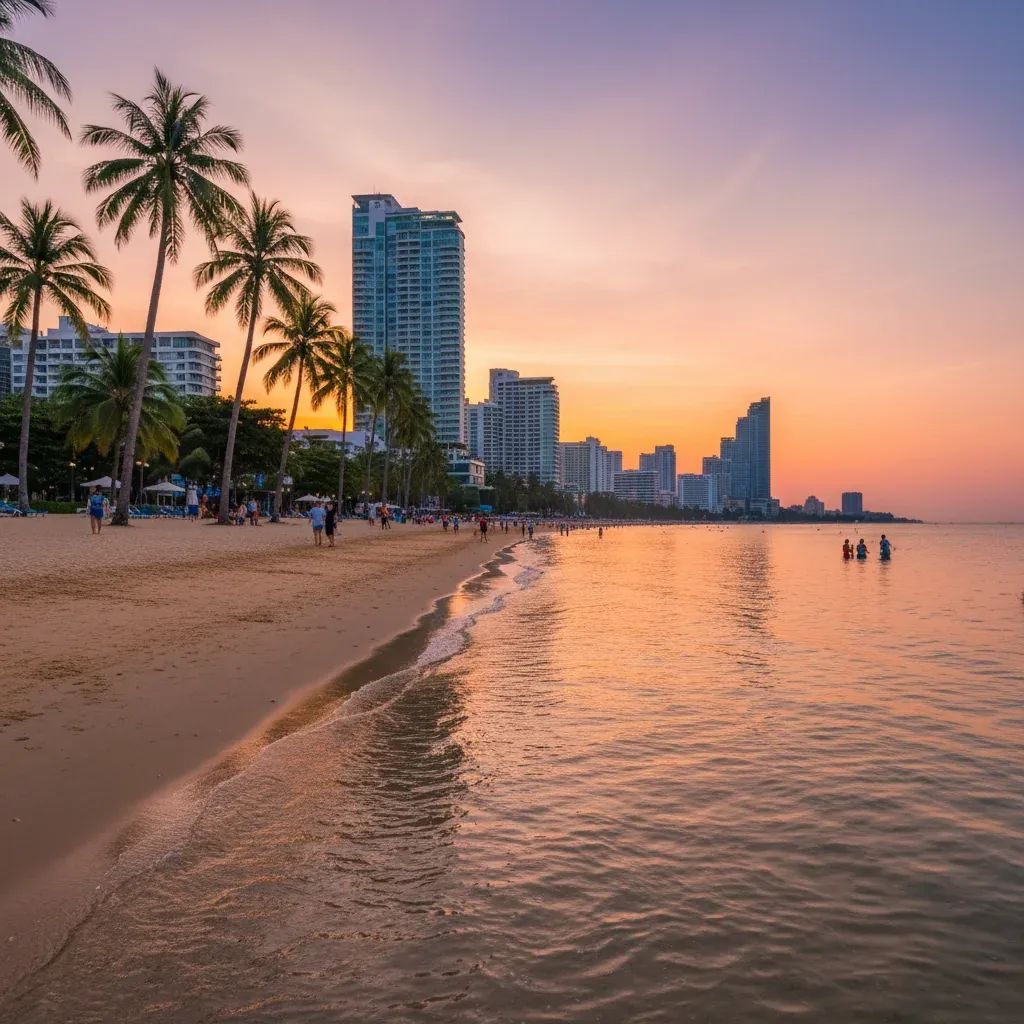
Pattaya remains operationally functional and culturally vibrant, a city where street food still costs ฿50-฿150 per meal, motorbike rentals run ฿200-฿300 daily, and beachfront access is free. The palm trees, neon lights, and 24-hour energy that have defined the city for decades are intact, even if the demographic mix and spending patterns are evolving.
The shift toward quality tourism is a calculated gamble. If executed well, it could stabilize revenue and reduce the wear-and-tear of mass-market crowds. If mishandled, it risks pricing out the budget travelers who have long formed the economic backbone of Pattaya's small businesses. For now, the city is betting that fewer visitors with fatter wallets will prove more sustainable than the pre-pandemic model. Whether that bet pays off will depend on infrastructure delivery, safety perception, and the baht's trajectory—factors largely beyond the control of Pattaya's hoteliers and restaurateurs.