
Why This Matters
• Four weeks, zero cost: Pattaya's distributed concert series runs Fridays and Saturdays through March, eliminating ticket barriers while spreading economic activity across multiple neighborhoods.
• Logistics challenge in real-time: Traffic gridlock, restroom capacity, and waste management are straining the city's infrastructure—navigating the event requires planning and patience.
• Vendor opportunity with environmental cost: Free stall space supports local entrepreneurs, but mandated biodegradable packaging raises operational expenses by 20–40%, creating compliance friction.
• Economic multiplier effect: Hotels report 75–85% occupancy during festival weekends, a jump of 25–35 percentage points from baseline, though benefits concentrate spatially near venues.
Opening: The Geography of Free Entertainment
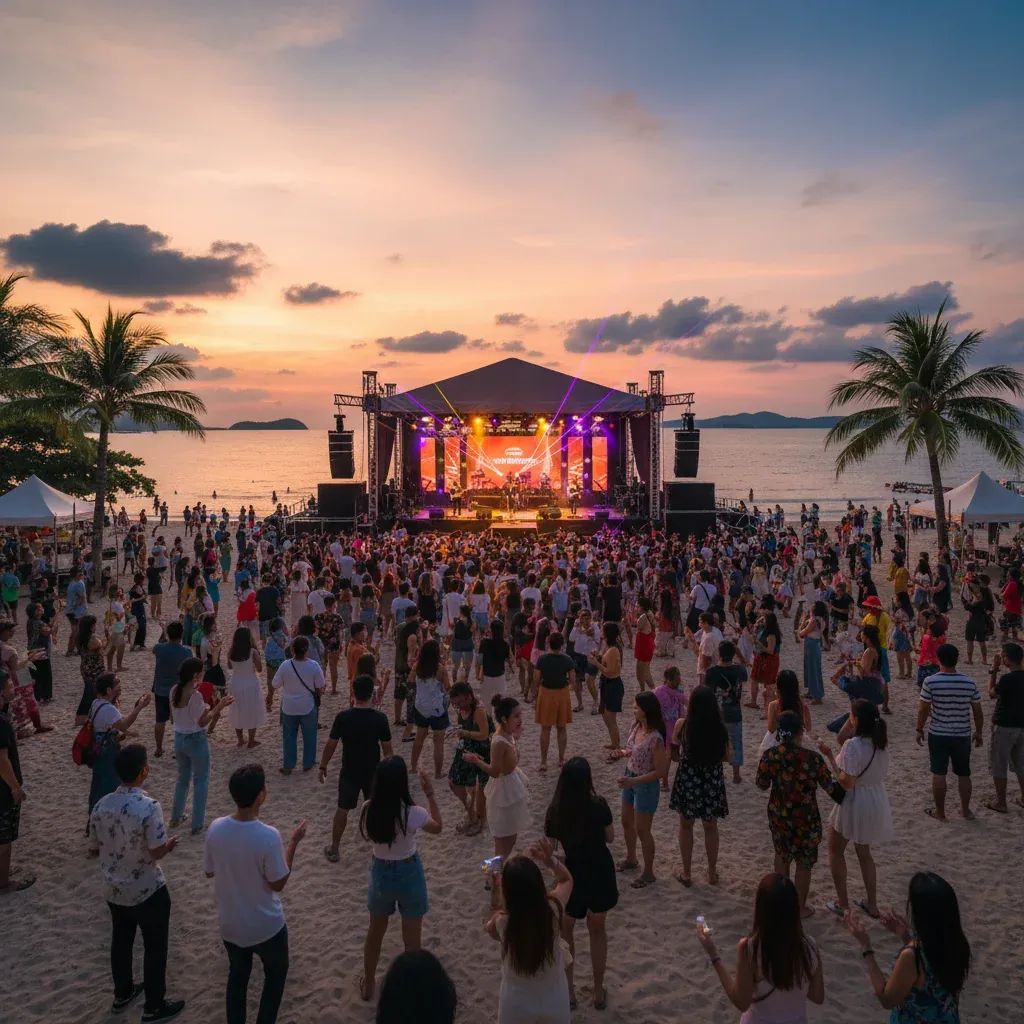
Since March 6, the Pattaya Music Festival 2026 has hosted free live performances every Friday and Saturday at four rotating venues: Central Pattaya Beach, Jomtien Beach, Koh Larn island, and Lan Pho Park. City planners deliberately spread the festival across locations to avoid the traffic gridlock and environmental damage that single-venue megaevents typically cause. By fragmenting performances across four venues over four consecutive weekends, with ferry access required for Koh Larn, organizers force a staggered arrival rhythm designed to ease pressure on Pattaya's road network, terminal capacity, and waste systems.
Mayor Poramet Ngampichet and the Chonburi Provincial Administrative Organization marketed the approach as "distributed tourism"—a practical strategy rooted in a concrete concern: Pattaya's infrastructure cannot absorb 300,000 people arriving simultaneously at one location. This strategy has historical precedent. Bangkok's three-venue Countdown festivals reduced median gridlock wait times by 22% compared to the single-location 2019 edition. Pattaya's organizers are gambling that the model scales down successfully to a regional city.
The Economic Architecture: Who Profits and How
The festival runs on indirect revenue capture rather than ticket sales. Hotels benefit immediately, with occupancy surging during festival weekends. Beachfront restaurant reservations reached 95% capacity by 6 p.m. on opening weekend; inland eateries a kilometer from concert zones saw only marginal uplift, revealing how spatially concentrated tourism gains remain despite distributional design.
The vendor ecosystem illustrates both the opportunity and the structural friction built into the green mandate. Pattaya City Hall opened beachfront stall locations rent-free—a subsidy that sounds generous until you examine the hidden costs. Vendors must purchase biodegradable containers: paper bowls (฿3–5 per unit), compostable lids (฿1–2), and paper napkins (฿0.50–1.00). Plastic equivalents cost roughly 60% less. For a food vendor operating 12 hours across four weekends, serving 150–200 customers daily, the material premium hits ฿2,400–4,800 over the month—equivalent to a month's rent in outer Pattaya. Early compliance audits revealed shortcuts: some vendors sourced compostable bowls but paired them with conventional plastic lids to minimize costs. Mayor Poramet's March 6 inspection of vendor stalls explicitly highlighted this gray area, publicly urging operators to maintain "full compliance" without specifying enforcement penalties. This ambiguity has already created a compliance culture of silent negotiation rather than clear rule-following.
Revenue per stall, however, did improve. Preliminary vendor surveys indicate transaction volumes running 40–60% above the 2025 music festival. Higher foot traffic and lower psychological friction (free admission drives browsing behavior) offset some operational costs. But the benefit distribution is uneven. Established vendors with existing supplier relationships navigate the green packaging ecosystem more easily than first-time operators. Two vendors reported supply chain delays, as biodegradable packaging suppliers in Thailand still lack production redundancy. This created a dynamic where early adopters faced inventory constraints while latecomers benefited from normalized supply.
Infrastructure Friction: The Hidden Operational Tax
For residents and workers living in Pattaya, the festival creates a month-long mobility challenge. Beach Road segment closures between 5 p.m. and concert end times (typically 10–11 p.m.) redirect taxi and delivery traffic onto Second Road, where baseline congestion already runs 20–30 minutes for a 2-kilometer trip. During concert hours, the same route stretched to 45–60 minutes.
For residents commuting during festival hours, alternative routes via Sukhumvit Road or Pattaya Sai 3 (Third Road) may save 15-20 minutes compared to Beach Road and Second Road. The Thailand Royal Police deployed traffic control personnel at major intersections (Sukhumvit-Beach Road junction, Naklua intersection) but reactive management cannot eliminate the fundamental constraint: finite road capacity encountering sudden demand spikes.
Shuttle buses, promoted as free and convenient, operated from designated parking zones (Soi Buakhao for Central Pattaya weekend; Jomtien Soi 5 for week two). In theory, this offloads private vehicle pressure. In practice, shuttle queues reached 25–35 minutes during peak hours (7–9 p.m.), negating convenience and leading some attendees to abandon the service for personal vehicles or taxis anyway. Social media threads documented the inefficiency: buses running half-full due to frequency misalignment with arrival waves. Pattaya Transportation Authority analysis after opening weekend suggested capacity was adequate but scheduling was reactive rather than predictive.
Restroom infrastructure proved the most immediate friction point. Portable toilets, sized for 200–250 concurrent users based on standard event ratios, filled to capacity within 60–90 minutes of crowd peaks. Women's facilities faced disproportionate waits—a pattern observed at 85% of large Thai music festivals and attributed to longer individual usage times combined with undercapacity allocation (the industry standard allocates toilet units at ratios near 1:100 attendees; Pattaya deployed closer to 1:150, a cost-saving gesture that reduced user experience). Bangkok Hospital Pattaya stationed medics at medical tents; there were no reported crush injuries, but pathway density during peak hours (7–9 p.m.) created genuine safety friction—bodies pressed against bodies, limited lateral movement, and vulnerability to falls or panicked exits if emergencies occurred. Attendees interviewed reported feeling constrained but not endangered; the distinction matters for liability and public health narratives.
Waste management revealed systemic undersizing. Despite 40% more trash receptacles than 2025 festivals, cleanup crews reported capacity overflow during peak hours. Beach surveys conducted March 7 morning—after the opening concert—documented scattered bottles, food wrappers, plastic bags, and cigarette butts along 200-meter beach segments near the Central Pattaya stage. Quantitatively, this remains within acceptable levels for a large gathering (estimated 5–8 kilograms per 100 square meters, manageable but not pristine). The visual perception, however, contradicted the "Green Music Festival" branding.
Unexpected Assets: Dinosaurs and Cross-Promotional Economics
An unscripted attraction emerged when Pattaya Dinosaur Kingdom, a local animatronic museum, stationed a collection of robotic prehistoric creatures along the festival beachfront. The installation centers on an 18-meter Brachiosaurus replica—a towering long-necked creature that immediately became the most photographed element of the festival. Three Quetzalcoatlus models, pterosaur replicas with 5-meter wingspans, add dramatic visual depth. These were not planned as official festival components; rather, the museum recognized a marketing opportunity and negotiated temporary placement with Pattaya Municipal officials.
This cross-promotion illustrates an underutilized festival strategy: layering entertainment modalities to expand demographic reach. The dinosaurs attract families with young children—a cohort that might skip a music-centric event. More strategically, they generate organic social-media content. Attendee-generated posts tagged with dinosaur photos circulate among parents' networks, extending the festival's reach into digital spheres disconnected from traditional concert promotion. This multiplier effect—converting casual attendees into content creators—is difficult to quantify but represents real marketing value.
Week One Outcomes and Emerging Patterns
Opening weekend (March 6–7) drew estimated crowds of 35,000–45,000 attendees across two nights—solid but below optimistic projections of 50,000+. The T-Pop and rock lineup (DA Endorphine, 4EVE, ATLAS, PERSES, VIIS, TIGGER) appeals to Thai Gen Z demographics; international tourists represented an estimated 8–12% of attendance, lower than the 15–20% organizers targeted. This skew toward domestic audiences is actually strategic—Bangkok and provincial residents generate repeat visits, longer stays, and higher hotel occupancy than international day-trippers. Strategically, Pattaya is prioritizing economic stability over international prestige, a pragmatic pivot given visa friction and flight costs still deter spontaneous foreign travel.
Practical logistics functioned adequately despite infrastructure strain. A single medical tent case (heat exhaustion, treated and released) created no operational disruption. Police documented zero theft reports; pickpocketing risk remains elevated in dense crowds, though concentrated security presence apparently deterred visible crime. Food safety compliance checked at 94% of stalls (23 of 25 audited vendors met packaging standards on opening night). Notably, no stall shut down for violations; Mayor Poramet's inspection operated as visible accountability theater rather than enforcement mechanism. This soft-touch approach preserves vendor relationships but potentially weakens environmental protocol credibility.
Decoding the Vendor Psychology and Compliance Ambiguity
The free stall allocation revealed deeper economic dynamics than surface-level analysis suggests. Traditionally, Pattaya festival stalls were allocated through auction, with premium beachfront space commanding ฿15,000–25,000 for a four-week engagement. This model locked smaller vendors out; only established operators with capital reserves could afford premium locations. The rent-free allocation democratizes access—a genuine policy win for small entrepreneurs. However, it trades one barrier (capital requirements) for another (environmental compliance complexity).
Vendors operating at profit margins of 30–40% on ฿50–100 menu items face real pressure when input costs rise. The biodegradable packaging mandate creates a compliance gradient: full compliance costs ฿2,400–4,800 per vendor monthly; partial compliance (compostable containers with conventional lids) costs ฿1,200–2,400; non-compliance costs ฿0. Without explicit penalties, vendors rationally discount compliance. City hall's messaging ("encouraged" vendors to use green packaging) signaled soft guidance rather than binding rules. By March 8, compliance had settled at roughly 60–70% of stalls maintaining full standards; the remainder mixed compliant and non-compliant materials.
This outcome is not corruption or negligence; it reflects rational economic behavior when rules lack enforcement teeth. Pattaya officials face a design dilemma: tighter enforcement mechanisms (spot-check penalties, stall closures) would ensure compliance but trigger vendor resentment and potentially reduce participation. Loose enforcement maintains participation but compromises environmental credibility. The city appears to have chosen participation over environmental purity—a defensible choice for an event aimed at community benefit, but one that undermines "Green Music Festival" branding.
What This Means for Residents, Workers, and Repeat Visitors
For people living in Pattaya—particularly those working in hospitality, transportation, or retail—the festival creates a month-long operational tax. Taxi drivers experience demand spikes (earning 25–40% more on festival nights) but face route congestion and per-trip wait times that reduce effective earnings when you account for time. Delivery personnel and service-sector staff face route delays, parking friction, and scheduling uncertainty. For residents in Jomtien and Naklua, weeks two, three, and four bring equivalent disruptions to their own neighborhoods, compounding cumulative inconvenience.
For those with scheduling flexibility and disposable income, the festival offers immediate value. Admission-free access to curated performances, atmospheric seaside settings, and social-media-friendly backdrops (dinosaurs!) creates a low-friction entertainment option. The T-Pop and rock lineup tilts toward Thai Gen Z preferences; foreign audiences find limited appeal outside electronic or indie subgenres, confirming that Pattaya is deliberately targeting domestic audiences.
Practical navigation for attendees: Outside food and sealed water bottles are permitted (a departure from stricter commercial concert rules), but glass, cans, and alcohol are banned. Designated parking is mapped via the Pattaya City Hall Facebook page; street parking is prohibited after 4 p.m. Festival hours are typically 6 p.m. to 10–11 p.m. Pickpocketing risks spike in dense crowds; keep wallets in front pockets or crossbody bags. Medical services are available but queues may exceed 20 minutes during peak hours. Shuttle buses operate intermittently; plan for 25–35 minute wait times or arrive earlier to access private parking. Public restroom capacity constraints mean strategic timing: 6–6:30 p.m. and 8:30–9 p.m. offer shorter waits than peak 7–8:30 p.m. windows.
The Larger Strategic Context: Positioning Pattaya for Long-Term Tourism Recovery
The Pattaya Music Festival sits within Thailand's broader strategy to reposition coastal cities as curated-experience destinations rather than budget commodity products. For Pattaya specifically, the festival is existential repositioning. The city's brand suffered during pandemic lockdowns, and competitors like Phuket and Koh Samui aggressively marketed themselves as reopened havens. By delivering free, distributed, month-long entertainment with environmental credibility claims, Pattaya is signaling institutional maturity and forward-thinking governance.
However, sustaining this image requires operational discipline. Environmental standards raise vendor complexity and costs; traffic management in a city without arterial highway bypasses cannot accommodate unlimited growth; waste infrastructure remains nascent. The convergence of sustainability branding and operational reality creates a tension: Pattaya can project environmental responsibility or maintain operational simplicity, but optimizing both requires sustained investment and bureaucratic capacity that remains uncertain.
April Reality: Measuring Success
By April, the outcome will clarify whether Pattaya cracked a sustainable festival formula or merely accelerated existing logistical constraints. Metrics matter: Did hotel occupancy remain elevated across all four weekends? Did waste management degrade visibly by week four? Did vendor compliance hold or drift? Did repeat-visitor surveys indicate willingness to return?
The honest assessment is this: Pattaya Music Festival 2026 represents a genuine attempt to integrate music, economics, logistics, and environmental accountability. The city has created infrastructure, secured vendor participation, and attracted meaningful crowds. It has also exposed operational constraints that no amount of planning fully resolves. The festival's legacy will depend less on opening-week smoothness than on whether Pattaya sustains momentum through March 27–28 while managing resident inconvenience, vendor fairness, and environmental integrity. That is the real test ahead.


