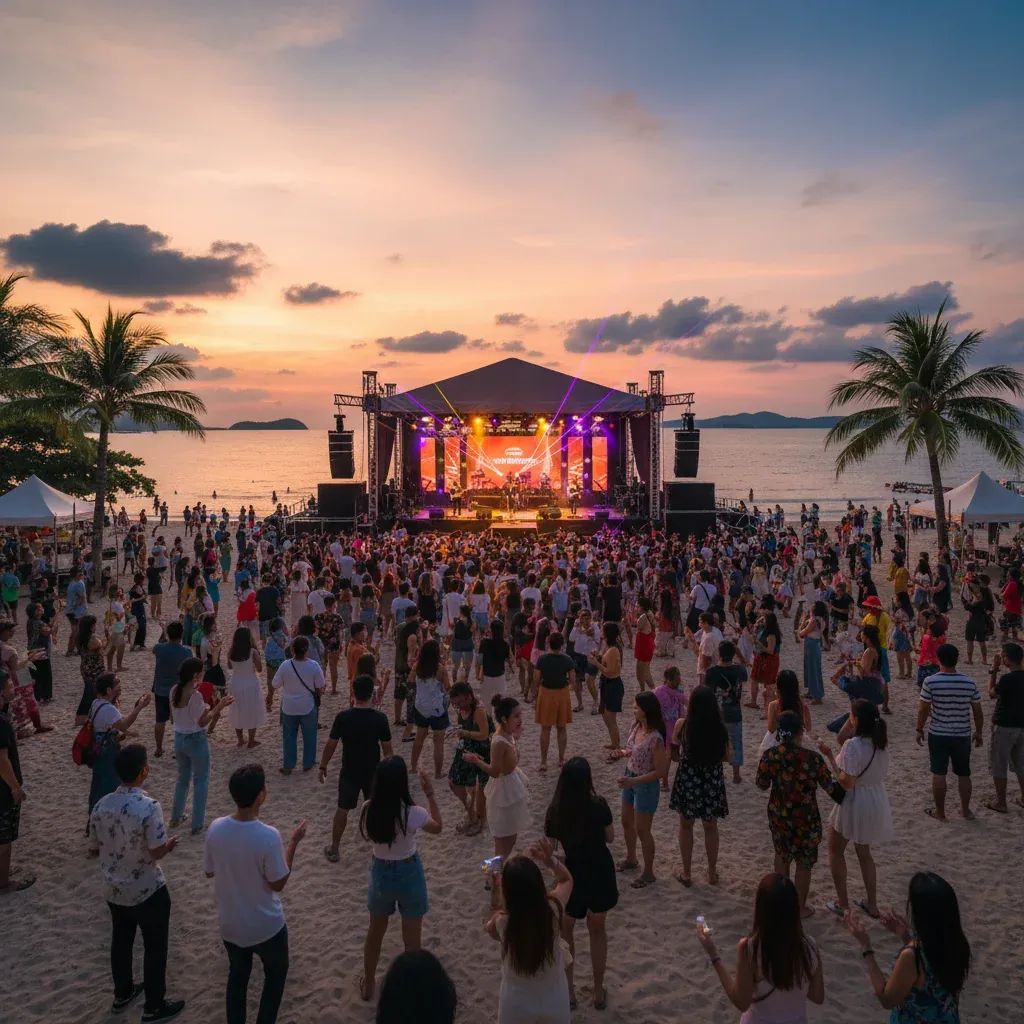
Pattaya's answer to the question "what's happening this weekend?" just became a month-long conversation. Scheduled for March 2026, Thailand's Eastern Seaboard will host eight nights of live music across four separate weekends under the banner of the Pattaya Music Festival 2026, transforming the coastal city into a rotating concert destination at zero entry cost. The strategy differs markedly from the typical all-in-one-day model: performances split across four separate venues, each drawing distinct demographics and spreading economic activity beyond the usual central beach concentration.
Why This Matters
• Free, all-access entertainment: No tickets, registration, or hidden charges—just arrive with sunscreen and cash for vendors.
• Four rotating venues: Central Pattaya Beach, Jomtien, Koh Larn, and an inland park, each catering to different travel patterns and crowd preferences.
• 40+ homegrown acts: Contemporary Thai hip-hop, indie rock, electronic production, and pop artists taking eight performance slots across the month.
• Regional economic boost: Historical data suggests over ฿100M in direct spending flows into Chonburi Province each festival weekend through hospitality, food, transport, and retail.
A Distributed Festival Model Takes Shape
Rather than concentrating crowds into a single mega-event, Pattaya municipal authorities designed this edition as a series of four standalone mini-festivals. The thinking is straightforward: less logistical strain, more geographic accessibility, and multiple entry points for visitors to select their preferred date and artist lineup. For residents and regular visitors, this means less infrastructure pressure on any single weekend while still maintaining the festive atmosphere.
The all-Thai artist focus represents a strategic decision. While earlier editions occasionally featured international crossover acts, this year prioritizes domestic talent visibility. For many residents and Bangkok-based weekenders, discovering contemporary Thai hip-hop collectives, indie acts, and electronic producers offers genuine cultural exposure often overlooked in mainstream entertainment circuits.
The Four-Weekend Breakdown
Opening Act: Central Pattaya Beach (March 6–7)
The festival launches at the city's most recognizable stretch, hosting 4Eve, ALALA, Atlas, Blue Pongtiwat, Da Endorphine, Jackie Jackrin, Perses, Tigger, VIIS, and VVV. This location dominates tourist mental maps and proximity to high-density hotel corridors. Early arrival—by 6 PM—secures reasonable viewing positions. Performances typically activate around 5 PM but prime viewing real estate fills quickly during top-billed acts.
Southern Migration: Jomtien Beach (March 13–14)
Week two shifts south to a quieter zone attracting families and residents seeking alternatives to the central beach chaos. The lineup—D Gerrard, Fixxd x 1Mill x Sunnybone x 4Bang x Ben, Gamma, Goodmood, Joey Phuwasit, Lazyloxy x Samblack x OG, Lomosonic, Paradox, Proxie, and Taitosmith—tilts heavily toward hip-hop and collaborative electronic sets. Accommodation inventory here is more budget-conscious inland while remaining comfortably accessible via motorbike or personal vehicle.
Island Adventure: Koh Larn's Saem Beach (March 20–21)
The third weekend requires planning. A 30-minute ferry journey from Bali Hai Pier transports visitors offshore to Koh Larn's concert venue. Acts include Big Ass, Blvckheart x Thaowan, Bowkylion, Diamond, Gavin:D, Gunner, Mirrr, Purpeech, The Toys, Wanyai, Younggu, and Z9 x Sexski x 2K x 2TFLOW x 1ST. Ferry services typically conclude by early evening; special extended schedules may operate on performance nights. Advance ticket purchase at Bali Hai Pier avoids queueing headaches upon arrival.
Inland Conclusion: Lan Pho Na Kluea Public Park (March 27–28)
The closing weekend relocates northward to a municipal park setting, headlined by Clo'ver, Dept, F.Hero, Felizz, Jaonaay x Jaokhun, Mean, Nanon, Perth, PiXXiE, and Yes'sir Days. This venue welcomes vehicle and motorbike access, appealing to Bangkok commuters on day trips or multi-day excursions. The park configuration allows superior crowd dispersal compared to the physical constraints of beach venues.
Impact on Residents and Regular Visitors
For those living permanently or semi-permanently in Pattaya, this represents rare exposure to premier domestic talent without ticket costs. Comparable music festivals elsewhere in Southeast Asia charge ฿2,000–฿5,000 per day. The free-entry framework exists specifically to boost spending in hotels, restaurants, shops, and transportation services rather than gatekeeping through paid admission.
Historical precedent shows hotels recording 20–30% occupancy increases during festival weekends. Budget guesthouses inland remain options but expect pricing pressure during peak dates. Beachfront properties near Central Pattaya and Jomtien typically reach capacity first, particularly for the inaugural and island-based weekends.
Traffic congestion peaks between 6 PM and midnight along Beach Road and Sukhumvit. Ride-hailing platforms commonly activate surge pricing—fare increases of 30–50% are standard during festival hours. For the Koh Larn weekend, ferry logistics compound travel-time calculations; factor in potential queue delays when scheduling arrival.
Practical essentials: Pack sunscreen—March averages 33°C highs. Bring insect repellent. Carry cash; many beachside vendors operate cash-only or maintain unreliable card readers. The Pattaya municipal government branded this edition "Pattaya Waves Got Rhythm" with explicit "Green Music Festival" commitments: reduced single-use plastics, mandatory vendor recycling compliance, and reusable water bottle encouragement.
The International Artist Question
Notably absent: confirmed international performers. Promotional materials reference potential "special foreign guest artists," yet no public confirmations exist. This marks a departure from earlier iterations that occasionally featured South Korean, Japanese, and regional acts. Late-artist announcements historically occur within two weeks of performance dates, leaving room for surprise reveals.
Social media sentiment reveals divided opinions. Longer-term residents recall 2010s-era lineups featuring global crossover appeal. Some view the all-Thai approach as limiting; others see it as highlighting genuinely underexposed contemporary Thai music ecosystems. Modern indie acts like The Toys and Lomosonic, alongside thriving rap collectives and genre-blending producers, remain largely invisible internationally and even to casual domestic audiences. For expats and foreign tourists unfamiliar with contemporary Thai hip-hop and electronic scenes, the festival functions as accelerated cultural education.
Economic Impact Within Broader Strategy
This festival aligns with Thailand's Ministry of Tourism and Sports positioning of Pattaya as a year-round entertainment destination, not merely a seasonal beach destination. Pre-pandemic analysis demonstrated consistent ฿100M weekly revenue generation across hotels, restaurants, retail, and transport sectors within Chonburi Province.
Timing carries strategic weight. Thailand's domestic tourism sector rebounded strongly post-pandemic, yet international arrivals to secondary cities like Pattaya remain below 2019 levels. The festival operates dually: drawing Bangkok urbanites seeking 90-minute weekend escapes and retaining foreign tourists already in-region. The four-weekend structure prioritizes repeat participation over the all-or-nothing bet of single mega-events.
For comparison, Tomorrowland Thailand, scheduled December 2026 at Wisdom Valley in Pattaya, projects 50,000–60,000 daily attendees generating over ฿5B inaugural-year economic impact. That event targets high-spending international EDM audiences. The Pattaya Music Festival occupies complementary space: accessible, family-compatible, and designed for repeated weekend participation without paid-entry barriers.
Logistics and Timing
Most venues activate around 5 PM, but optimal viewing positions fill by 6 PM during popular artist slots. Pattaya municipal authorities will release final stage times and performance sequencing approximately one week prior to each weekend through official city channels and social platforms.
The Thailand Royal Police deploy additional patrols during festival nights; medical tents operate near each stage. Alcohol consumption is permitted in designated zones, but intoxication law enforcement remains active. Congestion on Beach Road and Sukhumvit is unavoidable during performance hours; ride-hailing surge pricing is standard. For the Koh Larn weekend, advance ferry tickets from Bali Hai Pier prevent late-arrival complications.
What Comes Next
The rotating venue model effectively creates four discrete mini-festivals, permitting visitors to cherry-pick dates based on artist preference or geographic convenience. For year-round residents, the event represents simultaneous economic opportunity and minor disruption—increased noise, traffic, and crowd density are inevitable. Yet the spending stimulus—job creation, tax revenue, and boost to hospitality and retail sectors—provides meaningful benefit during months when tourism naturally dips post-Chinese New Year and before April's Songkran festival period.
Whether international artists will eventually return to future lineups remains speculative. Currently, the strategic focus rests on amplifying Thai homegrown music talent to the broadest possible audience without financial barriers to entry.