
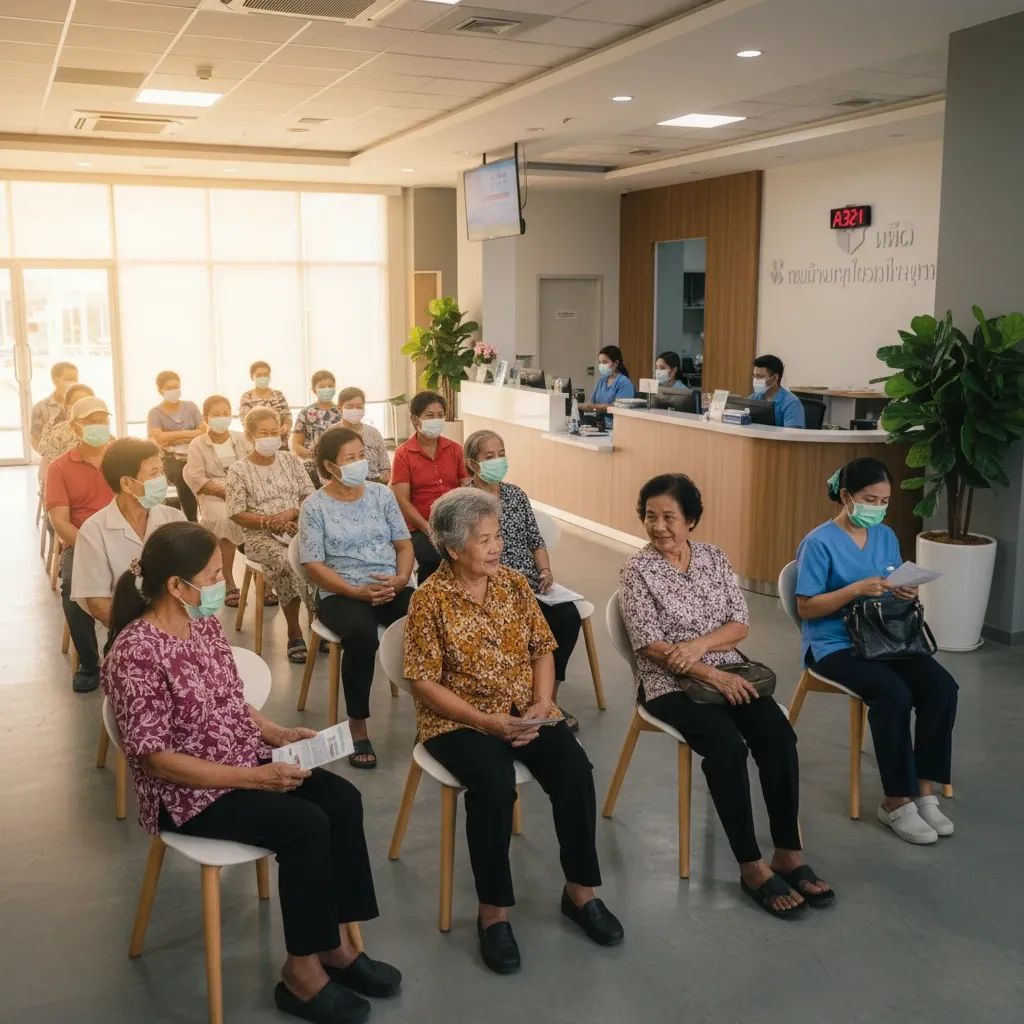
When elderly residents arrive at Pattaya's community health clinics, they're increasingly finding empty medicine shelves and renovation zones that limit access—a sign that the city's healthcare infrastructure is struggling to keep pace with its rapidly aging population.
The coastal municipality faces a fundamental challenge: residents aged 60 and older now represent 15.36% of the population, creating unprecedented demand on healthcare facilities originally designed for a younger demographic. At the same time, renovation delays, medicine shortages, and chronic underfunding are preventing those facilities from meeting current demand.
Why This Matters for You
Medication and vaccine shortages directly affect residents seeking routine care. Pediatric medicines, balms, and immunizations face real delays at grassroots health centers. Facility renovations are stalled at critical community clinics, limiting access to affordable primary care precisely when demand is climbing. Over 50% of Thailand's public hospitals operate at budget deficits, creating cascading constraints on community clinics that depend on provincial supply chains.
What You Need to Do Right Now
If you live in Pattaya and depend on community health centers, the current situation demands tactical awareness. Medicine shortages and vaccination delays are documented facts. Those managing conditions like diabetes or hypertension should verify medication availability before scheduling appointments and develop backup plans if preferred medications become temporarily unavailable. Parents seeking pediatric vaccines should confirm stock status in advance.
The "Healthy Living" free screening events represent the most immediately accessible preventive resource available, particularly for seniors navigating the gap between current service limitations and future upgrades. These events provide substantive medical assessment and generate baseline data on chronic disease prevalence that can inform individual healthcare decisions.
What's Actually Happening on the Ground
On August 28, 2025, Deputy Mayor Wuthisak Rermkijakarn toured two community health promotion centers in Pattaya's Lan Pho and Arunothai districts. These facilities form the backbone of primary care—village health volunteers distribute basic medications and provide disease screening.
The Lan Pho center is undergoing renovations that have slowed its operations. The municipality accelerated contractor timelines, understanding that every week of partial operation means residents deferring screenings or traveling farther. Beyond construction challenges, officials identified critical gaps: supplies of adult incontinence products for homebound patients now require special authorization.
The Arunothai center told a sharper story. Staff documented systematic shortages: pediatric medications depleted, topical analgesic balms no longer reliably available, massage therapy services reduced, and vaccination schedules trailing demand. These aren't luxury services—they represent foundational offerings community clinics should provide without constraint.
Why Medicine Shortages Are Happening
Thailand's Ministry of Public Health confirmed in March 2026 that no nationwide drug shortage existed. However, the ministry acknowledged that geopolitical tensions in the Middle East have lengthened international supply routes and inflated acquisition costs for imported pharmaceuticals. This filters down through provincial supply chains to local clinics: hospital administrators received informal guidance to conserve resources—a directive that becomes binding constraint on facilities already operating with minimal margins.
National data from April 2026 indicated that more than half of Thailand's public hospitals were operating at budget deficits. For Pattaya, this creates a cascading fiscal problem: the health authority cannot justify emergency pharmaceutical purchases when core operations are losing money. Community clinics absorb these constraints first.
The Infrastructure Problem
Pattaya Municipal Medical Center (Wat Boon Kanjanaaram) has a formal expansion plan addressing concrete failures: waiting areas exceeding capacity during peak hours, water infiltration damaging operations during monsoon season, and inadequate pharmaceutical storage lacking climate control. Proposed additions include emergency treatment capacity, staff workspace, and temperature-regulated medicine storage—amenities that should exist in any 21st-century primary care facility.
The Public Health Services Department and district council representatives have completed preliminary space assessments. These specifications are now with the municipal engineering office for suitability review before formal architectural design begins. In practical terms, this means several additional months before construction can advance.
Why Pattaya's Aging Population Changes Everything
Pattaya has crossed a statistical boundary that fundamentally reframes municipal healthcare planning. With 15.36% of residents aged 60 and above as of November 2024, the municipality meets the United Nations classification of an aged society. Across Chonburi province, the elderly population totals approximately 243,165 people—generating demand for preventive health monitoring and chronic disease management that existing infrastructure wasn't designed to handle.
The "Healthy Living" Initiative: What Residents Can Access
Mayor Poramet Ngampichet unveiled the "Healthy Living" program for fiscal year 2026, centered on early detection of age-related chronic conditions—diabetes, hypertension, elevated cholesterol, stroke risk, cardiovascular disease—through free health screenings for seniors. The theory is straightforward: early identification while conditions remain manageable reduces long-term hospital admissions and disability.
The program includes the "Pattaya Senior School for Health," now in its third year. This component emphasizes integrated wellness spanning physical, mental, social, and cognitive dimensions—recognizing that aging requires support across multiple domains.
Private-Public Partnership Efforts
Pattaya Municipality is pursuing a "Wellness City" designation through partnerships with private healthcare providers under the "Good Health, Happy Life" project for fiscal year 2026. The strategy attempts to expand service capacity by integrating private medical providers into the municipal health framework.
Jomtien Hospital's Respite Care Center provides 24-hour comprehensive care for terminally ill and post-acute recovery patients. The center earned clinical service recognition at the Healthcare Asia Awards 2025. Thammasat University Pattaya Center's Central Health Development Center for the Elderly has secured loan support from Government Savings Bank for project development, signaling institutional banking sector engagement with elderly care infrastructure.
What the Timeline Actually Looks Like
Deputy Mayor Wuthisak has committed to accelerating resource allocation for health center upgrades, though specific budget allocations remain undisclosed. The municipality targets mid-2026 for completion of Lan Pho renovations and anticipates addressing medicine shortages through improved supply chain coordination with provincial health authorities.
For residents, the practical takeaway requires honest assessment. Pattaya has articulated an ambitious vision for adapting healthcare infrastructure to serve an aging population, and certain initiatives—particularly preventive screening programs and specialized geriatric facilities—are already operational. The current system, however, operates under measurable strain. Community clinics remain the affordable, accessible backbone of the healthcare network, but that backbone faces demographic pressure. The interval between current capacity and future requirement is narrowing.
For now, residents should plan strategically: verify medication and vaccine availability before appointments, anticipate delays at renovation sites, and utilize preventive screening events when available. The infrastructure upgrade trajectory is real, but it unfolds on municipal timelines. Whether renovations advance quickly enough to prevent service degradation remains uncertain, but city officials have acknowledged the problem publicly—which is often the first step toward addressing it.


