
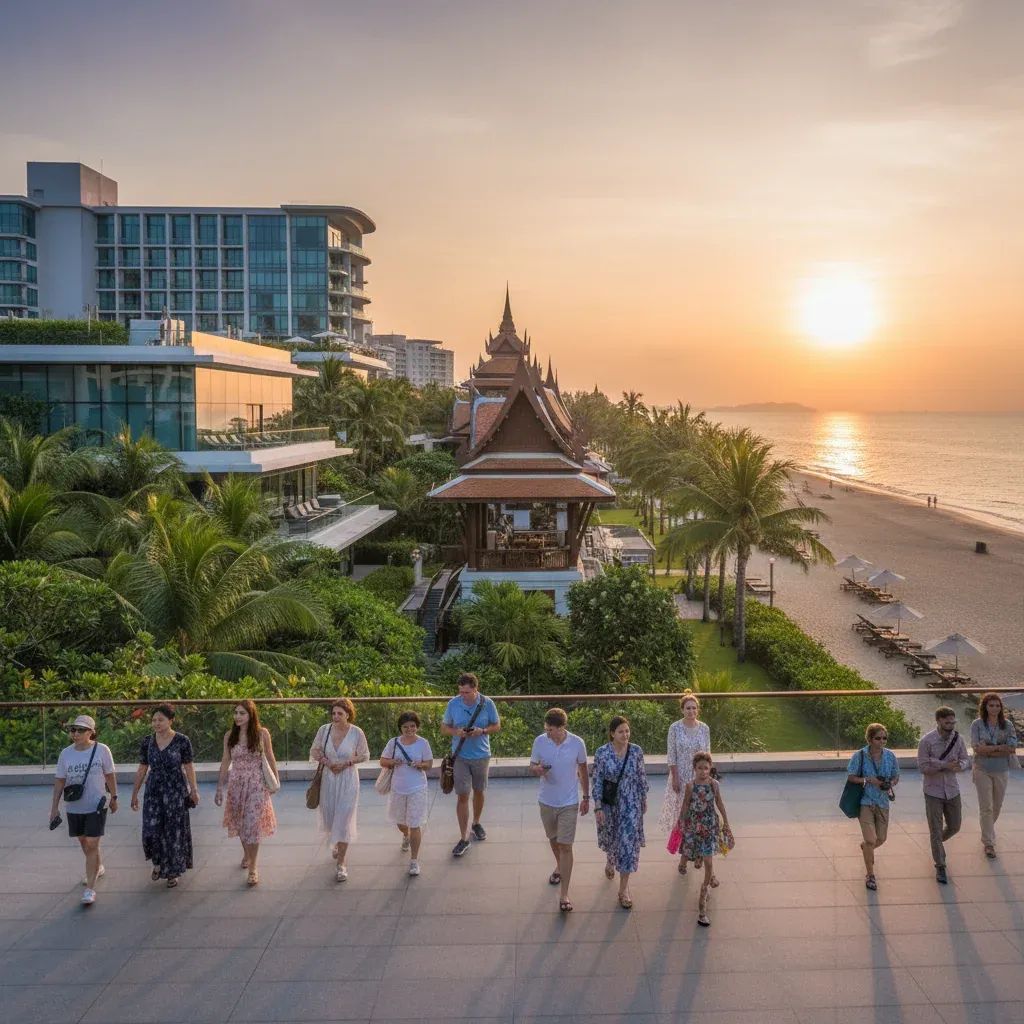
Pattaya City Hall has presented an urgent intervention plan to Thailand's Tourism Ministry, demanding immediate action to rescue the resort city's struggling tourism sector. The coordinated push comes amid declining visitor confidence, intensifying regional competition, and soaring operational costs that threaten one of the kingdom's most critical tourism zones.
At a Glance: Impact on Residents
If you're living in Thailand—whether in Pattaya or elsewhere—these policy shifts directly affect you:
• Visa rules under review: The ministry may restrict the 60-day visa-free scheme from 93 countries down to 57, affecting foot traffic and prices in expat-heavy areas
• Exit fee proposed: A ฿1,000 fee on Thai nationals traveling abroad (unclear if foreign residents with long-term visas are exempt)
• Rental licensing crackdown: Unlicensed short-term rentals will face enforcement; legal property owners may see improved market conditions
• Tourism Development Fund: New co-investment opportunities for private developers in eco-certified resorts and cultural projects
• Landing fee coming: A potential ฿200-฿500 charge on foreign arrivals to fund infrastructure and visitor insurance
Why This Matters
• Pattaya's crisis reflects nationwide trends: Visitor volumes are down, but the city is betting on quality-over-quantity tourism—fewer arrivals, higher spending per capita.
• New tourism minister Surasak Phanjaroenworakul took office March 30 and faces immediate pressure to deliver policy fixes, including a controversial ฿1,000 exit fee and potential visa rule tightening.
• Asian tourist markets have contracted significantly: Chinese arrivals have declined sharply in early 2026, while the strong baht has priced Thailand out for budget travelers—Vietnam and Indonesia are winning market share.
• Regional instability and elevated fuel costs have forced airlines to cancel routes, driving up ticket prices and deterring long-haul tourists.
The Delegation's Demands
On May 1, Pattaya Mayor Poramet Ngampichet led a 20-person delegation—including deputy mayors, council members, and representatives from the Pattaya and Chonburi tourism and business associations—to the Ministry of Tourism and Sports in Bangkok. The meeting marked Minister Surasak's first major engagement with a provincial tourism hub since his appointment under Prime Minister Anutin Charnvirakul's administration.
The city's proposals centered on six pillars: cultural integration to boost per-trip spending, a dedicated tourism development fund, mandatory travel insurance covering life and accidents, environmental infrastructure upgrades, fair pricing enforcement, and a crackdown on illegal accommodation operators. Pattaya officials stressed that unlicensed guesthouses and short-term rentals undercut legitimate businesses, evade taxes, and compromise guest safety—a problem that has festered for years without meaningful enforcement.
The city also demanded that all operators secure proper licenses, meet international safety standards, and pay their share of taxes. Without a level playing field, legitimate hoteliers argue, the market will continue to fragment, eroding service quality and damaging the destination's reputation.
The Broader Crisis
Pattaya's troubles are symptomatic of a nationwide tourism slump. The Thailand Tourism Authority has revised its 2026 foreign visitor target downward to between 30 million and 34 million arrivals, acknowledging headwinds from Middle Eastern conflicts, global economic uncertainty, and declining arrivals from key Asian markets.
Market breakdown:
• Chinese tourists have seen the sharpest declines in early 2026
• Long-haul markets from Europe and the Americas saw growth capped at just 5% in 2025-26, as travelers found better value in Vietnam, Malaysia, and Indonesia
• Arrivals from Hong Kong, South Korea, and Taiwan have fallen significantly
• Safety concerns—including a high-profile kidnapping of a Chinese actor in Bangkok in January 2025, earthquakes, and border disputes—have further deterred East Asian tourists
The strong baht has been particularly punishing for budget travelers. Meanwhile, arrivals from regional markets have contracted, with visitors now favoring Vietnam's cleaner reputation and competitive pricing.
What elevated fuel costs mean: Airlines have adjusted routes and raised fares due to global oil price surges linked to Middle Eastern tensions. This has disproportionately hurt Thailand, which relies heavily on long-haul connectivity to sustain its high-end tourism segment. Domestic travel has increased, but Thai tourists spend far less per trip—typically under ฿5,000—compared to international visitors.
What This Means for Residents
For anyone living in Thailand, the tourism ministry's policy direction under Minister Surasak will ripple through the economy and your daily life:
Visa Changes: The government is preparing to review the 60-day visa-free scheme, which currently covers 93 countries. Minister Surasak has signaled he may restrict the program to 57 countries, citing the need to screen visitors and attract "quality" tourists over sheer volume. If enacted, this could reduce foot traffic in expat-heavy areas like Pattaya, Chiang Mai, and Bangkok's lower-end districts, but may stabilize pricing and improve services in mid-range and upscale segments. Important: It remains unclear whether foreign residents on long-term visas would be exempt from any new restrictions or if this applies only to Thai passport holders.
Exit Fee: The government is preparing to implement a ฿1,000 "exit fee" on Thai nationals traveling abroad, with proceeds earmarked for domestic tourism promotion. For context, ฿1,000 is roughly equivalent to a budget domestic flight—this would apply each time a Thai resident travels abroad. The move has sparked debate: critics argue it punishes middle-class families seeking affordable holidays, while supporters claim it will channel funds back into local infrastructure.
Landing Fee: The ministry is moving ahead with a Thailand Tourism Fee (TTF)—essentially a "landing fee" for foreign arrivals—to fund infrastructure, environmental projects, and automatic accident insurance for visitors. The exact amount hasn't been announced, but industry insiders suggest it will be in the ฿200-฿500 range, collected at airports or via online visa applications.
Rental Enforcement: The crackdown on unlicensed accommodation is welcome news for legal hotel and condo owners, who have long complained of unfair competition from Airbnb-style listings that bypass safety inspections and tax obligations. If enforced consistently, this could restore margins and improve service standards across the board. For property investors, this means a potential shift in demand away from short-term rental markets and toward licensed operations.
Pattaya's Pivot: Fewer Tourists, Higher Revenue
Despite the drop in visitor numbers during the New Year 2026 holiday period, Pattaya reported a significant increase in tourism revenue, driven by longer stays and higher spending from European and Russian tourists. This shift reflects the city's deliberate pivot toward experiential, wellness, and cultural tourism—segments that attract affluent travelers willing to pay premium prices for private villas, wellness retreats, and bespoke dining experiences.
The trend aligns with the ministry's "Value over Volume" mantra, which prioritizes revenue per visitor over raw arrival figures. For local businesses, this means adapting:
• Budget hotels and mass-market restaurants face declining demand
• Boutique properties, spa resorts, and high-end entertainment venues see growth
• Service quality upgrades become competitive advantage
Regional Competitive Pressures
Thailand's challenges are compounded by aggressive moves from neighboring countries:
• Vietnam: Expanded airport capacity, launched high-speed rail projects, now boasts more hotel rooms than Thailand
• Indonesia: Rolled out visa-free entry for Chinese and Australian tourists
• Malaysia & Singapore: Ramped up cultural festival marketing and MICE (meetings, incentives, conferences, exhibitions) infrastructure
In response, the Thailand Cabinet is considering expanded visa-free policies for emerging markets—India, the Middle East, and Eastern Europe—while tightening entry for nationalities associated with visa overstays or criminal activity. The ministry is also pushing airlines to open direct routes from tier-two Indian cities and Gulf capitals, betting that these markets will offset losses from China and South Korea.
The Road Ahead
Minister Surasak has outlined an ambitious agenda for the remainder of 2026, including a push for Thailand to host the 2030 Youth Olympic Games, the development of a "Destination Thailand" campaign promoting year-round travel to secondary cities, and investment in green tourism infrastructure. His "10 Plus" policy framework emphasizes community-based tourism, with funding directed to rural villages that can offer authentic cultural experiences without replicating the overdeveloped coastal model.
For Pattaya, the immediate challenge is execution. Mayor Poramet emphasized that "national policy must align with local realities," warning that top-down mandates often fail when they ignore the operational constraints faced by cities on the ground. The May 1 meeting was framed as a new era of central-local cooperation, but whether that translates into tangible support—funding for infrastructure, enforcement against illegal operators, and targeted marketing budgets—remains to be seen.
Impact on Expats and Investors
For foreign residents and property investors in Thailand, the policy shifts carry both risk and opportunity:
Risks:
• The strong baht and potential visa rule tightening could dampen short-term visitor demand, affecting rental yields in tourist zones
• Stricter enforcement of tax residency rules, particularly for remote workers and retirees who have operated in a gray zone
• Reduced foot traffic in expat-heavy areas if visa restrictions take effect
Opportunities:
• The focus on wellness tourism, digital nomads, and long-stay visitors may open new rental niches
• The crackdown on unlicensed accommodation benefits legal hotel and condo owners by restoring fair competition and improving margins
• The proposed Tourism Development Fund could offer co-investment opportunities for private developers willing to build eco-certified resorts or cultural heritage sites (details remain scarce, but the ministry has indicated interest in public-private partnerships modeled on Singapore's integrated resort framework)
Thailand's tourism sector is navigating a "fragile recovery"—growth is positive, but brittle, vulnerable to external shocks, and increasingly dependent on attracting the right kind of visitor rather than simply more bodies. For Pattaya, the city that has long symbolized the kingdom's tourism resilience, the next 12 months will test whether it can reinvent itself for a more selective, higher-value future—or whether it will be overtaken by rivals who have learned to compete on quality, not just price.


