
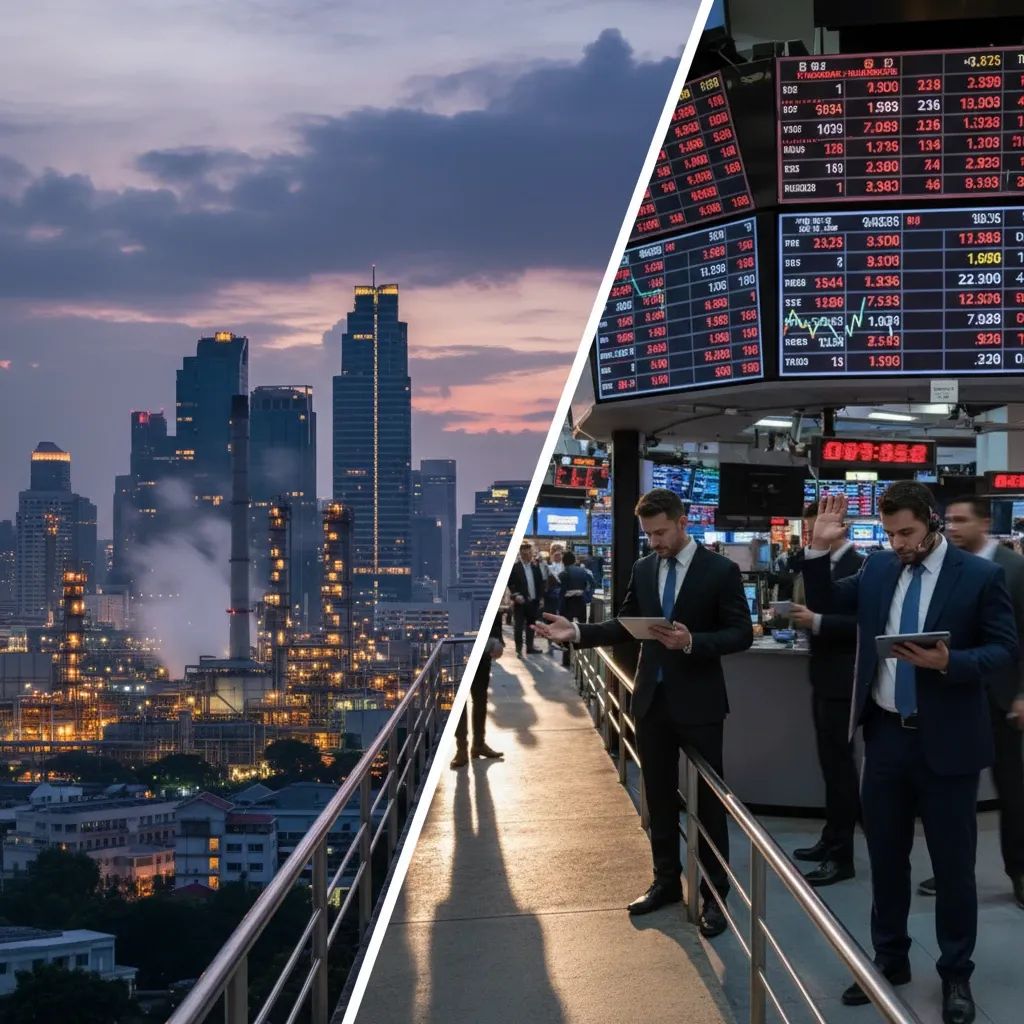
The Thailand Tourism Authority reports nearly 6 million foreign arrivals in the first two months of 2026, generating ฿293.1B in revenue. For Pattaya, the coastal resort 150 kilometers southeast of Bangkok, this translates into a deliberate strategic shift: fewer tourists, but wealthier ones—a widening gap between expectation and experience that residents and expats need to understand.
The Strategic Pivot
Pattaya's tourism board is executing a conscious shift from mass tourism to premium segments. Before the pandemic, Chinese tourists represented 70% of the city's visitors. By 2025, that figure had collapsed by 35%, partly due to safety perceptions and a strengthening baht. The Pattaya Business and Tourism Association now reports a strategic change: rather than chasing volume, the city is courting "high-quality tourists" who stay longer and spend more per day.
The numbers confirm this pivot. Thailand's Chonburi Province, which encompasses Pattaya, welcomed visitors from 93 nationalities between January 1 and February 22, 2026. The top five source markets were China (969,505 arrivals), Malaysia (573,323), Russia (457,250), India (376,738), and South Korea (283,623). For the week ending February 22, Malaysian arrivals surged 33% to 111,581—the highest in eight weeks, driven by school holidays. Russian visitors climbed 7.57% during the same period. Yet Pattaya attracted fewer tourists during New Year 2026 than 2025, while revenue increased significantly due to higher-spending visitors from Europe and Russia.
European visitors—particularly from Germany, the UK, the Netherlands, Sweden, and Denmark—now dominate the November-to-April high season, often booking stays measured in weeks rather than nights. Thailand Revenue Department data shows Pattaya's average daily tourist spend climbing even as headcounts plateau. The city is positioning itself as a mid-tier destination: more expensive than Chiang Mai (฿1,030–฿10,303 daily range), cheaper than Phuket (฿2,500–฿4,000 mid-range, ฿8,000+ luxury), and roughly on par with Bangkok (฿1,830–฿10,245).
What This Means for Residents
For foreigners living in or near Pattaya, the quality-over-quantity model has tangible consequences. Traffic patterns are shifting: fewer tour buses, more rental cars. Restaurant pricing is stratifying: street food remains affordable (฿80–฿120 per dish), but international buffet cruises now command ฿1,680, and seafood restaurants with views exceed ฿700 per meal. The gap between local and tourist pricing is widening, creating distinct economic zones within the city.
Safety infrastructure is tightening. In late 2025, Pattaya City Police installed 12 additional CCTV clusters covering Pattaya Central, South, Walking Street, and Bali Hai Pier. A 24-hour tourist information center now operates citywide. Following heightened geopolitical tensions, Chonburi authorities ordered 100% CCTV uptime and increased patrols for visitors from the United States, Iran, and Israel. In practice, this means more visible police presence in entertainment districts—but also more scrutiny of businesses operating in gray zones.
The crackdown extends beyond safety. Thailand Immigration Bureau has intensified enforcement against "nominee" business structures, where foreigners illegally control Thai-registered companies. Several entertainment venues were ordered to restructure in early 2026. For expats running small businesses, the regulatory climate is becoming less forgiving.
The Safety Reality
Pattaya's safety index of 54.16 places it 9th among ASEAN cities for security. Violent crime remains statistically low. However, the visibility of certain incidents shapes perception disproportionately to actual risk levels. Between January and March 2026, Thailand Royal Police documented several high-profile incidents including assaults on Walking Street involving fee disputes with local individuals and sex workers, tourist deaths from motorcycle collisions on city roads, and a three-vehicle pileup on Sukhumvit Road that killed three and injured 16.
While statistically rare, these incidents—combined with more common occurrences like petty scams involving jet ski deposits and overpriced taxis—create behavioral patterns among long-term residents. Many avoid Walking Street entirely after midnight, not because the area is objectively dangerous compared to Western cities, but because the probability of witnessing or being drawn into an incident remains nontrivial. Predictability, rather than raw statistics, shapes how residents navigate the city.
The Cost Structure: Where Pattaya Fits
For residents comparing housing and living costs across destinations: Pattaya undercuts Phuket but exceeds Chiang Mai. A budget traveler can survive on ฿1,177 daily by eating street food, staying in hostels (฿1,487/night), and avoiding taxis. Mid-range comfort—decent hotel, mix of local and tourist restaurants, occasional Grab rides—runs ฿3,729 daily. Luxury seekers paying for beachfront resorts (฿5,472/night) and international buffets will approach ฿12,265 daily.
By comparison, Chiang Mai offers similar quality at 20–30% lower prices, particularly for accommodation and local meals. Bangkok has wider variance: you can eat Michelin-starred street food for ฿500–฿1,200 or spend ฿1,000+ on fine dining. Phuket charges a premium on everything—hotels (฿4,000–฿8,000 for 5-star), island tours (฿1,050–฿2,300), and taxis (฿500–฿1,000 per trip).
Pattaya's value proposition hinges on beach proximity combined with urban-level services. You cannot replicate this in Chiang Mai (no ocean) or Bangkok (no beach within city limits). Street-level pad thai still costs ฿40-50, keeping daily expenses accessible even as premium offerings expand. Whether that justifies the cost depends on how much value you assign to swimming distance and convenience.
The Infrastructure Reality
The Thailand Ministry of Tourism and Sports classifies Pattaya as a "mature destination undergoing repositioning." Translation: the city is old, and upgrades are slow. Sidewalk improvements along Beach Road have dragged on for months. Sewage discharge into Jomtien Beach was reported in February 2026, prompting a Chonburi Environmental Office investigation.
Traffic congestion worsens during high season. Youth motorcycle racing and chaotic intersections in South Pattaya remain unresolved. The provincial government approved a digital infrastructure upgrade in 2025, but implementation lags. Free public Wi-Fi is inconsistent. English-language signage is improving but still patchy outside major tourist zones.
For residents, this translates to daily friction: longer commute times, unpredictable road conditions, and occasional service disruptions. The city functions, but rarely smoothly.
The Expat Calculation
Foreigners living in Thailand and considering Pattaya face a straightforward trade-off: accessibility versus atmosphere. Pattaya is 90 minutes from Bangkok by car, 30 minutes from U-Tapao International Airport, and well-connected to regional destinations. Cost of living remains lower than Western equivalents. Entertainment options are abundant. The beach exists.
But the city lacks the cultural depth of Chiang Mai, the cosmopolitan polish of Bangkok, or the natural beauty of Krabi. It is functionally convenient rather than inspiring. For retirees seeking affordable beachside living with robust medical facilities (several international-standard hospitals operate in Pattaya), it works. For digital nomads prioritizing coworking spaces and stable internet, Bangkok or Chiang Mai offer better infrastructure. For families, the safety perception gap and limited international schooling options create friction.
Pattaya is not objectively "good" or "bad." It is a specific product serving specific needs. The city's deliberate pivot toward premium tourism reshapes what that product offers. Understanding which needs matter to you determines whether it functions as intended or disappoints.


