
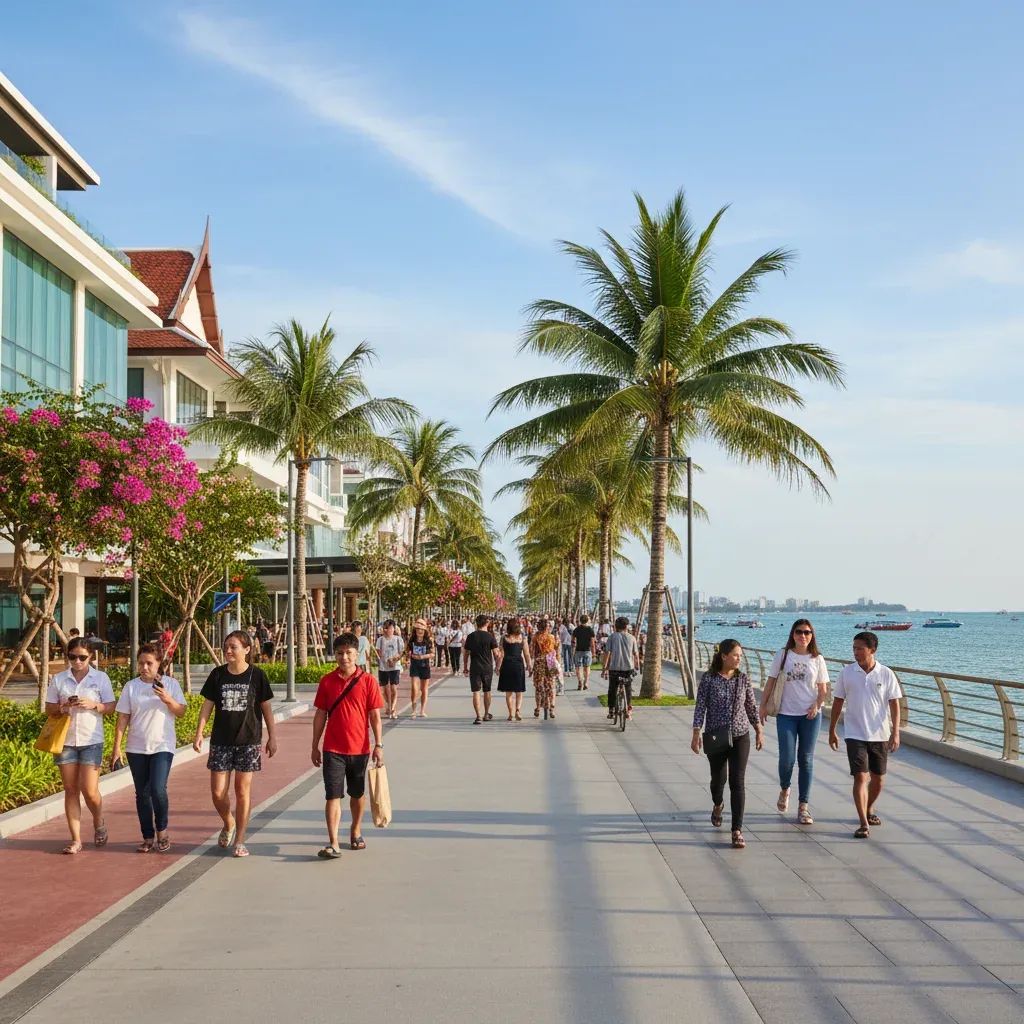
Pattaya's tourism sector is confronting a persistent social challenge that has resurfaced with urgency: growing numbers of homeless individuals are using beachfront areas and public spaces as overnight shelters, prompting business operators to press for sustained intervention from Thailand's Ministry of Social Development and Human Security (MSDHS) and local authorities.
Why This Matters
• Tourism image at stake: Homeless populations now occupy key tourist zones including Pattaya Beach and Second Road, areas that draw thousands of daily visitors.
• Pattern of return: Despite multiple government sweeps throughout 2026, many homeless individuals cycle back to public spaces within weeks.
• New state program launched: The "Family Foster" initiative, active since May 2026, offers ฿5,000 monthly subsidies to citizens who house homeless individuals — but uptake in Chonburi Province remains limited.
The Ground Reality
Late-night surveys conducted in mid-June 2026 by local journalists revealed dozens of homeless individuals scattered along the Pattaya Beach promenade in Bang Lamung District, Chonburi Province. Some slept shirtless on public benches in zones typically filled with dining tourists during daylight hours. Others arranged makeshift bedding using cloth and personal belongings to shield against dew along the waterfront.
On Pattaya Second Road, homeless groups occupied storefronts of shuttered businesses. Local residents and business operators reported late-night alcohol consumption and loud conversations that disrupted the commercial atmosphere — a concern in a city where nighttime economy activity drives significant revenue.
The visibility issue extends beyond aesthetics. A Second Road restaurant owner noted that the presence contradicts Pattaya's carefully cultivated image as a family-friendly destination, particularly as the city works to recover tourism numbers post-pandemic.
Where to Expect Increased Homeless Presence
Residents should be aware that the issue is most visible in these specific areas:
• Pattaya Beach promenade (Bang Lamung District) — particularly overnight hours
• Second Road business district — especially near shuttered storefronts
• Public parks and benches throughout the beach zone
• Walking Street vicinity during early morning hours (before commercial activity begins)
Scale of the Challenge
Thailand recorded 2,499 homeless individuals nationwide in a 2023 survey by the Thai Health Promotion Foundation and partner networks. Bangkok, Chonburi, and Chiang Mai ranked as the three provinces with the highest concentrations. By 2024, Chonburi accounted for roughly 3% of the national homeless population.
The homeless population in Pattaya tends to be older: 57% are between ages 40-59, while 22% are over 60. Notably, 39% became homeless within the past two years — many losing employment during the COVID-19 tourism collapse that devastated Pattaya's hospitality sector.
Primary causes identified in research include job loss or termination, family breakdown, alcohol dependency, and mental health crises. A subset involves foreign nationals who arrived seeking opportunity but fell into destitution due to financial mismanagement, illness, or fraud.
Government Response and Structural Gaps
Thailand's MSDHS has deployed multiple interventions throughout 2026, coordinating with Pattaya City Hall, the Chonburi Provincial Protection Center for the Homeless, and the Bang Lamung District Office.
In January 2026, a joint operation identified 25 individuals experiencing homelessness. Authorities removed 10 from public areas, transferred 11 to protection shelters, screened 3 for narcotics, and flagged 1 for immigration status review. Yet within weeks, many returned to their previous locations.
Current state programs include:
• "Family Foster" subsidies: ฿5,000 per month to households willing to temporarily house homeless individuals (launched May 2026).
• Housing support: Up to ฿1,500 monthly rent assistance plus ฿500 for utilities, along with bedding and clothing.
• "Housing First" pilot: Based on internationally recognized models, this approach prioritizes stable accommodation before addressing secondary issues like addiction or job training.
The Health and Opportunity Network (HON) Pattaya, a coalition of government agencies, health services, and civil society groups, conducts outreach to build trust with homeless populations. The network assists with obtaining national ID cards — a critical barrier, as lacking documentation blocks access to Thailand's universal healthcare system and social welfare programs.
What This Means for Residents
For everyday residents living in Pattaya, this situation creates several practical concerns:
• Safety in public spaces: Late-night users of beaches and parks should be aware of increased homeless populations, particularly during off-peak tourism hours.
• Community participation: Interested residents can volunteer with HON Pattaya or join the Family Foster program — contact the Bang Lamung District Office for details.
• Local advocacy: Several community forums are being organized by Pattaya City Hall to discuss solutions. Residents can check municipal notice boards or contact district offices for upcoming meetings.
For expatriates and long-term residents, the situation underscores the tension between Thailand's tourism-driven development model and gaps in its social safety net. Pattaya's economy relies heavily on projecting order and cleanliness, yet enforcement options remain constrained by human rights protections that prevent forcible relocation without individual consent.
How the Problem Could Be Solved: Learning from Other Cities
Other Asian cities facing similar challenges have tried different approaches with varying success. Tokyo moved nearly 2,000 homeless individuals from public parks into subsidized apartments between 2004-2009, combining housing with job placement and healthcare — a resource-intensive model requiring sustained city budgets. Seoul reduced its homeless population by 30% between 2010-2017 through community outreach and transitional housing offering six-month stays with job training, proving that moderate-length support programs work better than one-time sweeps.
Singapore cut rough sleepers by 40% between 2019-2021 via the PEERS Network, pairing social workers with homeless individuals to navigate them into shelters and long-term housing. Malaysia's Yellow House KL piloted "Unseen Tours," training formerly homeless individuals as tour guides — a social enterprise model providing both income and dignity.
For Pattaya, these international experiences suggest that quick clearances alone don't work; sustainable solutions require ongoing housing support, employment assistance, and community integration programs. Whether Pattaya chooses to invest in such long-term approaches remains to be seen.
Political and Enforcement Realities
Thailand's legal framework complicates enforcement. Authorities cannot compel homeless individuals into shelters without voluntary consent, a human rights safeguard that limits rapid clearance operations. Periodic sweeps may temporarily disperse populations, but without addressing root causes — unemployment, addiction, mental illness — individuals return.
Local government budgets also constrain sustained intervention. Pattaya City operates with tight municipal finances, and the "Family Foster" program depends on citizen volunteers who may lack training or long-term commitment to host vulnerable individuals.
What Comes Next
Business associations are lobbying Chonburi Provincial Governor's office and the Tourism Authority of Thailand (TAT) for coordinated, multi-month operations rather than one-off sweeps. Proposals include:
• Dedicated outreach teams assigned to high-visibility zones with consistent follow-up.
• Expanded shelter capacity in Bang Lamung District, where bed shortages limit intake.
• Fast-track ID issuance for homeless individuals lacking documentation, enabling welfare access.
• Partnerships with private sector employers willing to hire individuals exiting homelessness.
Whether these measures materialize remains uncertain. For now, the nightly tableau along Pattaya Beach persists — a visible reminder that Thailand's economic recovery has not reached all segments of society, and that the gap between tourist zones and social vulnerability remains uncomfortably narrow.


